Women Politicians and Hockey Players Take Center Stage in St. Paul
The new book “Perpich: A Minnesota Original” recounts DFL Gov. Rudy Perpich’s thought process for appointing the first woman to the Minnesota Supreme Court in 1977. Author Ben Schierer reports that “Rudy was looking for humanity and compassion.”
Perpich found those qualities in Rosalie Wahl, a divorced mother with the grit required to juggle attending law school and caring for her children. Wahl, who served as a public defender and a law professor, understood what it was like to struggle and persevere.
Those qualities—a willingness to take on hard challenges and keep working toward a goal—are on public display this week in St. Paul.
They’ve manifested themselves in women pioneers in athletics and politics.

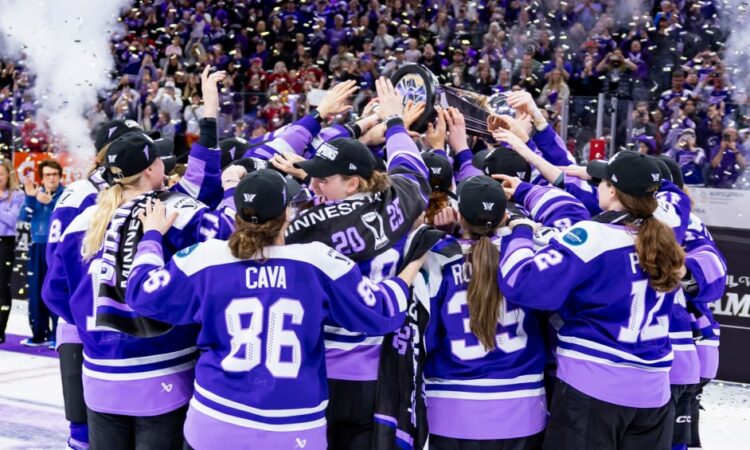
On Memorial Day, the Minnesota Frost won their second consecutive league title in the second year of the Professional Women’s Hockey League (PWHL). They captured the Walter Cup trophy by defeating Ottawa 2-1 in overtime in front of 11,024 fans at Xcel Energy Center.
Women hockey players who demonstrated their talent in college and Olympic competitions have had limited opportunities to play hockey at a pro level. However, now women who play in the PWHL are governed by a collective bargaining agreement (CBA) ratified in 2023 by members of the Professional Women’s Hockey League Players Association. Their eight-year labor agreement is the first CBA to exist in professional women’s hockey.
This week, Minnesota legislators also are working in overtime because the evenly divided Legislature—101 Democrats and 100 Republicans—didn’t reach compromises on a two-year state budget by the May 19 adjournment date.
In 2025, three of the four legislative caucus leaders are women: House Speaker Lisa Demuth, a Republican; House Speaker Emerita Melissa Hortman, a Democrat; and Senate Majority Leader Erin Murphy, a Democrat. They were elected by their legislator peers.
During Perpich’s terms as governor in the 1970s and 1980s, men still dominated leadership roles in the Legislature. Yet Perpich, a dentist from the Iron Range, repeatedly made the case to open doors for talented women to serve in state government.
When he was running for governor in 1982, Perpich chose Marlene Johnson to be his running mate, and she was sworn in as Minnesota’s first woman lieutenant governor in 1983. Perpich also appointed women to major commissioner positions.
It took the Minnesota Legislature much longer to elect women to the top two positions. Rep. Dee Long, a Democrat, became the first woman House speaker in 1992. Two decades later, Sen. Amy Koch, a Republican, was elected in 2011 to serve as Senate majority leader.
2023 was the first session in which women held both key leadership positions. Hortman served as House speaker, while Kari Dziedzic, who died of cancer in December, served as Senate majority leader.
In Schierer’s book, written with Lori Sturdevant, a veteran Minnesota Star Tribune journalist, he spotlights a speech that Perpich made to the DFL Feminist Caucus. Perpich cited a study that documented women in state government with 20 years of experience were earning the same as the average starting wage for men. Perpich insisted on a thorough review of pay levels for state employees.
“This administration pledges that it will make a determined effort to promote women to all levels of state government,” Perpich said in a speech quoted in the book. “Not because it is the political thing to do, but because it is the right thing to do.”
Perpich, who included his wife, Lola, in his official portrait as governor, believed that state government should reflect the people who lived in Minnesota—men and women, people of different races, people from all regions, and people with varied occupations.
He advocated for equality of opportunity and wanted state government jobs to be filled by intelligent people who had different life experiences.
Billie Jean King was a star professional tennis player during the Perpich era. Now 81, King was on the ice at Xcel Energy Center on Monday during the Minnesota Frost’s title celebration. King urged businessman Mark Walter to establish the women’s hockey league. She ultimately won him over, and Walter currently owns all the league’s teams. King is an adviser to the PWHL.
King was the most ardent advocate for equal pay for women tennis players in the 1970s. She led formation of the Women’s Tennis Association, and her work prompted the U.S. Open to be the first major tournament to pay equal prize money to men and women.
The Perpich and King life stories remind us of major breakthroughs in the 1970s that supported women’s career advancements. It took five more decades before Minnesota women assumed leadership over both majority caucuses in the Legislature. After King’s pay equity success in the tennis world, it took five decades for women to gain a fair contract to play pro hockey.
While women’s career progress seems incredibly slow in some professions, we can look around and see it happening in many industries. Perpich and Wahl, an attorney and Supreme Court justice, recognized that state and federal laws would affect the rate of progress.
“I had spent a lot of time sitting outside the doors of board rooms where men were sitting inside making decisions,” Wahl is quoted as saying in the Perpich book. “Law was one key to the door.”