Small Retailers Scramble to Keep Shelves Stocked
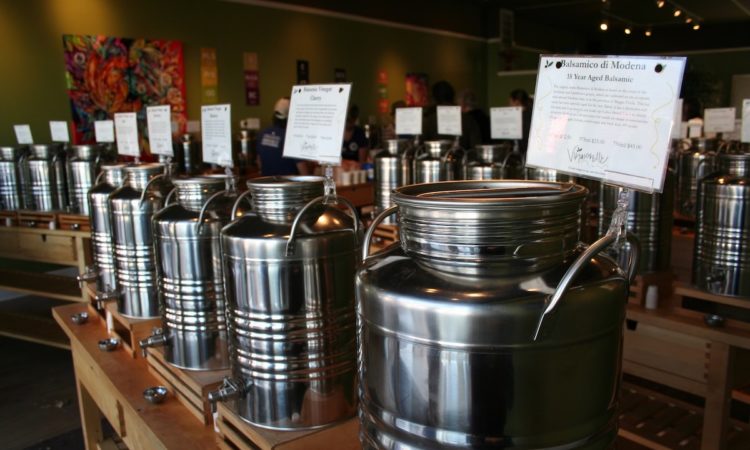
Like many Minnesota families, Sarah and Richard Piepenburg wanted to spend the long MEA weekend in October having some fun with their three young kids. Instead, Richard Piepenburg drove to Chicago alone—he needed every inch of the family minivan to load up a 5,000 pound pallet of olive oil. The Piepenburgs had run out of product at their South Minneapolis shop Vinaigrette, and the only way to keep the store open while awaiting inventory stuck on a cargo vessel was to pick it up themselves.
Retailers of all sizes are getting pinched by supply chain issues. But while Target and Walmart can charter their own cargo ships and hire thousands of new employees to help keep shelves stocked, the Piepenburgs had only their minivan. They couldn’t find truck drivers for hire, nor available rental trucks. Olive oil is in short supply, as are the bottles they use to package it.
Since early 2020, Vinaigrette’s expenses have shot up 47 percent, Sarah Piepenburg said. That includes increases in materials and business insurance. The barrage of challenges, including difficulty hiring workers, threatens to hamper the critical holiday shopping season, which many small businesses like Vinaigrette rely on to carry them through the winter.
“We make a third of our revenue in 48 days. It starts the week before Thanksgiving and it goes until the week after New Year’s,” Sarah Piepenburg said. “I’m nervous. I’m nervous I won’t have bottles and I’m nervous we won’t have product.”
As much as large retailers are warning of supply chain delays, Piepenburg said it’s even worse for small businesses.
“Our stuff is going to be the last unloaded,” she said. “Anything that’s sold on Amazon, Target, and Walmart, anything that’s sold at any of these big-box retailers [will get prioritized at the ports]; we’re going to be the last to get unloaded. We’re going to be the last to get through customs.”
In a recent survey of 10,000 small business owners, the National Federation of Independent Businesses found that 35 percent reported supply chain disruptions have had a significant impact on their businesses. Ten percent of independent retailers viewed their inventory as “too low” in September.
“Shop small. Shop early.” — Ace General Store owners Alex and Dan Cordell
Local solutions
Prior to the pandemic, Minneapolis-based apparel brand Great Lakes sold its goods online and through seasonal popup shops, like one at Ridgedale Center. With mall traffic down and so many small retailers struggling to keep up with demand, co-founders Spencer Barrett and David Burke saw an opportunity to launch a wholesale program aimed at regional sellers.
“Many retailers we work with are having issues getting products from some larger companies,” Barrett said. “So they’re grateful for any products of ours that they can get on their shelves.”
Back in September, Excelsior gift boutique Ace General Store posted a holiday scene on its Instagram with this message for consumers: “We’re quickly figuring out this holiday season will be weird…again. Our first vendor let us know that our most recent shipment will be the last we receive this year. The supply chain for many of our makers and small businesses has been shattered. They are doing their best with a fraction of the material, supplies, and staff. So, without further ado, our annual PSA we wish we didn’t have to make: Shop small. Shop early.”
Ace General is currently awaiting products that are delayed from Japan, tying up thousands of dollars for the small shop owned by Alex and Dan Cordell. Even so, the couple remains optimistic, considering the way its customers rallied around the shop last year.
“Maybe it was due to delayed or longer than usual transit times for online orders or maybe because the pandemic opened all of our eyes to the importance of shopping local, but we’ve never felt more support,” Cordell said. “We had the best holiday season we have ever had in 2020 thanks to the people who waited in line every day to support our small business.”
Sarah Crozier, communications director for Main Street Alliance of Minnesota, a public policy organization that lobbies on behalf of small businesses, said she hopes consumers shop with patience.
“Consumers really need to know that small businesses are small, they’re small staffed and so give them grace when they’re fulfilling shipping orders,” Crozier says. “I think what will be key for consumers to know is if you go to a retail space and see the product on the shelf, that may be your best option because it’s physically in front of you. And if you’re buying online [from a small retailer], give them extra time and [don’t] request refunds just for shipping delays.”
Piepenburg hopes customers will be understanding. Still, she worries.
“We as a collective society need to realize our ability to wield our economic power,” Piepenburg said. “So, stop into your little corner coffee shop, because that $4 or $7 that you spend on that coffee there means a lot more than it does at Starbucks. We’ve already seen so many of our metro stores close—there’s a bunch of us that are hanging on by a thread. And we’ve just got to recognize that and keep it a priority.”