Sen. Amy Klobuchar, Tina Smith Fighting to Reverse Hemp Ban
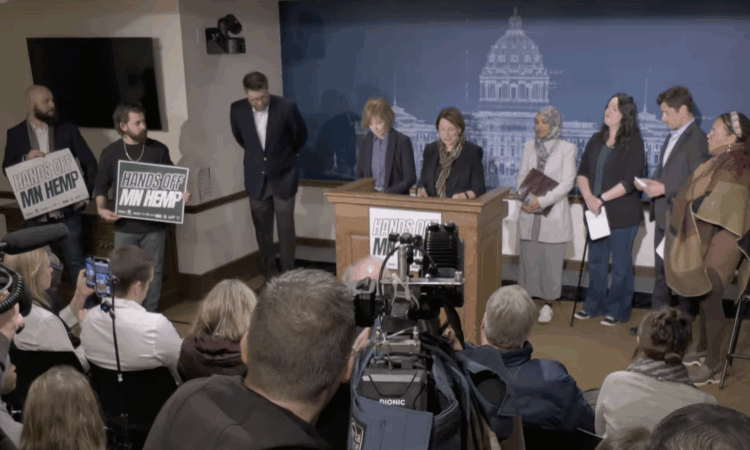
Local officials and hemp-industry professionals convened at the Minnesota State Capitol on Monday to denounce the federal measure that bans most hemp-derived THC products. That measure passed earlier this month as a late addition to the government spending bill. President Trump signed it into law, ending the federal government’s 43-day shutdown—and apparently upending a fast-growing industry.
Senators Amy Klobuchar and Tina Smith, Rep. Ilhan Omar, Minneapolis mayor Jacob Frey, and hemp-industry and brewing professionals highlighted the ban’s potentially gutting impact on both the local hemp market and the broader economy.
“We are here today because this is a pivotal moment for many farmers, workers, and small business owners who have built our state’s successful hemp industry,” Sen. Klobuchar said, describing the ban as a “last-minute, in-the-middle-of-the-night addition” to the shutdown bill, inserted without a hearing.
“Hemp products alone brought in $16 million of state tax revenues through September,” she said. The amendment, in the year before it takes effect, “could cost 2,700 jobs.”
Both senators promised they would try to reverse the amendment in the year before it becomes official. They touted Minnesota as a national model of hemp-derived THC regulations, suggesting the state’s framework could scale up to the federal level. Instead of a ban, they implied, this process could end in federal regulations on hemp THC products that resemble Minnesota’s.
The ban essentially reverses an effect of the 2018 Farm Bill, which included a loophole that allowed for the hemp-derived THC boom. Minnesota introduced its own regulations on such products in 2022.
Much of the blame for the ban has gone to “bad actors,” or states with poorly regulated hemp THC markets. Last month, Minnesota attorney general Keith Ellison joined 38 other attorneys general in signing a letter asking the federal government to ban intoxicating hemp-derived THC products, stating the 2018 Farm Bill loophole has been “wrongly exploited.” Ellison has since clarified he is not seeking to shut down the state’s existing legal framework around hemp-derived THC.
“Minnesota has one of the strongest and safest and most responsible hemp markets in the whole country,” Smith said at the conference. “We were the first to legalize hemp-derived THC products, and we did it in the right way, with clear guardrails and bipartisan support and a regulatory framework that is grounded in public health and consumer safety and in supporting small businesses.”
Klobuchar said she and Smith are well positioned to reverse the ban because they’re on the Senate agriculture committee and can push for a hearing “when there’s maybe a compromise brewing.”
Klobuchar also pointed to possible means of averting the ban, such as pushing for a vote on related issues. This could include a “skinny farm bill” to address rising loan rates, SNAP-related problems— “all kinds of things that would give us a vehicle to put a change on this.”
She sounded optimistic about closing the voting gap in the Senate (76–24) that allowed the amendment to pass. “There was no hearing. There was no planning,” she said. Ryan Kopperud, VP of growth at Duluth’s Wild State Cider, added that brewers largely see the vote as one to reopen the government, rather than to crush the hemp THC market.
Potential impacts
Hemp represents a $200 million industry in Minnesota, according to state senator Lindsey Port, who was chief author of the 2023 law that legalized adult-use cannabis. Nationally, hemp-derived THC is estimated to be a $28 billion business.
More than 5,300 Minnesota retailers are licensed to sell hemp-derived products, according to Smith, and many distribute nationally. Within Minneapolis, Mayor Frey said the ban would affect 650 businesses. About 150 of those would have to shut down.
Kopperud, of Wild State Cider, emphasized the impact on breweries. Many breweries have supplemented flagging alcohol sales with hemp-based THC drinks. “While this ban will devastate Minnesota’s beverage industry, its impact reaches far beyond it,” Kopperud said, gesturing to a supply chain of farmers, processors, manufacturers, and retailers.
One of those farmers is Angela Dawson, founder and CEO of the 40 Acre Co-op. The Willow River-based cooperative, launched in 2020, grows hemp in northern Minnesota. Dawson, a fourth-generation farmer, also trains hemp farmers to grow compliantly and scale up.
“Ever since the 2018 Farm Bill, Minnesota farmers, especially family farmers, have had access to markets that we haven’t had in a really long time,” Dawson said at the conference, adding that hemp has allowed her farm revenue to grow 10 times larger.
If legislators technically have a year to undo the ban, Kevin Hilliard, co-owner of Insight Brewing Company, pointed out they have less time if they’re considering farmers. “I can tell you that the hemp crop is going to go into the ground right around Mother’s Day this year,” he said, “and if a farmer has uncertainty, they’re not going to plant.”
Bob Galligan, director of government and industry relations for the Minnesota Craft Brewers Guild, offered examples of hurdles on the brewery side. “What this does is essentially make hemp, cannabis,” he said. “It makes banking absolutely more difficult for us. Insurance, then, becomes an uphill battle. We have to hold [Alcohol and Tobacco Tax and Trade Bureau] licenses—they will not operate with a federally illicit business, so we no longer can make beer. We have to choose hemp or beer. There is a tax provision … where now we cannot write off any of our business expenses.”
Rep. Omar noted the ban could also become a criminal justice issue for business owners. “Overnight, a legal, regulated product in Minnesota would be pushed back into the shadows,” she said. “We will see confusion, selective enforcement, and the very real possibility that ordinary workers and small business owners could face criminal penalties for something that was legal yesterday.”