Pros, Cons, and Complexities of Downtown Data Centers
Cities face dueling crises: They need to revitalize their downtowns—increase dynamism and foot traffic—while also boosting property values and their tax bases.
Those crises unfold against a familiar post-pandemic backdrop: The office vacancy rate in downtown Minneapolis sits at 32.6%, per the latest Cushman & Wakefield report. Downtown St. Paul faces a similar rate: over 33%.
Office valuations continue to drop. Downtown Minneapolis’ commercial real estate values fell 13.7% last year, according to the city’s assessment report. In downtown St. Paul, the top seven office buildings saw dips this year averaging 16.5%, per KSTP.
A principal strategy nationwide has been to reimagine office buildings as residencies. This plan tackles housing shortages, as well.
Meanwhile, data centers shape our horizon more and more. They aren’t new players but are growing in square footage and notoriety. Spending on AI and cloud computing grows, and so does spending on these computing powerhouses, which process, store, and transmit data. So, why not patch up some downtown vacancies with data centers?
The Twin Cities house several dozen data centers already, and they’re playing a minor role in downtown Minneapolis’ revitalization.
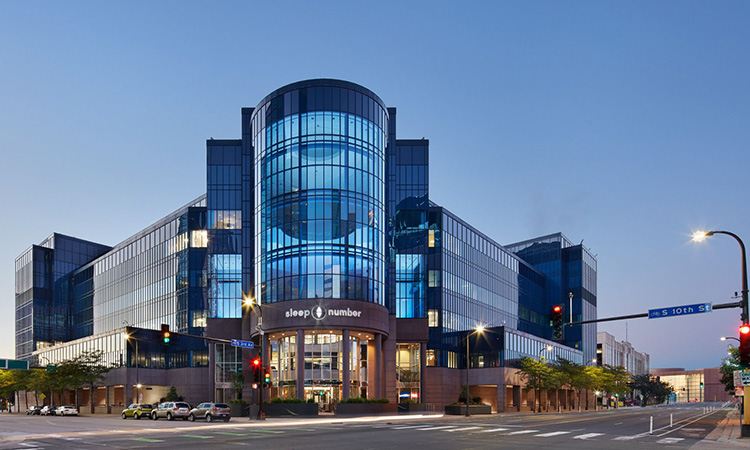
Two major buildings—one housing Sleep Number, the other formerly housing Wells Fargo—recently announced plans to expand capacity of their existing data centers.
One or two more data centers are expected downtown, says Adam Duininck, president of the Minneapolis Downtown Council, although in no set timeframe. Xcel Energy, the Minneapolis-based utility and the state’s biggest electricity provider, reports it “continue[s] to see interest from data center developers in Minneapolis and St. Paul” and is in talks with those developers about electricity needs.
But, with revitalization in mind, one problem is that data centers have little direct impact on area dynamism. In other words: They don’t employ many in the long term.
To convert offices into data centers is also expensive and challenging. “When you look at the long-term adaptability of conventional uses—like residential, office, and hotel—these properties, these physical buildings, are pretty flexible,” says Dave Higgins, president of the St. Paul Downtown Development Corporation, a St. Paul Downtown Alliance subsidiary focused on real estate. In contrast, data center buildings are “very inflexible,” needing to accommodate intensive security, heavy equipment, and huge power capacities.
Duininck says data centers will take up “a tiny part of the conversion story” in downtown Minneapolis. Of downtown’s 8-9 million square feet of commercial vacancies, he estimates 5-10% could turn over to data centers, and housing remains paramount on his wish list. “If we’re able to do a couple million square feet of housing conversion, that’ll be the leader in terms of what we can convert space to.”
But with more data centers on the way, their role in downtown redevelopment is worth considering.
Divergent views from leaders in Minneapolis and St. Paul
Higgins says data centers won’t play a role in St. Paul’s downtown revival, unless available real estate calls for no better use.
“Some people have asked me, ‘Should we take any number of these buildings and just turn them into data centers?’ There’s a lot of demand,” Higgins notes. His answer: “Yeah, if we don’t want vitality on the streets.”
He imagines a city block occupied by a data center: “No eyes on the street. No retail. Uncomfortable, barren wall to walk by, so nobody even walks by it, nobody builds retail by it.”
Duininck points out data centers can boost the downtown tax base, putting otherwise languishing buildings to use. The Sleep Number building provides a recent example: It sold for $235 million, more than eight times its assessed value. That was thanks to the building’s data center, per the Star Tribune.
Higher valuations could attract employers, who would create jobs—and vitality. “In a place like downtown Minneapolis, where we’ve seen property valuations decline, that means less tax revenue, and that means fewer dollars for the city to provide great services,” making for a region less attractive to employers, says Amanda Taylor, vice president of business investment for Greater MSP, the economic development organization that works to recruit employers to the Twin Cities.
But Higgins suspects added tax value would be limited. “Only 20-30% of the value [of a downtown data center] is actually subject to real estate tax,” he surmises. “Most of the value [of a data center] is the contents of the building, not in the building itself.”
He says Minneapolis’ two expanded data centers make sense: “Those projects are essentially bringing back online data centers that were already data centers.”
But when it comes to St. Paul’s empty basements and ground floors, suitable for heavy equipment, he says, “Those [levels] are often parking, or storage, or loading docks”—all necessary for uses in direct support of vitality.
Plus, he says, data centers often don’t fit the mixed-use mold. Residents can pose security risks while accessing Wi-Fi and Bluetooth. “That’s part of why you see [data centers] popping up in the middle of nowhere.”
Could proximity perks drive business growth?
Latency is another piece of the discussion around downtown data centers. This refers to the time it takes data to travel across a network, from server to user. “With the large-scale growth of generative AI, there is tremendous reliance on data centers that process information quickly and with low latency,” the Brookings Institution reported late last year. Closeness to a data center lowers latency, usually measured in milliseconds.
That proximity may matter more with time. AI and cloud computing are advancing so fast, Duininck says, “we will start to measure [latency] in microseconds.”
So, along with a healthier tax base, Duininck says, lower latency could pull employers closer to urban-core data centers. “Longer term, our hope would be that having this sort of infrastructure would help with economic development or recruitment of companies,” Duininck says.
He imagines a modern manufacturer—say, a microchip maker: “We’ve historically thought, ‘That’s a Greenfield development [job],’ or, ‘That’s [a business] for the exurbs or farther away from the core.’ But when you think about the strength of the region, of having access to jobs, there are many more workers that can come downtown and can get to a job than [in] Rosemount or Rogers or Forest Lake.”
Higgins says the perk around latency feels too speculative. “I don’t mean to say that I’m skeptical that this stuff will matter,” he says, but he isn’t aware of widespread demand for lower latency. “Is our internet not fast? Are our calls dropping all the time?”
The complexities of power consumption
Data centers stoke concerns they will drive up residential utility bills by straining power supply. Other resident worries include noise pollution and environmental drain. (One estimate places the amount of water needed to cool a midsize hyperscale center at hundreds of thousands of gallons per day.)
Urban data centers are much smaller than the “hyperscale” versions captivating attention. Those warehouse-size data crunchers rise in rural areas. Locally, proposals have targeted Farmington, Hermantown, Pine Island, and Rosemount. Urban-core data center capacity often runs between 5 and 25 megawatts, per Xcel Energy.
Minnesota is trying to prevent rate increases driven by large data centers’ significant demands. Once the Public Utilities Commission locks in the definition of a “very large customer” by mid-December, the commission must ensure costs attributable to users in that group do not burden other customers. Xcel has recommended the category begin at 100 megawatts.
A few additional downtown data centers may negligibly impact available power, Higgins says.
But he imagines an unwieldy scenario, with data centers multiplying and outstripping supply as redevelopment continues: “If a data center shows up on Monday, needing the power that’s equivalent to five residential projects that might show up the rest of the week, is there enough power left over for that utility to fulfill its mandate?”
Xcel says more urban data centers, on the contrary, would redistribute costs and lower rates. “By connecting new data centers to our grid in areas where we have existing capacity, this could lower other customer bills by spreading fixed costs to build and maintain our system,” a company representative said.
Xcel’s claim appears to check out, says John Farrell, a Minnesota resident who serves as director of the D.C.-based Energy Democracy Initiative, which advocates for affordable and locally owned energy.
Small-scale urban data centers test out one of Farrell’s recent ideas: “What would happen if you took a typical [hyperscale] data center and broke it up into 10 pieces and spread it out on the grid?” Smaller data centers could spring up where infrastructure can absorb incremental new demand. Thus, those data centers could help defray fixed maintenance costs. Farrell uses a carpooling analogy: If gas for a trip costs $5, you now have four people paying instead of one.
Still, “the devil’s in the details,” he notes. “Xcel’s financial incentive, in general, is to make capital investments—that’s the way that the law is set up to reward them.”
Utilities, as “regulated monopolies,” don’t set their own rates; public utility commissions set them. To ensure the grid is maintained, regulators guarantee monetary returns on approved infrastructure investments. The more a utility can invest in infrastructure, the more it profits.
“It’ll be interesting to see if this project is, in fact, executed in a way that lives up to that [rate-lowering] potential, or if something else happens in the meantime,” Farrell says, “where Xcel says, ‘Actually, it would be convenient for us to have to do a substation upgrade downtown and earn a little return on that.’”
As with so much around AI, data centers, and the life of our downtowns, it remains to be seen.