Nonprofits Should ‘Face Outward’
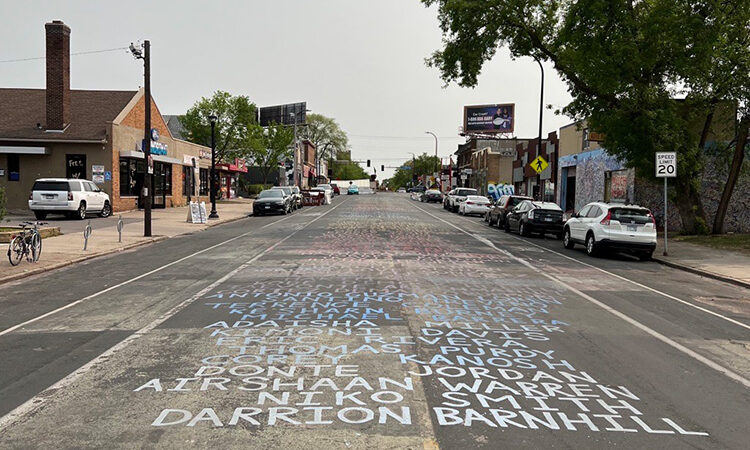
In a recent conversation, an economist friend said he hoped that plans for redevelopment and investment around George Floyd Square in South Minneapolis don’t include a majority of nonprofit organizations.
His reasoning? Nonprofits tend to face inward, he observes, toward whatever activities are going on inside their buildings, whereas small businesses, like stores and restaurants, face outward and relate to people, streets, and neighborhoods.
My friend’s opinion is influenced by the work of legendary urban theorist Jane Jacobs, who studied the conditions present in economically vibrant urban spaces. Her work has informed a generation of architects, policymakers, economists, and planners who seek to create neighborhoods, towns, and cities where the conditions of urban vitality are present.
Those include pedestrian-friendly elements, diverse activities, buildings and spaces that are not too large—allowing people multiple interactions in a relatively compact space, plus varied housing that enables people of all ages and income levels to live together.
If you walk or drive around our cities and towns and look at buildings critically, you might agree that nonprofits could do more to contribute to these conditions. Schools, libraries, hospitals and clinics, human services organizations, cultural organizations—many of these appear as mini-fortresses.
They are closed off from public interaction. Their exteriors aren’t inviting, so people rarely enter the buildings just to discover and learn what’s happening on the inside. Yes, there may be signage with the organization’s name, but that’s about it.
What if more nonprofits turned themselves inside out? What if more nonprofit organizations thought about contributing to street-level liveliness as part of their civic purpose?
Tom Fisher, professor of architecture at the University of Minnesota and director of the Minnesota Design Center, suggests that a shift in perspective could yield rewards for the nonprofits and their neighborhoods.
“The benefits for nonprofits to have a more visible and active street presence are not only the marketing and communication value of doing so, but also the immediate, tangible benefits that street-level activity can provide,” Fisher says. “Nonprofits often do long-term work, with outcomes that occur slowly over many years, and an active street agenda can offer short-term value and a rapid return on the investment.”
In the Twin Cities, several cultural nonprofits come to mind as ones trying to animate their streets and neighborhoods, show their work, and invite casual interactions as an introduction to deeper forms of engagement.
- The Textile Center of Minnesota, on University Avenue in Minneapolis, added colorful signage and now highlights the artworks on display in its street-level gallery and store with large, well-lit windows. Outdoor planters overflow with blooming flowers in season, and a sandwich board lets passersby know that the gallery is open or when events are taking place. One element of the center’s mission is to “inspire widespread participation in fiber art,” and the center’s sense of welcome—on the street—exemplifies that vision.
- Springboard for the Arts, on University Avenue in St. Paul, uses its parking lot and small open space to welcome neighbors to public programming. Its colorful building and giant windsocks call attention to live events. Last winter Springboard installed a small ice rink on its property and invited neighbors to borrow skates, while offering mini-lessons from Brownbody, the Twin Cities-based dance and figure skating organization.
Imagine what our streetscapes could be like if more nonprofits’ buildings promoted the message “Come, visit, look around, see what we’re up to.” But with everything else nonprofits are doing, why should they prioritize this?
Reason one: Post-pandemic, our cities and towns need help. With retail outlets struggling and many storefronts empty, nonprofits can help create visible activity, adding liveliness that generates visual interest and makes streets seem more occupied than vacant.
Reason two: More people will see where nonprofits exist and what they do. That can’t be bad for the sector.
Reason three: It doesn’t have to cost a lot. Adding planters, a sandwich board, signage, or lighting does not have to become a big expense. Someone will need to tend the activity, but even in a small nonprofit this might be a rotating or shared task.
Fisher suggests a few simple ideas. “Organizations could reach out to passing pedestrians, put out tables and chairs for passersby to use, or occasionally pay the meters for a parking space or two and create a ‘parklet’ that allows people to sit and converse.”
He concludes with this: “Nonprofits all have a community focus of some sort, and being more visible in and along the street is a great way to reinforce that mission.”
Read more from this issue

Nonprofits, step outside your fortresses. There’s much to be gained and maybe even more to be learned.