

New Tariffs Thrust C.H. Robinson Into a Big Problem-Solver Role
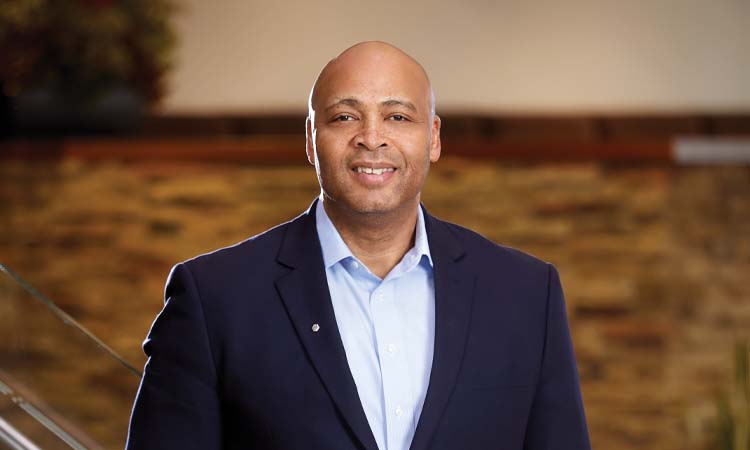
Just two years after he left Ford Motor Co. to turn around C.H. Robinson, CEO Dave Bozeman finds himself dealing with a volatile U.S. tariff policy that has upended global trade.
As a huge logistics provider, C.H. Robinson’s 83,000 customers look to the Eden Prairie-based corporation for solutions.
“This is not the first time the industry has seen disruption, and it won’t be the last,” Bozeman says in a May TCB interview. “Shippers need a logistics partner who just understands not only how to navigate an increasingly complex environment, but also how to partner with them to solve and execute on these unique supply chain challenges.”
To aid customers, Bozeman says he’s leveraging the company’s large scale, financial prowess, and experience building resilient supply chains during and after the pandemic.
“I had a big customer that was exporting pet food out of the U.S. inbound to China,” he says.
In Depth: How Trump’s Tariffs Are Impacting Minnesota Businesses
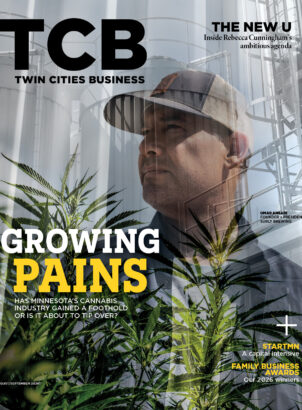
In a feature in TCB’s June/July issue, senior editor Liz Fedor interviews business leaders and academic experts to identify how companies are navigating the ever-changing tariff landscape. Read More
When President Trump unveiled his tariff strategy in April, he targeted China for the highest tariffs and the country announced retaliatory duties.
If the ship carrying the pet food had docked in China, it would have meant an extra $6 million in costs for the business, Bozeman says. “What we had to do was work with that customer and reroute the shipment, which is not easy to do all the time,” he says.
Ultimately, the pet food was shipped to Japan. “So that customer does not take on a $6 million hit,” Bozeman says. “I have thousands of stories like that.”
Based on its high output of goods, he notes that China is often regarded as the “world factory.” But supply chain woes associated with the pandemic caused some businesses to rethink where they were sourcing their goods.
“A number of our customers have a China plus-one strategy,” he says, which makes those businesses less vulnerable to disastrous financial consequences if they can purchase products or parts in countries that have lower tariffs than those imposed on China.
For instance, he says, some customers shifted a portion of their purchases to businesses in southeast Asia, including Vietnam, and the India subcontinent, which encompasses Bangladesh, India, Pakistan, Nepal, Bhutan, Sri Lanka, and the Maldives.
“A number of our customers have a China plus-one strategy.”
—Dave Bozeman, CEO, C.H. Robinson
The issue of companies reassessing where to source their goods isn’t a new one for C.H. Robinson, and shifts have been taking place over the past several years. “There was the first version of Trump’s tariffs going back a few years” in his first term, Bozeman says. “But even going back to the financial crisis [in 2007], supply chains have been really looked at and starting to change.” Those assessments were heightened during the pandemic.
Read more from this issue

One of the outgrowths of that analysis has been a phenomenon called “near-shoring” or “friend-shoring,” which means U.S. companies opening facilities or sourcing goods closer to home in ally nations that include Mexico, Bozeman says.
Before Trump unveiled worldwide tariffs early this year, progress had been made by many businesses in diversifying their supply chains. But Bozeman notes the tremendous uncertainty over where Trump’s trade policies or deals ultimately may land has caused some companies to take a wait-and-see approach before crafting long-term business strategies.
Many companies are simply trying to figure out what they should do in the short-term. “We see a spike in wanting help around customs, and we’re doing that,” he says. “We see customers who want help on warehousing, and so we’re helping them with that as well.”
Because Trump emphasized tariffs during his campaign, Bozeman says some companies took preemptive actions. “They would have ordered more inventory to get ahead of when the tariffs would start,” he says.
But he emphasizes there’s a lot of variability in tariff effects based on a company’s size, the products it sells, and the countries where it does business. “Some are taking the brunt of the tariff costs,” he says, while others are covering part of the tariff costs and passing the rest along to consumers. C.H. Robinson is helping its customers build tariff-related contingency plans.
Before the tariff-volatility challenge arose, Bozeman and his employees were focused on transforming how C.H. Robinson works. After he arrived in mid-2023 to lead the company, Bozeman spent a few months identifying the company’s strengths and weaknesses.
The company describes its work as “reimagine supply chains, advance freight technology, and solve logistics challenges.” Beyond its 83,000 customers, C.H. Robinson has a network of 450,000 contract carriers, and on an annual basis it manages 37 million shipments and $23 billion in freight.
When he talked to employees, he says, “I saw people who really wanted to win, but just didn’t have the blueprint to do that.” He introduced a new operating model in 2024 and says it’s been producing results. On April 30, C.H. Robinson reported that it increased its first-quarter income from operations by 39.1% to $176.9 million.
Bozeman stresses the early definition of problems and rapid resolution of them, while making better use of the company’s data, technology platform, and artificial intelligence. “Now we look at things in real time,” he says. “We’re not going to admire that problem. We’re going to fix that problem right now.”