New Farmers Market Is One Piece of the Uptown Puzzle
Who, among Twin Cities nostalgists, can resist indulging in Uptown lore? Growing up in Northfield in the ’90s, Michaella Holden remembers taking trips to the southwest Minneapolis commercial district with her mom—to get their hair done, to catch a movie. “I remember hanging out for hours at Bobby Bead,” she laughs.
This was before the national chains and well before the litany of pandemic-shuttered stores. In the ’90s and early 2000s, Uptown was funky. By Holden’s recollection, it was eclectic, gritty, cool. Today, though, even the Apple, H&M, and Target stores have closed, all within the past five years.
The death of Uptown is a story told, retold, and told again. Hennepin Avenue construction has made the past year even rougher. The corollary is always “How can we bring Uptown back?”—the sort of huge question that demands so many small to medium-size answers.
And one of those answers appears to be the new farmers market.
Here it is, thanks to wrangling by volunteers, funders, and the Uptown Association: The Uptown Farmers Market debuts June 12, to run Thursdays, 4 to 8 p.m., through Sept. 25 on the Girard Avenue Plaza, outside the Seven Points shopping center (formerly known as Calhoun Square).
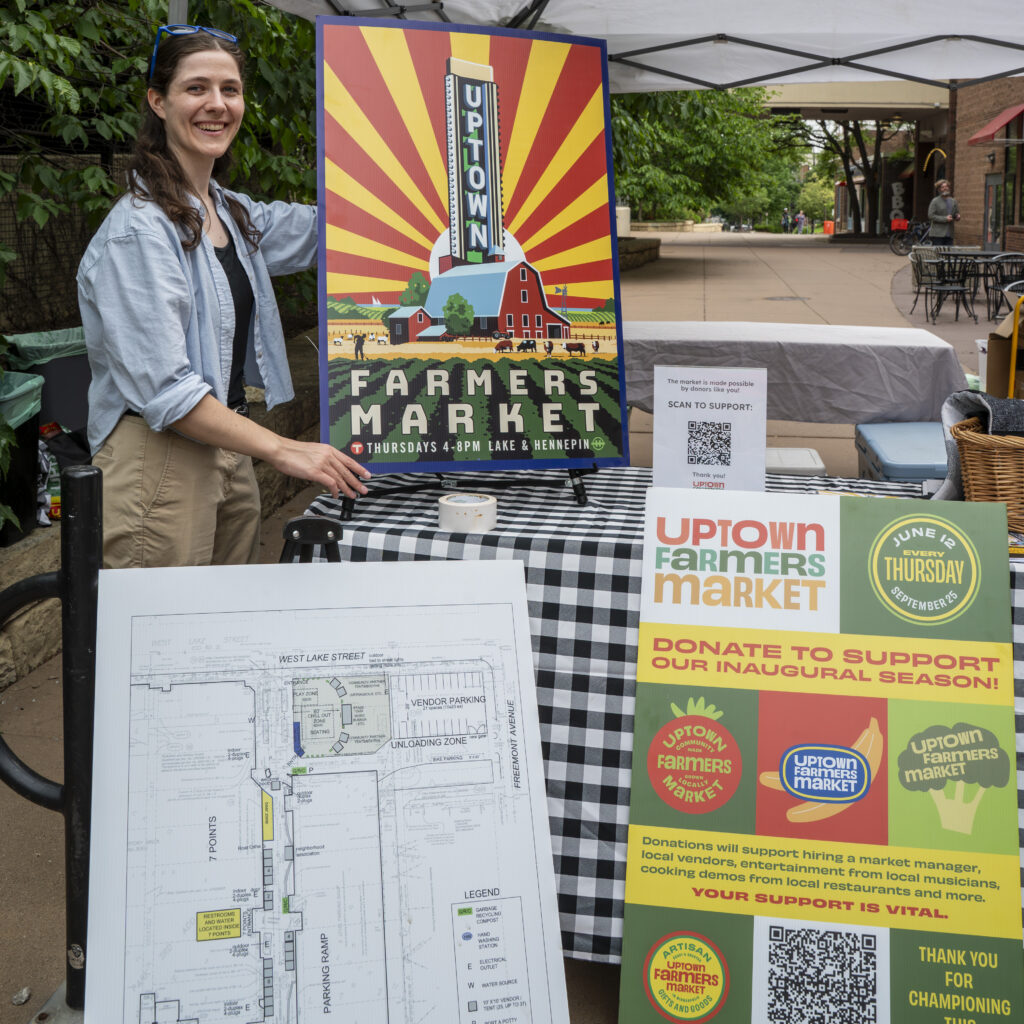
Boasting about 25 vendors—with grab-and-go offerings from Uptown eateries like Curioso and Roat Osha—the new market replaces the East Isles Farmers Market, which formerly occupied the strip behind the Walker Library. That market went on permanent hiatus in 2023. “[The East Isles market] was losing a significant amount of money,” says Dan Sutton, who’s on the East Isles Neighborhood Association board. “The board asked if I would look into resurrecting it.”
Now, Sutton co-chairs the Uptown Farmers Market committee. It promises to be bigger, better advertised, and more connected, with promotion and support from all eight surrounding neighborhood associations, versus just one for the East Isles market, Sutton says.
Sutton, who founded the Whittier-based Roundpeg strategy consultancy, places Uptown’s “heartbeat” at Lake Street and Hennepin. But today, he says, “there’s no reason to go there.” Loyal residents support businesses, sure, but there are safety concerns, and foot traffic looks minimal. “The farmers market is exactly a reaction to that.”
There have been other recent reactions. Mayor Jacob Frey has promised “buds of progress” in Uptown this summer, and the Uptown Association, a nonprofit dedicated to neighborhood vitality, has been working to solve its catch-22: There’s not enough foot traffic to attract new businesses, and not enough businesses to draw foot traffic. Its efforts include working with leasing agents to fill vacancies and pushing to redesignate the region as a Business Improvement District for tax advantages. And, of course: opening the farmers market.
As Sutton describes it, the new market has been a labor of love—as well as frustration at Uptown’s lack of progress. “The most surprising thing to me is how excited people are,” he says, “how much they want to help, whether that’s financially, with their time, with their marketing, whatever it is.”
Economic Ripple
Between 15 and 20 business leaders form a “core” of volunteers, he says, who have been building the market for about five months. They include marketing, design, and planning talents, and Sutton guesses they’ve committed at least 3,000 hours of work. For him, it’s been a second, unpaid, full-time job.
Holden is part of that volunteer core. Today, she’s an Uptown-based event producer. “One of the goals is for this to become not just a farmers market but a space where people can come and hang out on Thursday nights,” she says.
Holden founded Lucent Blue Events + Design, with a space in the largely vacant Seven Points shopping center. She has volunteered to oversee logistics and help with fundraising. “When I heard that they were looking for a new space … I immediately wanted to connect them to Seven Points,” she says.
Volunteers helped to clean the nearby West Lake Street lot. Prior to the last two months, Sutton says, it was littered with fentanyl syringes and stray clothes. After that, they had a construction day, building a stage intended for live music. “We’ll have some community programming, arts, arts activities for kids, and that sort of thing,” Holden says.
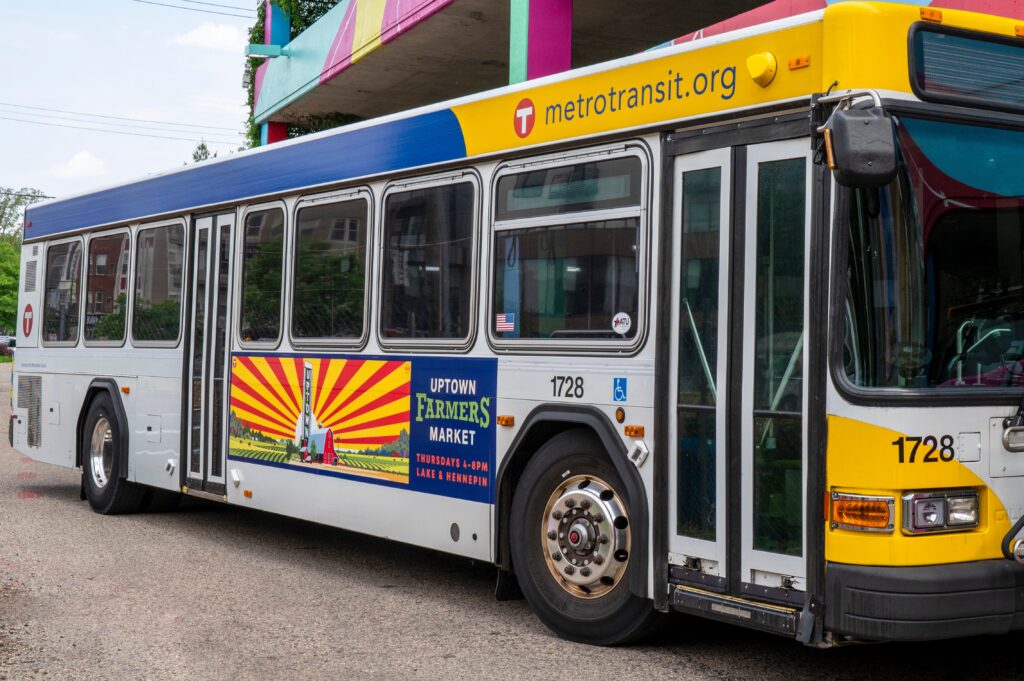
The market committee has counted on a mélange of funding amounting to nearly $150,000, Sutton reports. That doesn’t include Metro Transit’s $110,000 of in-kind advertising (as seen on the sides of buses).
He says the biggest sources include the City of Minneapolis’ Department of Community Planning and Economic Development ($42,000), the Minneapolis Foundation ($15,000), the Lake Street Council ($10,000), MidWestOne Bank ($10,000), and Ragstock ($10,000). (The latter two have locations in the Uptown area.)
“All the commercial property owners are really stepping forward,” he adds, “because it’s in their best interest, as well. A farmers market is honestly an economic development accelerator.”
This is key: the economic ripple. “Uptown has roughly 35,000 residents … and every neighborhood association is promoting it to their neighborhood,” Sutton says. If East Isles drew 9,000 visitors a season, he guesses Uptown “will easily exceed that number.”
The Uptown Association helped by contacting area businesses, Sutton says, and asking them to host Thursday-night specials. “The idea is: Hit up the new Uptown Farmers Market grand opening this Thursday, then walk over to Lake & Irving for Trivia Mafia at 8:30.”
Input from neighborhood associations cinched Thursday evening. That timing doesn’t compete as much with other farmers markets, and the weekday comes with fewer safety concerns, Sutton says. “And the Uptown businesses need that business during the week, so we purposely ended at 8, so you can go see a movie afterward.”
He says there’s still a lot of vendor interest. The market has capacity for about 40, but its relatively inexperienced team is starting with 25 “to make sure that first experience is good.” (The cost for vendors is $25 per market appearance, with discounts for half- or full-season commitments.)
Some programming aside, what’s left now is to open.
“The banner is out and hanging over the Lake and Hennepin intersection,” Sutton says. “Honestly, it’s the first banner that has hung across that intersection since George Floyd.”
He has his own Uptown lore. Resettling in Minneapolis from the East Coast in the 2000s, thinking he’d stay for up to five years, Sutton is now a Minnesotan 26 years deep, and it was the diversity—in the food scene, in the arts, in the people—that endeared him to Uptown.
“Let’s create that weekly destination that hopefully brings back bike, foot, public, even car traffic to Uptown,” he says. “Give people a reason to take ownership and channel their energy into creating that common-ground space that everybody moved to this neighborhood for.”