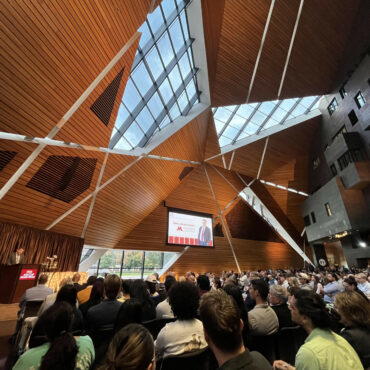
MN Cup 2025: Mission-Driven Ventures
Andrew Jones was ready to take another crack at entrepreneurship, having already started, scaled, and sold one startup. As he contemplated his next move, Jones knew that any business he launched would need to tackle a consequential problem and make a difference in the world.
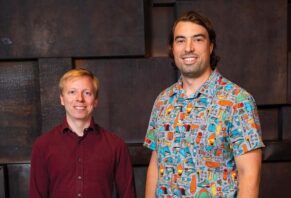
Jones and fellow chemical engineer Paul Dauenhauer started Carba in 2021 in Minneapolis. In 2023, Carba captured MN Cup’s Grand Prize for its efforts to combat climate change by permanently removing carbon dioxide from the atmosphere. “Climate change is the biggest challenge of our generation,” Jones says. “I want to use the skills and connections I’ve developed to make the biggest impact on the planet and humanity.”
Jones is not the only one. In recent years, MN Cup competitors, leaders, and judges have noticed a marked increase in new ventures aiming to address thorny problems, says John Stavig, managing director of the Gary S. Holmes Center for Entrepreneurship, home of MN Cup, at the University of Minnesota’s Carlson School of Management. In the earlier days of the competition—which started in 2005—MN Cup participants who wanted to make an impact on pressing problems primarily competed against other social entrepreneurs in the dedicated Impact Ventures Division.
Today, the Impact Ventures Division is a hotbed of startups with a deeply embedded purpose. But an increasing number of mission-driven competitors can be found across MN Cup’s eight other divisions, says Connie Rutledge; she’s been a judge since 2009 and is executive director at the Finnovation Institute, which supports social entrepreneurs. The last four Grand Prize winners—Nanodropper, Phoam Labs, Carba, and Momease Solutions—have all included a social impact component, as does this year’s winner, AcQumen Medical.
It’s difficult to quantify the total number of mission-driven companies in Minnesota, but a few indicators illuminate the trend. In 2024, the Minnesota Secretary of State listed 92 public benefit corporations, which are designed to deliver a social impact along with their business objectives. About 50 Minnesota companies also have earned rigorous B-Corp. certification, and Rutledge estimates there are about three to five times as many purpose-driven companies throughout the state.
There are numerous reasons entrepreneurs are opting more frequently to start companies with social impact in the business’ DNA. Many want to do what they can to address deeply challenging issues like climate change or inequality. Others seek to do good while doing well from day one. And it’s more common now for people to strive for meaning in their work and life using their companies to advance career and personal goals.
When it comes to MN Cup, being purpose-driven can also help competitors, giving them authenticity and making them stand out, says Morgan Kerfeld, a MN Cup judge and co-founder of Telo. The Minneapolis company won the 2022 General Division for its work to reimagine assistive mobility devices. Kerfeld notes that though still in the early stages of growth and yet to generate revenue, Momease Solutions, the 2024 Grand Prize and General Division winner, impressed judges with its mission to enhance lactation support and the powerful story behind its creation, ultimately setting the company apart from other competitors.
Generational shifts also help explain why MN Cup and the state’s overall startup ecosystem have been seeing more purpose-driven companies, Rutledge says. The traditional trajectory used to involve starting a company, growing it and thriving, and only then supporting causes after the business had succeeded. Many of the younger entrepreneurs during the past 15 years “see that as a little contradictory and have been exploring ways to do good while doing well financially,” she says. “It’s become a more holistic approach.”
Paired with that trend is consumers’ desire to patronize companies with purpose-driven brands, Rutledge says. That was the hope of Tingting Wang when she co-founded the jewelry company EARTHA, the 2025 Youth Division runner-up. With its recycled glass jewelry, the company addresses environmental damage caused by gemstone mining and jewelry manufacturing, and the aim is to connect with like-minded customers in search of eco-friendly products.
“One of the main factors in our growth is that customers come back repeatedly because they know our brand is trying to make a difference,” says Wang, a Mounds View High School junior. “It is possible for them to take action even if it’s addressing a small aspect of climate change, because every action helps solve a real-world issue.”
Along with building a loyal customer base, having a foundational purpose helps EARTHA and its leaders in other ways. “Our mission is something that allows us to know the next steps of our company,” Wang says. “If we do this, does it align with our mission? And if it doesn’t, then it’s not best for our company. That strengthens our mission and our company.”
Having more purpose-driven startups also reflects Minnesota’s business climate. As a Minnesota transplant, Rutledge has observed the state’s culture of innovation in the public sector, which often transfers to other business efforts. “This is a natural outcome of that, of saying that we can find ways to combine our principles and our priorities, and that benefits our business culture,” she says. “It’s really positive.”
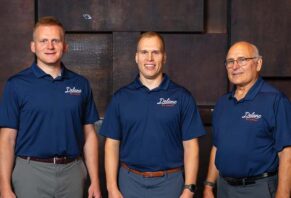
The three founders of Telo started the company as students in a Carlson School entrepreneurship class. From the beginning, Telo has been rooted in its purpose to change the status quo around mobility devices like canes and mobility walkers. “Starting a company is really hard, and having a purpose or mission to go back to can really help during those times that you are feeling defeated,” Kerfeld says. “Knowing that what you are doing is making an impact on individuals’ lives is a guiding light for us. It’s a connector for our team, and it allows us to continue pushing forward even when the path might be unclear.”
That clarity of purpose has guided Telo’s decisions from the start. Instead of leading with the mobility walker concept the team originally pitched at MN Cup, the company chose to launch the Y-Cane—a fresh take on the traditional cane—as its first product. The pivot allows Telo to bring a meaningful product to market sooner and continue self-funding its growth. “We can start having a positive impact in the community earlier and get an early revenue stream,” Kerfeld explains. “It allows us to continue serving our mission in a sustainable way.”
Stavig notes that this sense of purpose doesn’t just fuel founders—it also attracts and retains employees. When startups build their work around a clear mission, it helps teams stay motivated and resilient through the inevitable ups and downs of entrepreneurship.
Jones, from Carba, agrees. A millennial, he finds a common commitment among his peers and younger people. They want to apply their talents at companies striving to make an impact on the world. “I don’t think we’re satisfied to just go out there and make money. We want to make a difference,” he says. “More than anything, there is a lot of fear and anxiety over these big existential problems in our world—climate change being one of them—and we don’t want to sit idly by. Our generation has been drawn to that.”
Read more from this issue
Grand Prize Review Board
- Paul Campbell, Co-Founder & Managing Partner, Brown Venture Group
- Cathy Connett, CEO & Managing Partner, Sofia Fund
- Lisa Crump, Founder, Cairn Ventures
- Leslie Frecon, Managing Partner & CEO, LFE Capital
- Rick Gage, Co-Chair of Carlson Holdings, Carlson Family Foundation
- Michael Gorman, Managing Director, Split Rock Partners
- Ken Greer, Chief Innovation Officer, Augeo
- Fred Haberman, Co-Founder & CEO, Haberman
- Nick Hartl, Managing Partner, Atland Ventures
- Rick Huebsch, Associate Vice President, UMN TechComm
- Howard Leonhardt, Executive Chairman & CEO, Leonhardt Ventures
- Beth Leonard, Partner In Charge, EisnerAmper
- Brad Lehrman, Former Partner, Soffer Lehrman Law Group
- Scott Litman, Co-Founder & Managing Partner, Lucy
- Dan Mallin, Co-Founder & CEO, Lucy
- Shawn McIntee, Shareholder, Greenberg Traurig
- Jeff Robbins, Attorney, Avisen Legal
- Mickayla Rosard, Partner, Groove Capital
- Stephanie Rich, Partner, Bread and Butter Ventures
- Sara Russick, Co-Founder & Managing Partner, Gopher Angels
- Philip Soran, Director & Chairman, SPS Commerce
- Jeff Tollefson, President & CEO, Minnesota Technology Association
- Ben Wright, Vice President, 3M Ventures
- Sandy Yu, Assistant Professor, Carlson School of Management
- Ping Yeh, CEO, VOCxi Health