Flow Plans a $20M Factory—And More—for Its “Mechanical Room in a Box”
At its core, Flow Environmental Systems is a heat pump company. But it’s also one piece of a vision for how Minnesota can grow its clean tech and manufacturing sectors simultaneously. With hundreds of new jobs and a national expansion on the horizon, this Rogers-based company is worth some attention.
Flow has plans to announce a $20 million manufacturing facility somewhere in Minnesota in the next year. “We could pick anywhere in the U.S. to create a factory,” CFO Navaid Burney told TCB. “But high-quality, mission-aligned partnerships in both the private and public sectors make Minnesota a natural place for Flow to call home.”
Heat pumps provide heating and cooling by moving air around, rather than by generating their own heat source like traditional furnaces. In the winter, heat pumps pull heat in from outdoor air. In the summer, they push heat from inside your home, outside. (If you’re confused about how cold air can heat a home in winter: The air is compressed and squeezed, raising its temperature, and then it’s released into the home.)
Traditional heat pumps can shrink heating and cooling bills, and they can reduce the carbon footprint of a building. But they often aren’t as effective in really low temperatures, like what we saw in Minnesota this January, and they inefficiently switch between heating and cooling, according to Flow—whose aim is to solve those issues.
Unlike most traditional heat pump manufacturers, Flow says, it makes a heat pump that uses carbon dioxide as the refrigerant, which it says is better for heating than synthetic alternatives.
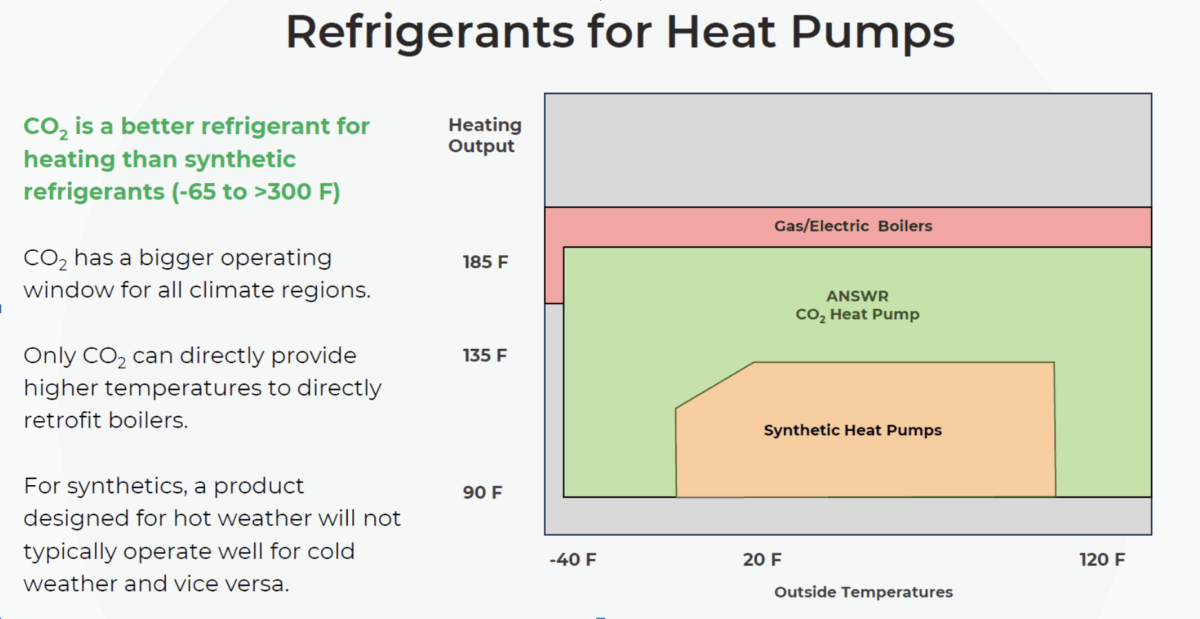
Most industrial heat pumps have a range of 50 to 100 degrees Fahrenheit between their low- and high-end temperatures. With its unique refrigerant, Flow’s heat pump, called ANSWR, runs between -40 and 120 degrees Fahrenheit—a whopping 160-degree range.
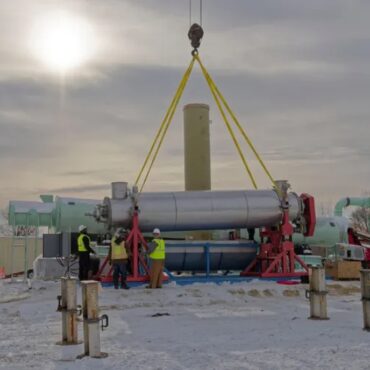
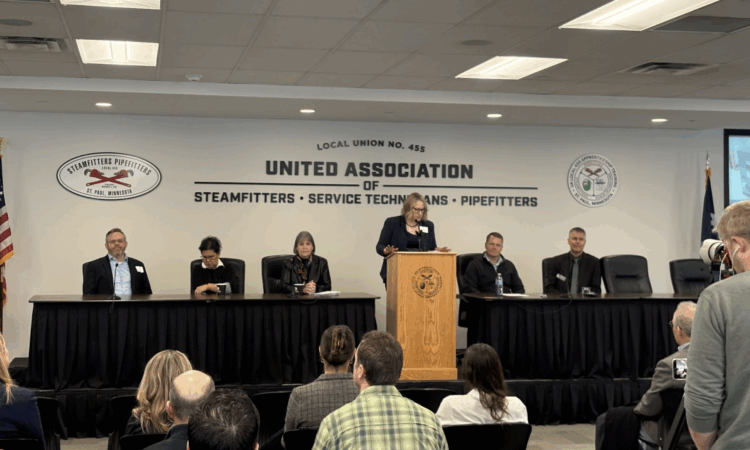
“It’s a whole mechanical room in a box,” chief technology officer Sean Jarvie said at a demonstration in mid-February at Local 455, the union in St. Paul representing Minnesota steamfitters and pipefitters.
That description hints at the versatility of Flow’s technology. An ANSWR pump can heat or cool spaces using air, water, the earth (commonly called geothermal heating/cooling), heat recovery chillers (which take cooling loads and turn them into useful heat), or a hybrid of all of them.
As the company expands, it has had some big early wins on both coasts. In September, Flow won the Empire Technology Prize in New York, which included a $100,000 prize and the installation of its system at the Union Theological Seminary’s building on Manhattan’s Upper West Side. The historic building needs a consistent cooling system to keep its library and rare books in optimal condition.
Flow is also part of a training center for HVAC professionals opened by DMG, a manufacturers representative based in San Jose, which gave the company a foothold in the Bay Area and across California.
Recently, the pump was featured as part of a project that reduced a San Jose software development facility’s carbon footprint by 90%, according to a LinkedIn post about the project.
Flow’s upcoming project pipeline features a couple familiar names with national profiles that the company isn’t ready to publicly disclose.
Flow expects to produce 400 units each year once its new Minnesota facility is up and running, and it hopes to scale to 1,000 units each year by 2030. Flow anticipates the facility will have created 400 full-time manufacturing jobs by then. Beyond manufacturing, the ANSWR system is expected to indirectly create jobs for installation technicians, too.
The Local 455 demonstration was the result of a larger partnership, as the labor group has been a key supporter of Flow due to the high pay that comes from installing the technology. The union hosts an ANSWR unit hooked up to a geothermal system and an outdoor air source, and it has been using the unit for demonstrations.
At the mid-February demonstration, State Representative Larry Kraft said he views the company as an example of the sort of business Minnesota should support. “This project ties in with Minnesota’s leadership on climate and clean energy,” he said. “Why shouldn’t we be able to create a tremendous ecosystem of innovation along with it?”
Minnesota Energy Alley, a public-private partnership created to boost the state’s climate tech and energy innovation ecosystem, supported the project. It was modeled on the successful Medical Alley partnership that has supported the state’s med tech ecosystem for years.
Flow has also received major support from Grid Catalyst, a clean-energy technology accelerator run by local energy innovation ringleader Nina Axelson. Grid Catalyst works to bring companies from ideas to commercialization.
Most Flow installations also will likely tap into federal tax incentives to assist financing.
“This is showing what a little bit of push from the state can do along with a lot of work to take something like this from the lab to installing them,” said Pete Wycoff, deputy commissioner for energy with the state’s Department of Commerce, at the demonstration. Wycoff was a leading force in the passage of the Inflation Reduction Act, which aimed to incentivize energy efficiency, when he worked for Sen. Tina Smith.
Industrial policy can be hard to execute given the number of moving parts to actually bring a plant online in the United States in 2026. But Flow is almost there. Right now—when policy, climate technology, industrial clients, manufacturing, labor, and more come together—they may be on the cusp of significant growth.