Centering the Black Experience in DEI Work
“Never, ever be afraid to make some noise and get in good trouble, necessary trouble.” — John Lewis
Recently, someone asked me why my DEI practice centers race and the Black experience. I’ve been asked why this DEI newsletter centers race. When I’m in sessions, facilitating and coaching, people have asked me why I talk so much about race and the Black experience. Essentially, they’re asking a combination of, “Isn’t diversity about more than just blackness?” “What about x, y, or z?” “Do we really have to talk about Black people?” My response is yes, and…
First, a conversation about DEI without a racial component ignores the most obvious reality of our day-to-day lived experience as people in the U.S. When we see a person, the first thing we assume about them is a racial identity. Consciously or not, we assign people a race—Black, Asian, white. This is called racializing, and it’s something we all do. While it can be our way of orienting ourselves and each other in the racial hierarchy, it has very real consequences.
In the last few years, the American Medical Association and the Center for Disease Control and Prevention both identified racism as a public health crisis. While other areas of our lives may be challenging, our skin color and people’s perception of our racial identity impact our life expectancy and overall health to such a degree that it’s a crisis.
I know people with varied life circumstances experience challenges, especially in today’s environment where egregious anti-LGBTQIA+ legislation is happening in many states, and women are disproportionately leaving jobs as flexibility disappears with return-to-office mandates. But if you add the complexity of race to gender, ability, sexual orientation, or any other very essential and core parts of our identities, it makes that individual’s life more challenging. Because race is a hierarchy—the darker skin experience you have, the more challenging your lived experience–and because of anti-blackness, things can be more challenging for people with a darker skin experience—even if they don’t consider themselves Black. Read that again.
For example, Black people only make up about 13% of the U.S. population. However, we are overrepresented in the criminal justice system, and Black women have the highest maternal mortality rate in the country.
Centering race is your path to the most good because racism is one of our country’s most persistent problems that we have not gotten our arms around. While conversations about race seem like they’re everywhere, in these conversations, we don’t talk about race directly, so we keep not getting to the roots of the issues. Throughout my career, I’ve sat in rooms of people talking about diversity, and they use that word, but they’ve never put an adjective in front of diversity. “Diversity” has allowed people to think they’re talking about race without actually saying the word race. How can we possibly address something we can’t even say out loud?
Advice for Accomplices
I always encourage people to use an adjective when they use the word “diversity” because it’s the only way to talk about the truth of our circumstances. If you mean racial diversity, say that. If you are talking about neurodiversity, say it. We can’t make progress without being specific and honest in our conversations. The lack of honesty allows us to make assumptions and that doesn’t help any of us.
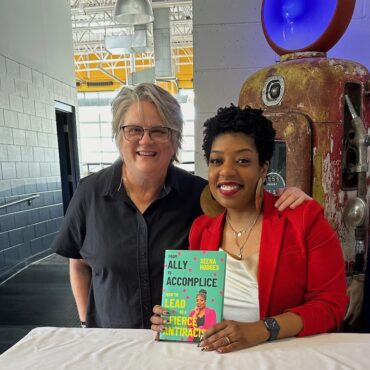
Want more tips and information? Buy my book From Ally to Accomplice.
Also, check out this month’s iteration of Leading Forward, which includes a conversation with four Black leaders about the Black experience.
In saying the word diversity as a code for race, we’re conveniently not talking about the system of racism or the truth about how this country was built on free Black labor. I understand it’s hard and uncomfortable for some people to talk about our complex past, but our current circumstances won’t improve if we never do it. They can’t.
To be honest, I am tired of having to answer this question about why race is so central to DEI. For me, it’s a no-brainer. Race is central to who we all are. It impacts all of our lived experiences and has yet to be fully dealt with.
Recently, I was in a room with attorneys having a conversation about leading their lives as fierce antiracists, and I mentioned the Scottsboro Boys case. Only three people had heard of the case in this room of 12. These people are charged with understanding and applying the law every day, and the Scottsboro Boys case has 40 years of history that somehow they were not taught in history class or law school, and they never happened upon it in their day-to-day practice. Yet, this case is important because our rights to a jury of our peers and an attorney stem directly from it, impacting everyone in this country. This is a classic example of how Black history is, in fact, American history.
Data tell us what’s happening to Black people in this country, so a DEI initiative that doesn’t center race doesn’t go to the deepest part of our collective challenge. Focusing on Blackness doesn’t erase other people, it helps other people. I’m not saying that if your work is rooted in helping specific groups of people who have specific needs, and they all happen to be white, you’re not doing any good. I’m saying that you’re not doing the most good you can, and you’re not making systemic, lasting change. If we understand our shared history and the struggles and triumphs of Black people, then we are more likely to better understand the Black experience and be less likely to repeat the injustices of our past. Think of how much good we could do if we learn to solve our country’s most central and enduring problem.
Sometimes, white people say things like, “I’m neurodivergent…” or “I’m a member of the queer community…” or “I am a person living with a disability…” My question for them is: would you want to be any or all of those things and Black, too?
Until next month,
Seena