Building A Talent Pipeline
While companies grapple with meeting the ambitious hiring and DEI goals they set in 2020, Dan Ryan is doing the work on his own.
He left an advertising job in 2021 to launch InspireMSP, an organization that is already delivering on its lofty mission to “empower the future workforce and unleash limitless creative minds.”
How? InspireMSP shows historically excluded youth what it’s like to be a creative professional. It’s that old adage “You can’t be what you don’t see” in action; for example, taking local middle school kids backstage at a theater to meet the lighting tech or going to a design-build firm and helping architects design a building prototype.
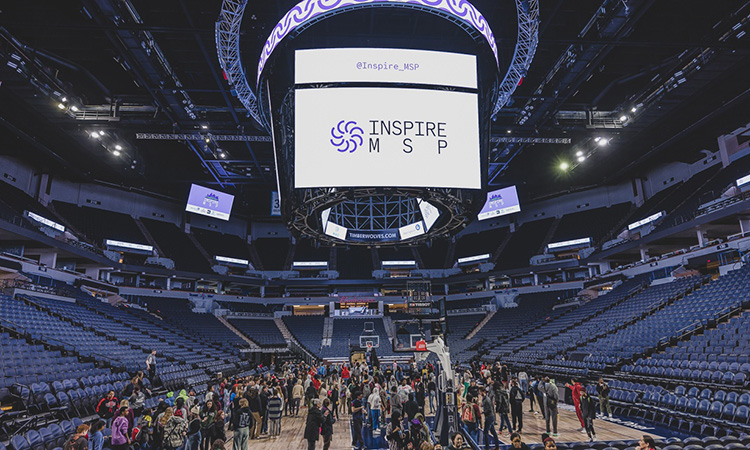
In its first year of programming for the 2022-23 school year, Inspire MSP brought more than 200 Twin Cities students on career field trips to places like First Avenue, the Guthrie Theater, and the Bakken Museum. It culminated with a career day at Target Center where they got to step onto the basketball court, but perhaps more importantly, talk to professionals who work off the court.
“They are making money and big moves,” exclaimed one student from Franklin Middle School in Minneapolis. The kids were polite but direct, asking the execs present questions like “Has it been hard to get where you’re at, especially as a Black person?” and “How did you make connections to get here?”—smart, practical questions from kids not yet old enough to get a fast-food job.
I was there to witness the light of possibility turning on. And I thought about the many companies—including my own—that struggle to develop a more diverse pipeline. These companies understand a diverse workforce is a more productive workforce, but they’re trying to get there—often with little success—by looking for qualified employees without considering the years of preparation (school, internships, extracurricular activities, and more) that must occur before an individual even thinks about applying.
“It seems a lot of funding goes to what’s already being funded because that’s what we’ve done.”
—Dan Ryan, Founder and Executive Director, InspireMSP
Ryan’s goal for this school year was to take 650 kids on InspireMSP field trips. Already, more than 800 want to participate. Teachers from districts that don’t have money to bus students to Target Center, or the time and connections to get in the door, were quick to see the value in a program like InspireMSP. “ ‘My kids left that day more than inspired,’ ” St. Paul Public Schools teacher Mary Voigt told Ryan. “They were empowered to think creatively about their futures, to see their identities as assets.”
As you can imagine in our collaborative community, many organizations have opened their doors to these students. Many individual professionals are eager to talk to them and show them around.
The list of companies stepping up to financially support InspireMSP is considerably shorter.
“I’m new to this,” says the gracious and soft-spoken Ryan. You can tell he’d much rather be taking a kid to the Target design offices or into a General Mills kitchen lab than talking about the dollars required to pull this off on a larger scale. “But it seems a lot of funding goes to what’s already being funded because that’s what we’ve done.”
Ryan is out there every day, meeting with companies, trying to get them to see what he sees—that we need to move beyond some of the metrics that count a program as a success only if it produces direct results. “We lose the true impact that exposure and providing choice can have down the road.” He points to InspireMSP supporter Nadege Souvenir. You may know her as chief operating officer for the Saint Paul & Minnesota Foundation. She also just completed a term as board chair of the Minnesota Opera. Souvenir didn’t see a fully staged opera until she was an adult, but she traces her interest back to one week of learning about and listening to Madame Butterfly in grade school.
“The measurement isn’t a three-year journey” from school to internship or job, Ryan says. “I believe collaboratively, we will significantly change industries. We might not see that for six to 10 years. But it’s a byproduct of what we’re doing today.”
As you read this issue of TCB, you might think about all of the experiences that led you to the job and title you hold today. Think about how powerful it could be to spark that sort of passion in the next generation, just by inviting them in.