


How Minnesota Women Are Racing to the Top of the AI Economy
“I can’t do that. I’ve never vibe coded before!”
It was a hot and muggy day in Cambridge, Massachusetts, and I was sitting outside, in a tent at a table with six other women in tech. My friend Urvashi Batra, a startup founder in Boston who had convinced me to fly across the country to attend the AI Powered Women’s Conference, was now trying to talk me into vibe coding on stage at MIT in front of hundreds of people.
“Urvashi, I’m serious. I know it’s supposed to be easy, but I haven’t even tried it yet.”
She said, “Caroline, don’t be ridiculous, you’ll figure it out in five minutes!”
“I mean…”
She leaned forward. “Let’s do this. You go back to your hotel room tonight, open Lovable, use the template I sent you, and text me what you think afterwards.”
Late that night, I opened up my laptop, opened a vibe coding platform called Lovable, and copied the template in.
She was right. It really was that easy.
“Why did I think that would be so hard?”
According to the Headlines, Women Are Losing at AI
One could be forgiven for assuming that AI has declared war on women.
Recent research highlighted by the Washington Post finds that women make up about 86% of the workers in jobs most vulnerable to AI automation, largely in clerical and administrative roles that are both highly exposed to AI and relatively “hard to transition out of.” That same article indicated that software engineers would be more likely to adapt to this new paradigm.
A Harvard Business School meta‑analysis of 18 studies estimates that women have about 22–25% lower odds of using generative AI than men.
Most disturbing, AI military surveillance company Palantir’s CEO Alex Karp was recently quoted on CNBC saying that this AI “technology disrupts humanities‑trained, largely Democratic voters, and makes their economic power less, and increases the economic power of vocationally trained, working‑class, often male voters.”
It’s a bleak vision of the future. I also believe it’s fundamentally wrong.
What are these researchers, journalists, and CEOs missing?
It’s true that AI systems can (or soon will be able to) automate a tremendous amount of work. Any role where the work is highly repetitive and digital is certainly at risk.
But what everyone above is overlooking is that AI tools have changed so substantially in the last three years that they now require an entirely different skillset. You no longer need to be technical or need to be a software engineer to use these tools. In fact, some software engineers really struggle utilizing AI-first tech.
The best users of these cutting-edge AI tools are excellent communicators, with strong critical thinking and organizational skills, who deeply understand the problems their clients or their business experience.
In many cases, the women that these journalists, researchers, and CEOs are overlooking are actually better positioned to succeed in an AI economy than traditional “tech bros.”
And what if I were to tell you that we are seeing a movement of incredibly talented, mostly non-technical women right here in Minnesota who are proving men like Karp wrong every single day?
MN Women in AI Begins
My name is Caroline Holden and I have spent the last eight years working in startups, tech, and venture capital in New York City and right here in Minneapolis. I have scaled grocery apps during the pandemic, run Twin Cities Startup Week, and even helped sell an AI startup to data giant Snowflake. And yes, the rumors are true, I also used to be a comedian in New York.
In late 2024, I decided I needed to go all-in on AI and start meeting everyone I could. I found a genuinely exciting community who inspired me to dream bigger, take risks, and challenge myself.
I also mostly met men. And in most cases, men who were significantly older than myself.
Now, like many of our local gold-medal Olympic champions, I grew up playing boys ice hockey. I have worked in male-dominated industries for my entire career. I don’t mind being the only woman in the room.
But the ratios at most AI events in 2024 were more skewed than I was used to seeing at other local tech and startup groups, which I found peculiar.
So, like any other super networker with a bad writing habit, I decided to write a post on LinkedIn.
It was short, and then it took a life of its own.
In under 24 hours, over 200 women commented or were tagged on the post. I had over 40 inbound messages and 10 phone calls from women asking when our first event was and how they could help get it off the ground.
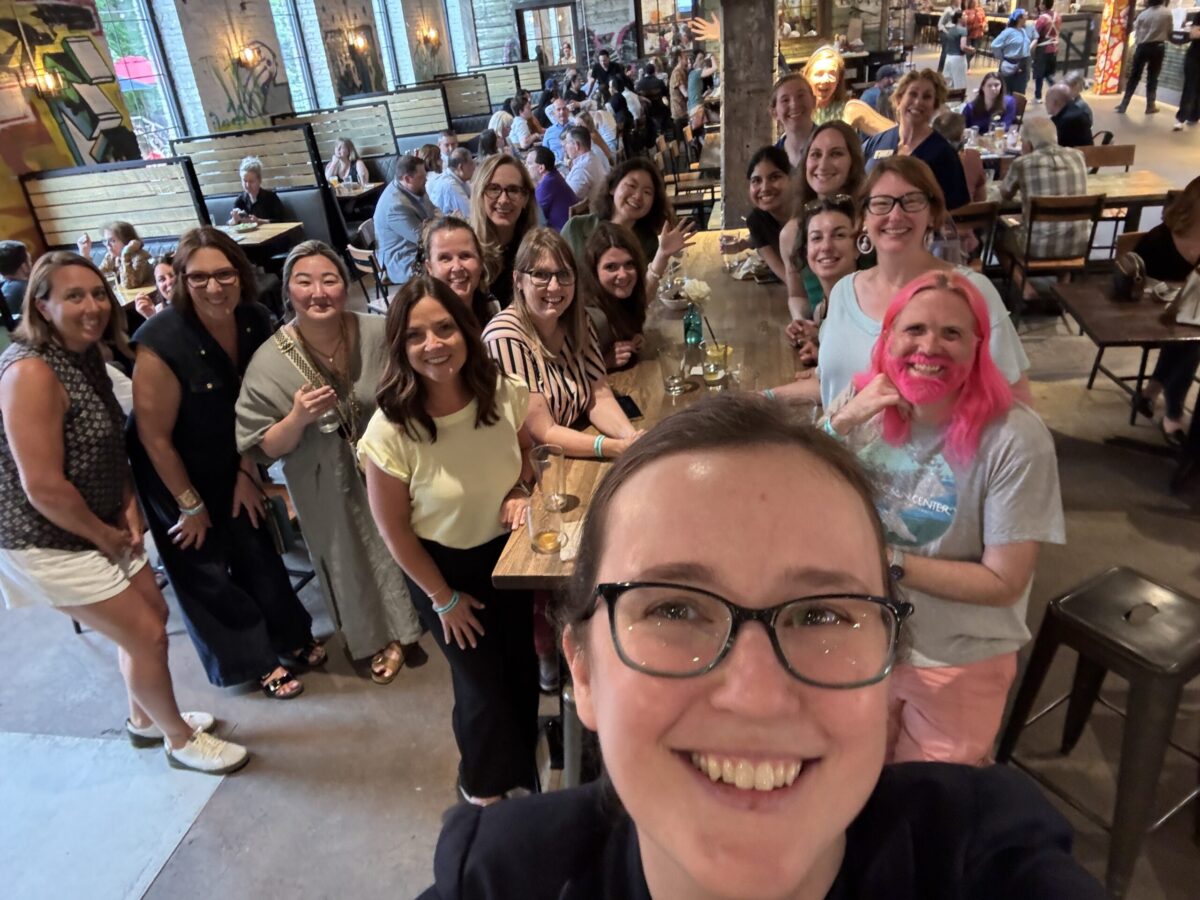
A week later, we had our first happy hour at Malcolm Yards. We named ourselves the MN Women in AI.
Many of these women were GenXers, excited to partake in their second technological revolution. Many were millennial moms who were ecstatic to use AI tools to make their work and home life more efficient. And many of these women had been the only ones at their jobs or in their families who were excited to learn more about AI.
And the majority of these women weren’t engineers.
They were marketers, saleswomen, strategists, product or project managers, educators, administrators, real estate agents, Emmy-winning filmmakers and journalists, small-business owners, independent consultants, job seekers, students, entrepreneurs, and so many more.
This was wildly different from what I was used to. I had been in rooms with male engineers, enterprise architects, and entrepreneurs.
And on top of that, many of these women were having the same thoughts and concerns about AI as I did. How will AI affect the future of work? Education? Copyright? Legislation? How can we build more sustainably and lower compute and energy usage?
Soon, we had an email list of over 100 women interested in learning more about AI, asking for more educational content, and eventually even winning awards.
Vibe Coding Solutions
In early September on a Sunday afternoon, I vibe coded on MIT’s stage. (Translation: I told an AI a website I wanted it to build, in plain English, and it did.)
On Friday morning, I showed our group at MN Women in AI how to vibe code on Lovable.
By Friday night, Kat Hill Contag, a growth and marketing specialist with no engineering background, signed up for Lovable’s SheBuilds Hackathon, an international competition to see who could vibe code the best app.
Two weeks later, Kat beat out thousands of women across the globe and won the hackathon.
By December, Lovable hosted its second SheBuilds Hackathon. Eight MN Women in AI members, most of whom were not software engineers, competed against thousands of vibe coders from all over the world. MN Women in AI members Jena Zangs (chief AI and data officer of the University of St Thomas) and Shannon Seaver (former K-12 educator and current ed tech entrepreneur) live-streamed building their ed tech app on Youtube for 48 hours.
Then they won the hackathon. There are now more Lovable SheBuilds Hackathon winners in Minnesota than in any other state or city in the world.
MN Women in AI Today
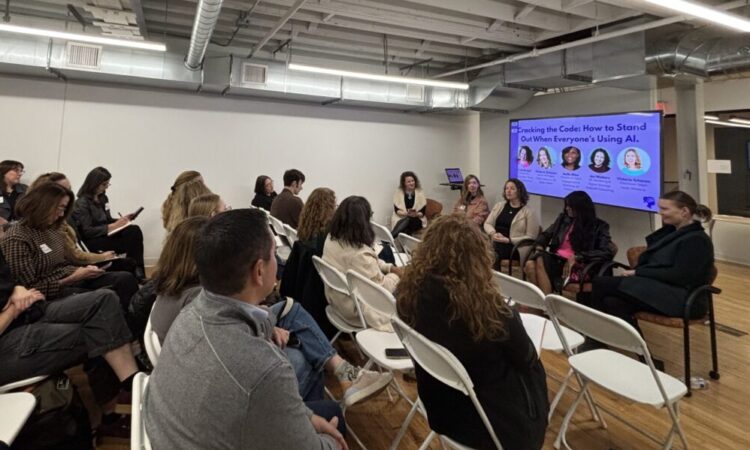
A few weeks ago, we co-hosted a Lovable SheBuilds International Women’s Day event, one of hundreds being hosted globally. This event was designed to educate as many women as possible how to vibe code and was not a competition.
Tragically, this meant we were unable to have another first-place winner, but we were able to train 45 women to build their first apps in under two hours. By the end of the day, people had built apps and websites for their high school sports organizations, personalized meal-prep apps, ed tech apps that translate instructions into dozens of languages, even apps tracking stock market trades made by Congressional officials.
What, like it’s hard?
Once again, most of these women had little to no software engineering experience. But at the same time, our software engineering members from Medtronic and Target had a blast building and demoing their new apps for our audience and marveling at just how democratized software engineering had become.
Now, many of our members are starting to turn their new AI products into startups. Tanya Coller, a Lovable ambassador with no engineering background, is building Ayla. SheBuilds Hackathon winner Shannon Seaver has two ed tech startups.
I told a few people in the last month, “It’s like we accidentally built a startup incubator program!”
What This Means
The narrative that AI is coming for women assumes that the women most “at risk” are passive recipients of a technological shift they can’t control or understand. What I’ve watched instead is a group of people who picked up these tools faster than almost anyone expected and immediately started building things that matter to them.
These tools are so simple and easy to use and have the ability to do far more than writing a few emails or generating cute cat images. Our members are doing everything from designing apps to building sophisticated automated systems that manage their work and home lives so they can spend more time doing what they love.
Our members at MN Women in AI are also women who deeply care about building AI systems more sustainably.
We have all seen the headlines on how much energy and water AI uses, how AI affects people’s mental health, how AI image generation can be used to harm young women and girls, how AI is affecting job hunting and our economy. These are not discussions that we ignore here at MN Women in AI.
We find that our members are engaged in these discussions and motivated to solve these problems. Multiple members joined their local caucuses in February, became delegates for their communities, and advocated for and against legislation about AI. We recognize that, while these issues are large and important, they will not be solved by simply opting out of the technology.
Learning how the tools work and what impact they have gives our members a crucial edge in slowing down or stopping larger problems before they explode.
Next for MN Women in AI, we are offering four-plus events a month (with six scheduled in April!), and we have launched a membership program designed to help upskill all AI leaders in our community—not just software engineers.
Because, believe it or not, it turns out women who have spent their entire careers in roles that prioritized strong communication, critical thinking, and organizational skills, who deeply understand the problems that their clients and businesses face, are now the ones racing to the top here in Minnesota.
Feeling scared to get started with AI? Don’t be ridiculous. You’ll figure it out in five minutes.