


2024 Person of the Year: The Timberwolves’ Tim Connelly
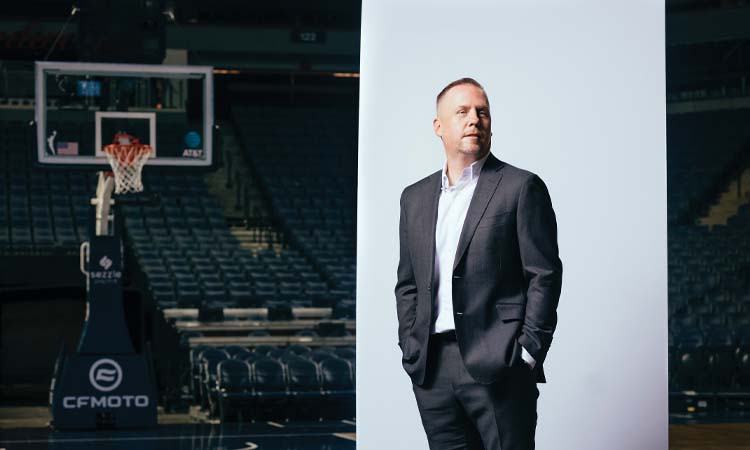
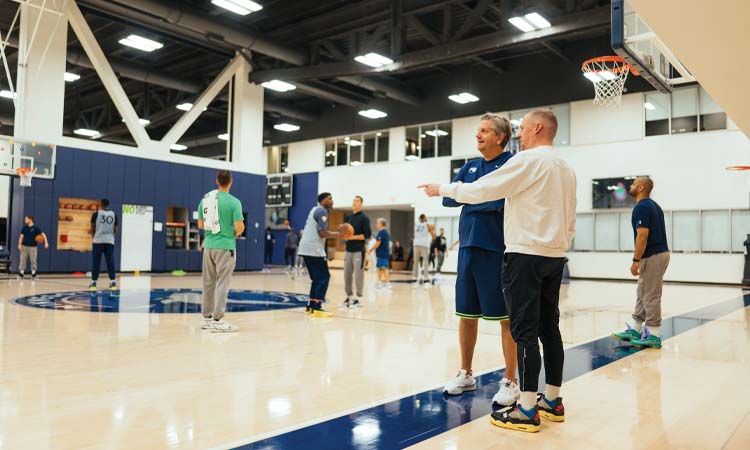
Tim Connelly, Wolves' president of basketball operations Photograph by Nate Ryan
The Minnesota Timberwolves’ hiring of Tim Connelly in summer 2022 as president of basketball operations was nothing if not audacious. The organization had rarely made such moves, almost never took the half-court shot. It had accumulated a few great players over the years—in high-draft picks after bad seasons—but was never able to find the right combination of complementary players, coaching, and organizational discipline to lock in at a high level.
Connelly, 48, is a basketball lifer. He was an intern for the Washington Bullets at 19. He ran the basketball side of the Denver Nuggets—a team on a championship trajectory—from 2013 to 2022 (they won it all in 2023). The Wolves had been without a basketball boss since Gersson Rosas was let go in 2021 following a rumored romantic relationship with a colleague.
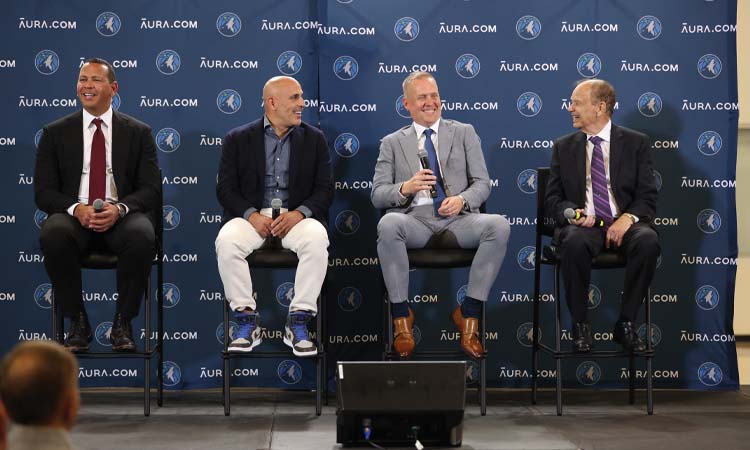
As the story goes, Wolves minority owners Marc Lore and Alex Rodriguez encouraged owner Glen Taylor (whom they are now fighting for control of the team) to seek out the hottest property in the league rather than an unknown or someone on the downslope of a career who wouldn’t view spending winters in Minneapolis as a downgrade.
They persuaded Taylor to pursue Connelly, who reportedly received a five-year, $40 million contract, an unprecedentedly large sum of money for a Midwest sports exec (though more and more, sports is paying pedigreed leaders like athletes). “Their impetus made the difference,” says veteran Wolves beat writer Britt Robson (MinnPost), who has covered the team since its inception. “They were the change agents. They had the audacity with Glen’s money.”
The Big Swing
“I was fortunate to be part of the early stages of that process,” recalls Wolves CEO Ethan Casson. It was about “who’s the best available person and let’s invest in a leadership team. All of the credit goes to our ownership group for finding a pathway.”
The lineage of the president of basketball operations (PBO) is a list of by no means obscure figures. It includes NBA royalty like Flip Saunders, Kevin McHale, Jack McCloskey, and Tom Thibodeau. But none came close to the brass ring, other than a 2004 trip to the Western Conference finals under McHale, one of only two PBOs in the team’s history with a .500 record.
Yet in just two seasons, Connelly turned the narrative around, engineered blockbuster trades and unexpected amateur drafts, and signed role players who complement the team’s superstars.
“Ownership wants to invest. It’s Glen’s vision to compete,” says Casson. “Never have we said, ‘Let’s move away from that.’ ”
Casson has been with the team since 2016 and had a hand in some of the missed shots. Yet he also is responsible for a WNBA Lynx organization that has a consistent record of success. He calls stability and continuity the foundation of winning organizations. “When you build a culture that’s unwavering, staff and fans embrace it,” he explains.
“[Lynx coach/PBO] Cheryl Reeve came in with a vision and mindset. In a very short time, Tim has created that same stability and continuity. It was always our intent [for the Wolves], we were seeking the same thing. You don’t go into it thinking you’ll get it wrong, but eight seasons of experience has made me a better judge.”
Casson says he saw key qualities in Connelly’s tenure at Denver. And Connelly saw a core of talent in the Wolves organization. “We needed to pair KAT [Karl-Anthony Towns] with a defensive-minded player without impeding Anthony Edwards’ growth,” Connelly explains. “We needed a [player] coming from a winning environment.”
“Ownership wants to invest. It’s Glen’s vision to compete. Never have we said, ‘Let’s move away from that.’”
—Wolves CEO Ethan Casson
Connelly’s 2022 trade for center Rudy Gobert set the league on its ear, and not all the reviews were positive. “I’m not risk-averse,” he notes. “That empowered me to take a big swing. Look, we hadn’t won a playoff series in 18 years!”
After a promising but ultimately disappointing first season, Connelly’s prescience paid off in 2023-24, as Gobert, Towns, and Edwards jelled as a unit and the team reached the Western Conference finals for the first time in two decades. Connelly seemed the difference-maker.
How to Win or Lose in the NBA
Stability and continuity don’t guarantee a deep run in the playoffs, of course. “If I’m not on a staff with Nikola Jokic [Nuggets center and 2021, 2022, 2024 MVP], I might be bartending,” Connelly jokes. “There’s a lot of luck involved.”
Read more from this issue

Connelly’s mantra is “character,” and the entire Wolves org preaches from the hymnal. “It’s a talent-driven business, of course,” says Wolves coach Chris Finch, “but the limit on it is [a player’s] character.
“It’s setting standards and holding people to them,” Finch continues. “The standard is what you are like at your best. You need a high level of accountability.”
Still, every sports executive preaches character. “I was skeptical,” says Robson. “We had [Thibodeau], who was a misanthrope of the first order, fostered an atmosphere of toxicity. They all say they’re looking for high-character people. But Connelly walks the talk. He doesn’t like to be complimented. Doesn’t like taking credit. He’s loyal to people.”
Shooting guard Anthony “Ant” Edwards was, in 2022, regarded as the transformational young talent on the Wolves, but the team had failed to make the most of previous high draft picks. Connelly believes character drives culture, and culture drives success. “Underachieving teams have a foundation that’s corrupted. It’s not team-oriented,” he suggests. “Guys don’t care. They have losing habits.”
But the Wolves have been hamstrung by more than bad trades. There were injuries, ego clashes, and the deaths of Malik Sealy and Flip Saunders that rocked the team over the years. Seemingly talented players and executives arrived, yet the team stagnated. It was Connelly’s job not to produce a rerun.
“Elite players are in such deep waters that any stagnation causes you to lose your place in line,” explains Connelly. “You can’t be an elite player if you don’t win. Ant never won at high school and college.”
Arriving in town, Connelly’s goal was to create “a really positive environment. Surround the young guys with really high-level pros. Guys like [point guard] Mike [Conley] and Rudy [Gobert], who have a strong work ethic and approach.”

Beyond Luck
After Lore and Rodriguez homed in on Connelly, Casson says it was clear he’d be a fit: “Tim’s humble and cares deeply about players and staff. He’s a great person. You want to be around him.”
Casson and Connelly are at the same level on the org chart. “We’re partners; we both report directly to ownership,” Casson says. “We collaborate. There are no silos.”
“You only win at a high level if you have alignment,” explains Finch. “One of [Tim’s] jobs is managing ownership.” Another is managing the basketball staff. “Before the Gobert trade, Tim tells me, ‘This only works if you help make this work.’ I love that,” says Finch. “It creates an opportunity for me.”
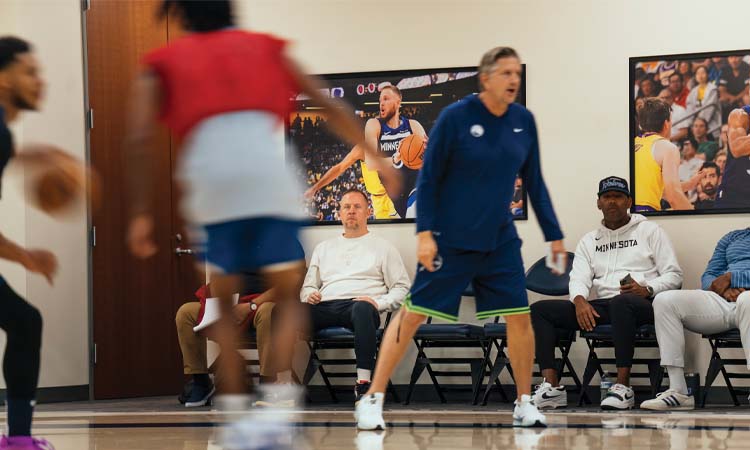
Finch has worked for a bunch of PBOs. “Some are guarded,” Finch says. “Some are opinionated. Some are paranoid.” Connelly’s approach is none of the above. “He’s not a process guy, he’s a people-driven guy. He fosters discussions where people can disagree. He is never stuck.” His approach is “‘If this doesn’t work, we’ll do something else.’”
From 2010-13 Connelly worked in New Orleans under Dell Demps, who ran basketball for the Hornets. Connelly brought Demps to Minneapolis to work alongside him in 2022. Demps says the PBO job’s greatest difficulty is the relentless pull of multiple constituencies.
“Time management is hard,” he says. “Owners, coaches, agents, media, sponsors, business side, medical staff, analytics, scouting. The demands are ever-increasing.” Demps describes Connelly’s style of leadership as “honesty, compassion, collaborating on a plan. He’s done a good job of establishing culture here because he’s such a people person.”
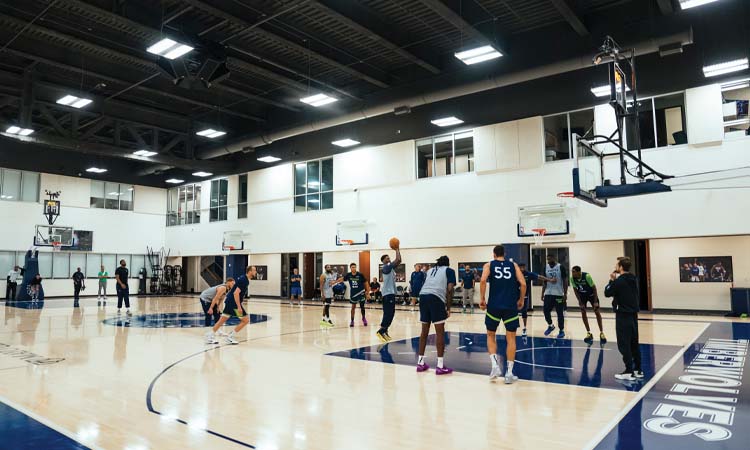
Mayo Clinic Square, the Wolves HQ and practice facility in downtown Minneapolis, is an informal place. Even Casson dresses in sweats. Nonetheless, the most notable surprise about Connelly is his relatability. Sit down with Connelly and there are no airs or formality. He speaks in a colloquial patois, maybe a trace of a Baltimore accent. He’s extroverted and an eager conversationalist.
Robson calls him “a glad-hander at heart. He was loath to leave Denver. He had good relationships; he cherishes them. If he’s gonna cut a player, he tries to find them their next job.” When Connelly broke the trade to Towns, he did it at Towns’ home late at night. Most execs would have phoned.
“Tim understands people. He is a great communicator,” Demps notes. “That helps get the max out of people. You’d be amazed for how many of our players his connection is more than business. It’s a friendship. It’s someone to confide in. Sometimes I’m in awe of how he’s able to do it. He’s able to connect with so many people and make them feel good.”
Mike Conley has played in three NBA organizations and for several basketball execs and says Connelly stands out. “He sees people as humans. It’s not so much of a business environment. He thinks about your family and kids,” Conley says. “A lot of [PBOs] try to toe the line-; it’s a work relationship. Tim invites you over for a bite to eat. He refers to business decisions as ‘the gross part of the game.’”
Legendary baseball manager Leo Durocher was oft quoted for his bromide “Nice guys finish last.” Connelly is the antithesis, but there’s more to Connelly than mere affability. He seems to have a sixth sense for talent. “He can project the value of a player. He can see what a player can become,” says Robson.
“He saw our talent,” recalls Finch. “He was bullish on Naz [Reid], and at the time Naz was playing 16 minutes a night behind KAT. We maybe thought that was his ceiling, but Tim saw beyond that.”
And Connelly likes risk. He gambled on the team’s future for Gobert, a player with a mixed reputation in the league, and then traded a player who was loved by fans. Many executives would have recoiled at such possibilities, but “you can’t be afraid at this level. He sees a window and takes a swing,” says Conley. (Note the popularity of the baseball analogy.)
Connelly credits many for his success. “I’ve been super-fortunate to learn from different people. I’ve done a lot of jobs in this business, so I appreciate everyone’s jobs and roles.
“My parents taught me not to take myself too seriously,” he continues. “I worked my way up, built relationships, observed what’s good, what isn’t. It’s osmosis in a way, when you can be around people like Wes Unseld and Dell Demps.”
Connelly feels fortunate to be part of a profession that’s so embraceable. “Two things bring people together: sports and food,” he says. “I love the people I’ve met. I’ve been all over the world for this game. It’s a beautiful game. It’s jazz, improvisation. It will always be a player’s game.”
“He’s not a process guy, he’s a people-driven guy. he fosters discussions where people can disagree. he is never stuck.”
—Wolves Coach Chris Finch
The Make-or-Break Year?
Last season was a game-changer for the Wolves in many respects. Though the Wolves often lost money on an operating basis, “playoff success has short-term benefit to the bottom line,” says Casson, “and it also feeds the future state of the business. We made $10 million worth of capital improvements [in the next offseason]. Success allows reinvestment.”
The Wolves were long regarded as a flyover franchise that could not attract or keep talented players. “This summer we were able to talk to [free agents who] wouldn’t talk to us two years ago,” says Connelly.
“We have the same business side and best practices,” notes Casson, “but on-court success changes everything.”
Not long after the Gobert trade, a new player agreement took effect that created strictures for teams over the league’s salary cap. “It contained really prohibitive restrictions on player movement,” says Connelly. “We wanted to keep the core together.”
So, in late summer, the Wolves traded Towns to the New York Knicks in a complicated transaction that the Wolves say was motivated by on-court priorities but also gives the Wolves greater flexibility to retain and re-sign their other players. Finch has estimated it will take the team up to 20 games to adjust to the revised roster, while the Western Conference continues to get stronger.
“Forty-six wins got you fourth seed two seasons ago,” explains Demps. “Last season, 10th.”
But the bigger uncertainty is who will own the team and what impact that will have on Connelly. Taylor nullified the team’s sale to Lore and Rodriguez in March, and an arbitration panel heard their dispute in November. An outcome is expected after Thanksgiving.
Connelly’s contract with the Wolves gave him an exit at the two-year mark, which was shifted last summer to the end of the current season. Connelly says he wants to be a part of the franchise long term (he lives here full time, as does his family) but clearly is awaiting a resolution of the ownership dispute to make long-term plans.
He would not address the situation directly, but he did say, “This community has been so gracious to us. It’s a great sports town: curious and smart. I just want to have fun and be a good teammate.”
If the Wolves can make another deep playoff run, Connelly will be a white-hot commodity—an NBA exec who built two champions. “He’d be a fool not to have that out clause,” Robson notes. “Connelly knows he’s on top of the world right now. He knows there is an ownership battle. He wants to keep his leverage.”
After all, there are other franchises whose fan bases groan under the weight of decades of disappointment, who pine for a transformative leader, where it isn’t 10 below at game time in January and the owner doesn’t have the team endlessly for sale.
In the NBA, nice guys sometimes finish first.
Winning Fixes Everything
2024-25 Season
- No. 1 in NBA for new season tickets sold
- Most season tickets sold since 1990
- Lower bowl sold out
- Premium seating sold out
2023-24 Season
- Top 5 in NBA in fan experience, based on fan surveys
- Top 5 in NBA in social engagement, per platform metrics
- TV ratings up 125%, ranked 2nd in NBA
- Largest streaming audience of all Bally Sports NBA teams
- Sold out all 41 home games for the first time since 1990
- Set franchise records for ticket sales, suite sales, sponsorships
- Retail sales up 186%
- 2023-24 Sports Business Journal Team of the Year finalist
- 2023-24 NBA Inclusion Leadership Award winner (for “Pack the Vote” initiative)