Will Gender Decide the 2024 Election’s Outcome?
“Dead Pantsuit Walking” is how one of my news sources referred to Hillary Clinton in 2008. It was a biting comment on the fact that Clinton, then a U.S. senator from New York, was losing the Democratic presidential primary competition to Barack Obama.
By 2016, Clinton’s monochromatic pantsuits were often brightly colored, and she had added substantial foreign policy experience to her resume after serving as President Obama’s secretary of state. Although she won the U.S. popular vote in 2016 as the Democratic presidential nominee, Donald Trump won enough electoral college votes to become the nation’s 45th president.
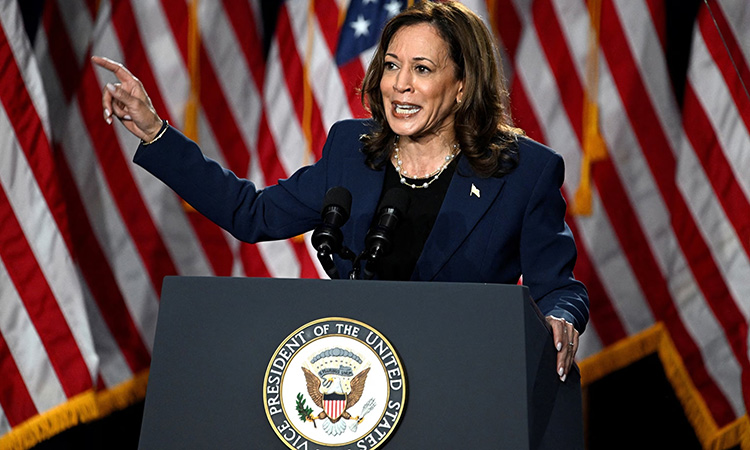
Another woman who favors pantsuits, Vice President Kamala Harris, is now under the public microscope of voters and journalists. She suddenly became the Democratic Party’s nominee for president after one of the nation’s most effective politicians, former House Speaker Nancy Pelosi, played the pivotal role in persuading President Biden to drop his low-energy reelection campaign.
Political reporters and voters don’t pay much attention to what male politicians wear. Yet for women candidates, their clothing, hairstyles, height, tone of voice, and personal relationships have generated considerable attention in recent election cycles.
When Sen. Elizabeth Warren sought the Democratic nomination for president in 2020, she was tagged with a “schoolmarm” label. It was a holdover characterization placed upon her in 2012, when the Harvard law professor was running for the U.S. Senate.
Writing in The Cut in 2020, Rhonda Garelick cited a column by George Will in which he described Warren as “a hectoring schoolmarm” and “grating.” Garelick maintains the frequent use of the term “schoolmarm” was intended to diminish Warren’s candidacy.
In the 2016 election cycle, Carly Fiorina, former CEO of Hewlett-Packard, was in a huge field of Republican candidates seeking the party’s presidential nomination. Then-candidate Trump decided to critique Fiorina’s appearance during an interview with Rolling Stone. “Look at that face!” Trump said, while watching her on television. “Would anyone vote for that? Can you imagine that, the face of our next president?”
Before Nikki Haley became Trump’s U.N. ambassador in 2017 and sought the Republican presidential nomination this year, she had to respond to affair allegations in South Carolina. In 2010, when Haley was running for governor, two men—a lobbyist and a political blogger—went public with accusations against Haley. One claimed he had a one-night stand with her, while the other said he had an “inappropriate physical relationship.” Politico reported that Haley pointed out the allegations only surfaced after she took a lead in the polls. She was elected governor in 2010 and reelected in 2014.
Earlier this year, I interviewed Debbie Walsh, director of the Center for American Women and Politics at Rutgers University in New Jersey, about why American voters have never elected a woman president.
“In large part, the presidency as an institution is an incredibly gendered institution,” Walsh said. Male presidential candidates, she noted, often try to project an image of “toughness and strongness” and emphasize their competency on handling economic issues and foreign policy.
“It’s not that women don’t have these skills, but the perception of them is that that’s not where their strength is,” Walsh said. Instead, she said, many voters view women as collaborative and associate them with lawmaking roles on domestic and family issues in Congress or state legislatures.
While American voters have never elected a woman to the top job in the federal government, Walsh said they are increasingly receptive to doing so in state government. Currently, 12 of the nation’s 50 governors are women, which is a record.
Democratic women are governors in Arizona, Kansas, Maine, Massachusetts, Michigan, New Mexico, New York and Oregon, while Republican women are governors in Alabama, Arkansas, Iowa and South Dakota.
Most presidential candidates are drawn from two talent pools—governorships and the U.S. Senate, where a record 25 women now serve.
Kamala Harris is only the second woman to win a major party presidential nomination. This year, she’ll win some general election votes because she’s a woman, and she’ll lose others because of her gender. But she isn’t emphasizing her gender or talking about breaking through the political glass ceiling. Instead, she’s campaigning on her leadership experience, core values, and policy positions.
In future elections, as more women governors and U.S. senators participate in presidential primaries, more voters will recognize that the presidency isn’t reserved for men. Most voters will simply assess candidates—men or women—based on their policy stands and their ability to lead the nation.