What Lessons Does the 1984 Election Hold for Minnesotans in 2024?
A few days before the Nov. 5 election, I was startled and amused by what I saw in a Roseville parking lot.
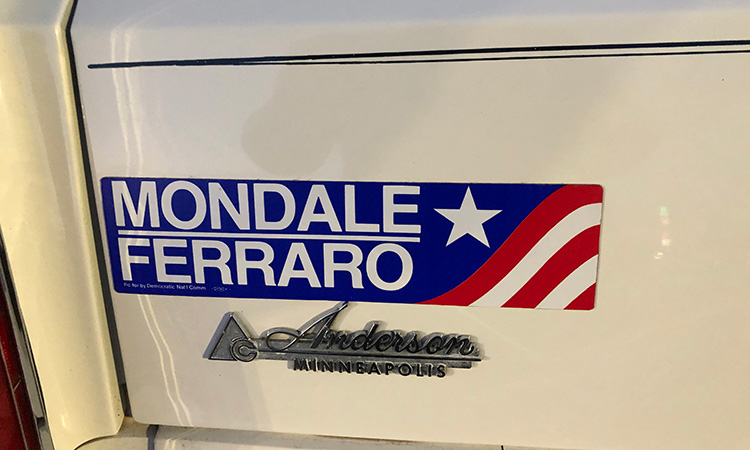
A white Cadillac Eldorado in mint condition bore a Mondale-Ferraro bumper sticker from the 1984 presidential election.
I needed to know more, so I asked the owner about the bumper sticker when he walked up to his car with a couple bags of groceries. As it turns out, the bumper sticker was in a box for decades. The car had been driven by a Minnesota businessman when he used it during winters he spent in Arizona. The car also has been in storage for part of its lifespan.
In the ensuing four decades since the bumper sticker was created, U.S. and Minnesota politics have grown more negative, expensive, and less fun.
In 1984, the average citizen didn’t stop talking to family members because of a partisan divide and most people didn’t wallow in politics for hours a day, which millions of Americans do today via social media, partisan radio and TV, and podcasts.
The “One Minnesota” that Gov. Tim Walz aspires to lead was much more a reality 40 years ago.
Here are aspects of 1984 that hold lessons for today’s citizens and politicians.
The Minnesota Legislature functions better when lawmakers aren’t divided into geographic silos. Following the 1984 election, DFL Gov. Rudy Perpich needed to craft a budget that would win support from a Democratic Senate and a Republican House. DFLers held a 42-25 advantage in the Senate, while Republicans in the House operated with a slim 69-65 majority.
In that era, DFL legislators were dominant on the Iron Range and held several seats in northwestern Minnesota, while Republicans occupied many of the seats in southern Minnesota. Both party caucuses had significant numbers of rural legislators, so both parties needed to understand and balance the interests of Hennepin and Ramsey counties, outer-ring suburbs, and rural areas.
Today, rural Minnesota is a sea of red served by Republicans, while the urban core is a deep blue where Democrats dominate in holding legislative seats. Citizens are best served when districts are competitive, voters are given two credible choices, and elected representatives and senators in every region of Minnesota come from both parties.
Democrats need to do a better job of addressing middle-class concerns and listening to working-class voters. U.S. Sen. Bernie Sanders, a Vermont independent, was criticized by some Democratic officials when he said the following. “It should come as no great surprise that a Democratic Party which has abandoned working-class people would find that the working class has abandoned them,” Sanders said in a written statement. “While the Democratic leadership defends the status quo, the American people are angry and want change. And they’re right.”
Food prices have increased 28% since 2019. While some Americans have received substantial boosts in pay during that time frame, other Americans haven’t been so fortunate. Many citizens are struggling to put food on the table, pay their electricity bills, and house their children.
On a national level, Vice President Kamala Harris was on the losing end of the presidential election, in large part because she lacked a clear and compelling economic message, and she was saddled with the unpopularity of the Biden administration. In an NBC News national poll conducted in September, 65% of registered voters surveyed said the country was on the “wrong track.”
“Democrats were once the party of the farm and then the factory floor,” Ron Elving, a senior editor for NPR, said the Saturday after the election. “Now they’re called the party of the faculty lounge. That’s how associated they’ve become with higher education and how distracted from what was once their bread and butter.”
If Democrats restrict their campaigns to the concerns of U.S. progressives and liberal elites on the East Coast and West Coast, then they won’t have winning coalitions.
While Minnesota reliably has voted for Democratic presidential candidates for decades, in 2024 Minnesota is closer to a purple state than a blue one. Harris, with Minnesota Gov. Walz as her running mate, got only 50.9% of the vote in the state. Democrats hold only a one-vote advantage in the Minnesota Senate, and Minnesota’s House is evenly divided. 2024 Minnesota voters elected four Democrats and four Republicans to the U.S. House.
It wasn’t an accident that in 1984 two of the most powerful Minnesota legislators were DFL lawmakers from northern Minnesota. Roger Moe, the Senate majority leader, was from northwest Minnesota, while Doug Johnson, the Senate tax committee chair, was from the Iron Range in northeast Minnesota.
In 1984, there was greater emphasis on the three prongs of the Democratic-Farmer-Labor Party in Minnesota. Voices of people who earned a living off the land—farming, mining, and tourism—had an easier time being heard.
Minnesota Republicans need to rediscover how to identify and support strong statewide candidates. In January, Gallup reported that 43% of U.S. adults consider themselves political independents, while 27% aligned with the Republicans and 27% considered themselves Democrats.
With that composition of the electorate, it stands to reason that in most elections voters would prefer to have two qualified candidates from both major parties who each come from the political mainstream.
Based on Minnesota voter choices in recent decades, there are a lot of independent voters who determine the outcome of statewide races. Minnesota voters have a history of choosing candidates who are center-left or center-right for statewide offices.
Since 1984, Minnesotans have been served by six governors: DFLers Rudy Perpich, Mark Dayton, and Tim Walz; Republicans Arne Carlson and Tim Pawlenty; and independent Jesse Ventura.
In 1984, Minnesota’s two U.S. senators were both Republicans and lawyers. Dave Durenberger had worked for a Republican governor as well as H.B. Fuller, while Rudy Boschwitz had gained name ID by appearing in TV ads for his Plywood Minnesota company. Durenberger was elected to three Senate terms and Boschwitz won two Senate elections.
In more recent years, Republicans often have failed to field statewide candidates who could appeal to a broad swath of Minnesota voters. A Republican candidate hasn’t been elected governor since 2006, when Pawlenty won his second term. In 2002, Norm Coleman was the last Republican to win a U.S. Senate seat from Minnesota.
So what should Republicans do to boost their chances of winning statewide?
Annette Meeks, a veteran Republican Party leader and CEO of the Freedom Foundation of Minnesota, outlined the best solution in an April commentary in the Star Tribune.
She advocated that Minnesota election law be changed to get rid of precinct caucuses. A subset of people who attend precinct caucuses end up as delegates to the Republican Party state convention, where the party frequently endorses candidates who excite party activists but hold limited appeal for the statewide electorate.
Meeks argued that statewide candidates should compete against each other in party primaries, where a vastly larger number of people could select the candidates.
“Precinct caucuses—in both the DFL and Republican parties—have turned into small, insular gatherings filled with hyperpartisan factions that aren’t nominating or attracting the most qualified candidates for some very important government offices,” Meeks wrote.
“A real political primary election generates interest, recruits volunteers, assists with name recognition and fundraising, but most important, allows anyone who wants to participate in our election process to do so,” Meeks wrote.
Former Minneapolis Mayor R.T. Rybak, who previously served as a vice chair of the Democratic National Committee, expressed his unhappiness with precinct caucuses in an April commentary in the Star Tribune.
“At a time when democracy is so threatened, it’s time to stop letting this flawed, outdated system of conventions and caucuses dictate who we get to vote for,” Rybak wrote.
“Parties won’t eliminate the current process that allows them to play an outsized role in who gets elected,” Rybak wrote. “It’s up to us to not be bound by decisions that take place when most of us aren’t in the room.”
Gov. Walz, who failed to win DFL endorsement in his first bid for governor in 2018, should add abolishment of precinct caucuses to his 2025 legislative priority list. Walz and his DFL governor predecessor, Mark Dayton, only qualified for the general election ballot by winning primaries.
Reforming the selection process for statewide candidates should increase the likelihood that both the Republicans and Democrats would nominate qualified, experienced and multi-issue candidates. That development would serve the interests of Republican, Democratic, and independent voters.