Twins Announce Leadership Transition
It was an open secret in the Twin Cities that longtime Minnesota Twins president/CEO Dave St. Peter was planning a gradual exit from the team he first joined back in 1990. Those plans were codified today with a surprising coda, that president, baseball operations Derek Falvey would replace St. Peter.
Surprising because rarely in pro sports does game-side leadership show an interest in or affinity for the business domain. Falvey came to the Twins in late 2016 from the Cleveland Indians with a reputation as a pitching development specialist. He spent his first few years in partnership with his chosen general manager, Thad Levine, modernizing and growing a baseball operation that was a generation behind in modern practices. Falvey was elevated to his current title in 2019. (Levine departed the team in October not long after the Pohlad family announced the team was for sale. He will be replaced by VP/assistant general manager Jeremy Zoll.)
St. Peter’s exit will be a long goodbye. He will transition to the role of special advisor in Q1 2025. His portfolio will the consist of: the renewal of Hennepin County’s ballpark tax that is sunsetting and sustains Target Field; the team’s broadcast and streaming transition from Bally’s to whatever is next; and the Pohlad family’s ownership transition. “I won’t have direct reports, so the structure of the business side will inevitably change,” he says.
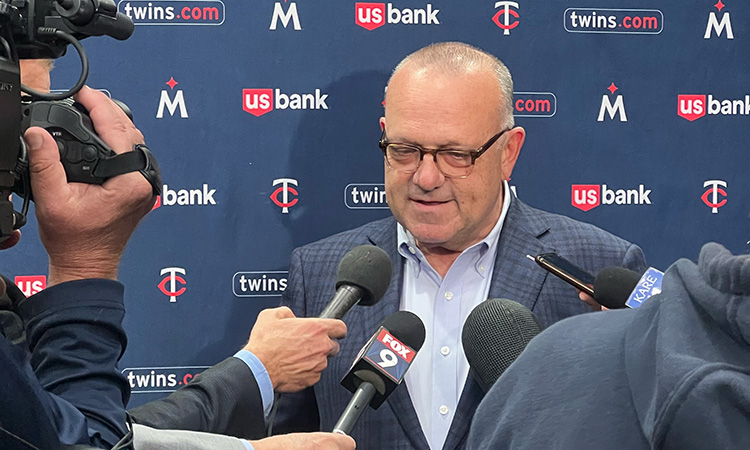
For his part, Falvey intends to lean on St. Peter’s expertise during the transition. “Dave is not going anywhere soon, so there’s lots of opportunity for us to talk about the work he’s done in the space,” Falvey told reporters gathered at Target Field on Tuesday afternoon. “I know that I can’t be everywhere all at once, so it’s about the team you have beneath you, just like at any job.”

To those surprised by the elevation of Falvey, St. Peter notes, “Derek is very dynamic, a smart, curious leader, someone capable of leading the organization.” St. Peter says he and ownership noted Falvey’s potential as early as when he interviewed in 2016. St. Peter adds that Falvey’s learning curve should not be too difficult.
“We have a single organizational structure; we don’t have a baseball/business divide. He’s had the opportunity to be exposed to business topics. There’s no decision he doesn’t have a voice in,” St. Peter says. “I’m proud of that partnership.”
St. Peter says Falvey’s elevation is not unprecedented in baseball, pointing to ex-Twins president Andy MacPhail who led both baseball and business sides for the Cubs, and Mark Shapiro, who currently wears both caps for the Blue Jays.
St. Peter says Falvey’s elevation was not rushed to secure a role before the ownership transition but was instead probably delayed by it. St. Peter says the organization has been focused on best practices succession planning, and that he’s known for a while he wanted a next act and would leave the organization while he still had time for that. “We recognize a new owner will have the clear right to do what they want to do, but we hope that when they look under the hood, they will like what they see.”
There has long been scuttlebutt in the baseball community that Joe Pohlad was planning to inherit St. Peter’s job, or at least a role with similar responsibilities, but if that was ever part of the plan it was scuttled by the family’s decision to sell the team.
St. Peter, 57, emphasizes he’s “not retiring. I’m open to what comes next, a new opportunity to deploy my skills. I love the Twins; I’ve loved every single day here. But I’m desiring to get some time back to invest in things like relationships. I hope I’m leaving a year or two too early.”
The Twins CEO role oversees an organization of approximately 350 people. St. Peter says he understands they are all working with some level of uncertainty given the potential length of the ownership transition, but “I’m hopeful that today’s news gives people something to hold onto.”
Digital editor Dan Niepow contributed to this report.