The Meter: Did Minnesotans Really Resign En Masse?
When the phrase “great resignation” was coined early in the pandemic, it might have created expectations of a massive exodus of workers to new employers, retirement, or a hiatus from employment.
At the Minnesota Department of Employment and Economic Development (DEED), senior research analyst Alessia Leibert took a deep dive into the data to figure out what really happened.
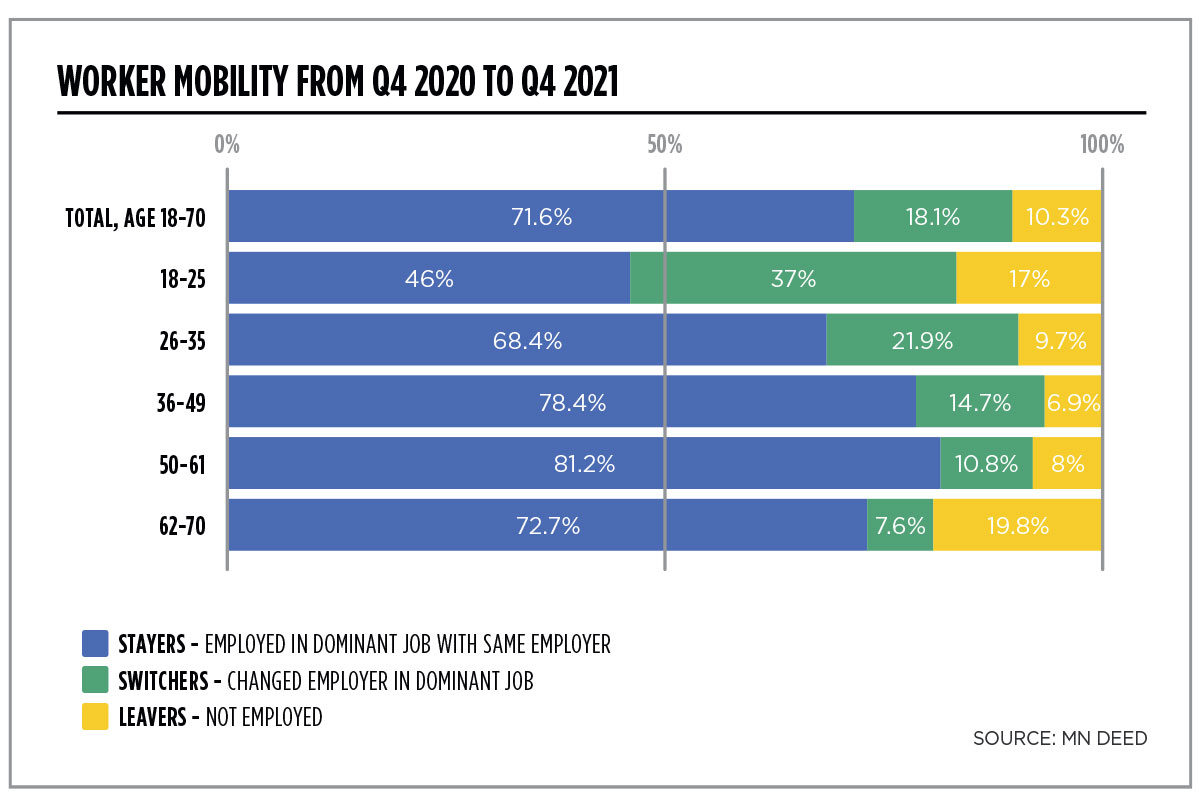
In a tight labor market, the data shows that the vast majority of Minnesotans actually chose to stay with their current employers. When comparing the fourth quarter of 2020 to the final quarter of 2021, 71.6% of workers remained with their employers.
About one in five jumped to new employers during that period, and about 1 in 10 left the labor market. People in the youngest demographic, ages 18 to 25, were much more likely to switch employers.
“Inflationary pressures can further contribute to an increase in mobility.”
—Alessia Leibert, senior research analyst, Minnesota Department of Employment and Economic Development
“The post-Covid labor market in Minnesota is characterized by historically high levels of demand for workers and low unemployment, generating the perfect conditions for workers to change employers,” Leibert wrote in a recent DEED report. “Inflationary pressures can further contribute to an increase in mobility if workers feel that the only way of beating inflation is to leave their current employer and move to a higher-paying job.”
Worker mobility data comparing late 2020 to late 2021 showed the Minnesotans least likely to leave their employers work in government, education, or at a firm’s headquarters.
Read more from this issue

In some industries, one-fourth or more of the employees switched employers over a 12-month period. Those are retail (26%); nursing, residential care facilities, and home health services (30%); accommodation and food services (33%); and temporary help (53%).