The Media Mouse Surviving the Big Tech Meteor
For those of us who work in print publishing, it can feel as if the end is near. And it may well be. The internet is an unruly ground for content sharing, and social media algorithms are poised to continue replacing human news editors. Consumers largely want information for free, creating a particular challenge for companies in the business of information.
Despite all of this, one Minnesota company has mostly managed to avoid fallout from the likes of Big Tech and Google. With wide-reaching global connections and a deep history with publishers in the global East dating back to the fall of the Soviet Union, Minnetonka-based East View Companies has maintained small but steady growth over the years.
“If mainstream media were Tyrannosaurus and Brontosaurus when this big asteroid of Big Tech hit, we turned out to be the little mice in the crevasses and gophers down in holes,” East View co-founder Kent Lee said in an interview with TCB. “It’s like we came back up from our hole one day and the dinosaurs were all dead, but we’re still here.”
With most of its content coming directly from the global East, the company has secured a niche that often works under the radar of most Western eyes. The company maintains a solid customer base of academic institutions, government organizations, corporations, public and federal libraries, and law firms. “The vast majority of our information is acquired and served up in its native forms, which condemns us to obscurity,” Lee joked.
But the company has come back into the spotlight in recent months. In December, East View received a trade award from Gov. Tim Walz. In February, its map branch, East View Map Link, acquired Benchmark Maps, a map publisher known for its detailed recreation of atlases and maps of the American West and beyond.
One of East View’s mottos: “supplying uncommon information from extraordinary places.”
“The oxygen that’s kind of killing the T-Rexes, or changing them, doesn’t affect us that much and, to be honest, sometimes they’re rotting corpses give food to our biggest databases,” Lee said. “Our biggest products are our dead newspapers.”
Bringing Eastern views to the West
Founded by Lee and his partner Dima Frangulov in 1989, East View launched after a series of kismet meetings between the two men. Frangulov, a translator and Soviet military specialist, was born in Georgia when the country was under Soviet Union rule. But he was working in New York when he first met Lee and had spent time studying “the evil Americans.” Lee, born in Minnesota, had studied “the evil Soviets.”
At the very beginning of the company, its product line was limited to what Lee and Frangulov were already familiar with: “We knew about foreign policy and public policy and security studies,” Lee said.

East View’s first product was a complete collection was Voennaia Mysl’, a long-running military journal. The company’s first customers were Columbia University and the U.S. Army’s Foreign Military Studies Office, both of which bought copies of the entire Voennaia Mysl’ collection. From there, the company began selling journals to more universities and quickly decided to expand past military journals. Meanwhile, new newspapers and free press were emerging in former Soviet rule states. “Editors and journalists began to smell the sweet smell of freedom in the air,” Frangulov said in a company documentary titled “East Side Story.”
The company would eventually expand into publications addressing science, technology, agriculture, social sciences, humanities, and more. But East View’s first goal was to share information that came directly from countries in their native languages.
“This is the East view. These are the local authoritative newspapers, journals, books–later on, databases, later on, maps, later on, scientific publications–and it comes right out of these native societies in their native languages,” Lee said. The biggest challenge for people people who are not Russian or Chinese seeking information from Russian and Chinese sources is simply that those sources are not in their language, Kent noted. “You have this linguistic block.”
Now East View has a staff that can speak a large range of languages, including Arabic, Chinese, English, French, German, Japanese, Korean, Polish, Portuguese, Russian, Spanish, Swahili, Ukrainian, and Yoruba. East View planted its headquarters in Minnesota in 1990 but also operates offices in Moscow, Kyiv, Nairobi, Beijing, and Hong Kong. The company’s services range from helping librarians select books for their collection to building entire databases. The company works with publishers to digitize content. As technology has evolved, it has become easier to add English translations to databases as well.
Frangulov emphasized that East View is not in the business of producing content. It’s in the business of providing access to diverse content and voices by preserving and making existing content available from around the world. As conflict in these Eastern countries rises, East View remains steadfast in its mission to obtain and preserve information. Recent sanctions have only minimally impacted East View, Frangulov said. For example, Canada has issued some specific sanctions policies against certain newspapers. As a supplier, these sanctions require East View to inform its customers of these sanctions. It’s up to each library to decide if they still would like to receive the paper.
“We’re trying to bring variability to academics and researchers,” he said. “We’re trying to show many different facets of newspapers or news from a country. From Russia or Ukraine, we can show the government publications as well as its opposition so that readers themselves can choose and can compare different views on the same subject.”
Looking to the future, Frangulov said he’s been dabbling with artificial intelligence to translate major Russian newspapers into English. For now, this is just a pilot project. “It allows us to broaden the audience of people who use our services.”
A translator by trade, Frangulov can evaluate the accuracy of AI translation. Poetry and fiction still present challenges for AI translators, he noted. But scientific journals can be accurately translated with the technology, he said.
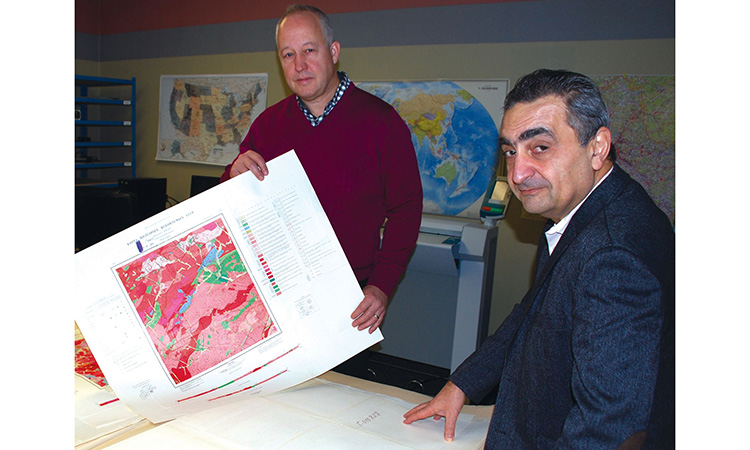
Meanwhile, the company’s recent acquisition of Benchmark Maps marks further growth in another niche field. Maps were not a part of the East View product line when it launched 35 years ago. But through the company’s connections to people in the former Soviet Union, East View had unique access to research done by the former Soviet Union that had largely been a secret before its fall, Lee said. This included comprehensive mapping.
“Our work is deeply international since we started out with product lines based on the massive worldwide creations of the Soviet military,” Lee said during a panel discussion held last month by East-West Connections, a Minnesota-based nonprofit aimed at building understanding between citizens in the U.S., Russia, and former Soviet republics. “During the Cold War, the Soviets created not only more maps, but arguably the best quality topographic maps on the planet, even of Twin Cities and Duluth. They’re both historically fascinating and still useful in numerous ways. But long story short, our global activity with Soviet military mapping exposed us to hundreds of local publishers around the world, as we sought to stay on top of the global geospatial phenomenon.”
Maps became a product line for East View in the mid-1990s. “It became such a pronounced product line, which had quite different customers than our traditional academic libraries.” The maps were used by companies building cell phone networks in Africa, mining in Mongolia, or even by organizations trying to learn more about the ocean or the North and South Pole.
Moving forward in publishing has proved a daunting task to many, but East View has maintained a strong footing. Lee and Frangulov remain hopeful about the future and remain dedicated to preserving and archiving information from across the world.
There will always be an academic audience interested in history and global perspectives, Lee said.
“With the world wide web you can be seduced into thinking that, actually, I don’t need any more information. It’s all right here. But it’s not. It’s actually not,” he said. “It’s like you just got fed macaroni and cheese every day and didn’t think that there was anything any different–a tragedy. You would miss out on so many good foods.”