The Growing Health Care Workforce Crisis
From the workers on a hospital floor to the patients those workers are treating, the state of Minnesota’s dwindling health care workforce is felt by all.
Stories from workers from across the health care sector demonstrate the impact of this shortage plainly. Clara Reed, a 26-year-old registered nurse, recalls the days she left work and sobbed in her car. On those days, “I had either too many patients, or my patients were too sick for the amount of patients I had. I just wasn’t able to give them everything that I knew that they needed,” she says.
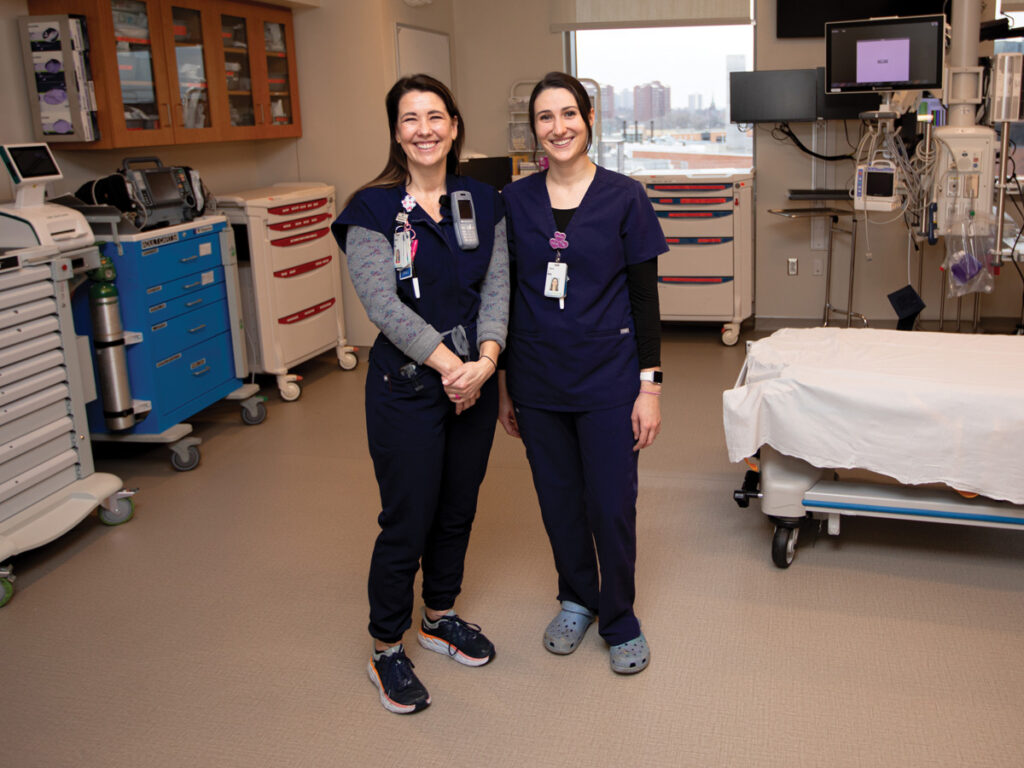
Reed is among the newest generation in Minnesota’s health care workforce. She began her career at Abbott Northwestern Hospital in Minneapolis in 2019 and works in all three of Abbott’s ICUs, the ER, and on the hospital’s rapid response team. Over the past four years, she has seen many colleagues leave the profession.
Though Reed stayed, her experience encapsulates the catch-22 those working to solve health care worker shortages grapple with. Workers in an understaffed environment do not have the resources and capacity to reduce their workload, often making it impossible for them to provide the standard of care they strive for. This has driven many to quit. Chronic or worsening shortages make these conditions worse, so more leave.
“You feel so alone, especially in your first couple years of practice. You always wonder, is everyone else going through this? Is everyone else having a hard time? Is anyone else getting bullied at work or feeling so overwhelmed by the end of the day?”
—Clara Reed, RN
Reed helps run a peer support group that meets with new workers at six weeks, three months, six months, and nine months into the job, where they discuss professional development, healthy work environments, and ways to develop resiliency.
“You feel so alone, especially in your first couple years of practice,” she says. “You always wonder, is everyone else going through this? Is everyone else having a hard time? Is anyone else getting bullied at work or feeling so overwhelmed by the end of the day?”
Alarming metrics
The state’s health care workforce is in a state of extreme flux. Reed is among a new generation of workers who stayed as many others left. While Covid expedited the hemorrhaging of workers from health care fields, shortages existed before the pandemic and have long been anticipated. Contributing factors include the state of the economy, burnout, and a generational shift as the baby boomer population ages.
These factors affect all levels of the health care ecosystem across the state and regions, from general care workers to specialized medical professionals, according to a December report by the Minnesota Department of Employment and Economic Development (DEED).
The overall supply of those licensed to be health care providers has steadily increased over the last decade, including during Covid years. But this rise in licensed pros is offset by a drop in the number of employees working in patient care. A DEED survey, for example, showed 92% of all physicians reported working in a position that involved patient care in 2019. By 2023 that number was down to 84%, a difference of roughly 2,000 physicians statewide.
This loss of younger qualified workers is a problem that snowballs. As Janette Dill, associate professor in the School of Public Health at the University of Minnesota explains, “If a worker who is inexperienced, hasn’t been out of their training for too long, and they go into a workplace that is overloaded and doesn’t have proper resources—where they’re caring for too many patients and have these grinding workloads—they’re going to quit, right?”
Doctors and registered nurses aren’t the only ones who face this situation, Dill notes. Much of her research revolves around direct care workers, which include nursing assistants, home health aides, and home health workers. These workers make up the largest occupational group in Minnesota, with 8% of the state’s workers working as an aide or an assistant.
According to data evaluated by DEED, 124 new physician assistants entered the Minnesota workforce in 2022. But between job growth and turnover in the state’s health care system, an estimated 244 new PAs are needed annually from 2020 to 2030.
A limited number of slots, plus obstacles to education and certification make the situation worse, Dill says. In the future, she sees a need to further bolster two-year technical schools and other forms of education to help break down barriers for students who might not have the money and resources to attend a four-year college. She also advocates for loan repayment programs.
So what are the chances this workforce crisis will resolve itself? “I just keep thinking it depends on what happens in the economy. Right now, we still are in this place of burnout and shortage,” Dill says. “But I have a feeling if the economy takes a turn for the worse, a lot of these issues will go away” because, in health care, more prospective practitioners enter the workforce during hard times than boom times. She notes the rise in those seeking education and reentering their field following the Great Recession.
Read more from this issue

When the economy is strong, workers can find jobs elsewhere that might be less grueling with more consistent hours, she notes. But when the economy is in a downturn, people return to health care because it is considered a stable job. It’s an industry that never faces obsolescence.
More jobs staying open
This past year, worker vacancy rates across the state’s health care institutions were around 17%, says Joe Schindler, vice president of finance policy for the Minnesota Hospital Association. This was the second year in a row these rates were “well beyond what hospitals have ever seen in a normal year.”
For many years before 2023, more Minnesota health care workers left the workforce than entered it, according to data compiled by the Minnesota Hospital Association. While 2023 marked the first year this wasn’t the case, sheer numbers don’t capture the whole picture. The majority of exits in 2023 were full-time workers, while many entering health care jobs were part-time hires. Meanwhile, demands on the system have hit record highs.
In recent years, particularly throughout the onset of Covid, hospitals resorted to hiring more expensive contract health care workers, Schindler says, but institutions are trying to move away from that to cut costs. “In 2023, hospitals have worked very diligently to try and reduce their exposure to contract staffing because the costs are three to four times what they would pay an employee.” Schindler notes that 50% of hospital overhead goes to salaries and benefits.
These factors mean that two different Minnesota stories are unfolding: one rural and one urban. Only about 7% of the entire licensed health care workforce practices in small towns and rural communities, even though approximately 15% of Minnesotans live in those areas, according to DEED.
“Two-thirds of our hospitals are losing money and have for the last couple of years here, so there’s a real concern about whether some of our more remote hospitals may close down certain services, or even close altogether,” Schindler says. If this happens, the hospitals that remain will face even more pressure to take on patients from farther away.
Chris Rubesch, president of the Minnesota Nurses Association and a registered nurse at Essentia Health St. Mary’s Medical Center in Duluth, has firsthand experience with rural health care needs. As a Level I trauma center, one of only a few in the state, St. Mary’s accepts patients not just from the surrounding Arrowhead region, but from upper Michigan to Fargo. “There is a huge demand on that resource,” Rubesch says.
As these demands rise, and time available for patient care shrinks, Rubesch says families often take on the job of caretaker for their loved one—often without sufficient training or time to adequately provide this care.
This adds another burden for providers—to educate “civilians,” Rubesch notes. He recalls needing to teach families about warfarin levels (a commonly used blood thinner), important dietary information, or how to administer shots at home. “It’s hard as a nurse when I have increasing demands on my time at work and I have less and less time to sit with families to make sure they are set up for success when their loved one goes home,” he says.
Rubesch is part of what many call the “sandwich generation”—people who are caring for both aging parents and young children. His role as a health care provider doesn’t stop when he leaves work.
Moving forward, Rubesch wants prospective workers to know that health care is a lucrative career with many opportunities for growth. As a union officer, he thinks that organizing is the key to stabilizing the health care workforce. In October, hundreds of Allina doctors voted to unionize under Doctors Council SEIU Local 10MD. A group of advanced providers, mostly nurse practitioners and physician’s assistants, recently filed a petition to unionize with the Minnesota Nurses Association. This is a pivotal step in ensuring the stability and longevity of both the current and incoming workforce, Rubesch believes.
Moral injury
In 2020, Jennifer Michelson, a career nurse, experienced the challenges from a new perspective when she became a patient. As she prepared for a double mastectomy, she learned that the hospital wanted to send her home the same day as the procedure.
Michelson, who was 60 at the time, knew she would likely need to stay overnight. According to a report by University of Michigan Medicine, post-mastectomy pain can be similar to that experienced after a limb amputation.
Michelson needed pain control to prevent nausea and an IV to stay hydrated in the hours that followed her surgery. “Being a nurse, I knew the language to help me stay in the hospital overnight. … They were saying, ‘We don’t have enough beds, so we will just send you home the same day.’ But I was able to stay. I needed to,” Michelson says.
She retired from United Hospital in St. Paul in 2023, two years earlier than planned. “It was not acceptable, the kind of patient care that [hospitals] were providing because we were so short-staffed.”
Michelson suggests that “burnout” does not sufficiently describe health care workers’ current challenges. The term doesn’t cover the gravity of what many frontline workers are facing, such as “moral injury,” a term used by organizations like the National Nurses Association, the National Institute for Health, and the National Center for PTSD. Moral injury occurs when people violate or witness the violation of deeply held values.
She talks about moments when health care workers are forced to send a patient home before they are ready, times when there aren’t enough beds or workers to care for them, or situations where there isn’t time or capacity for a health care worker to provide the standard of care a patient needs. “At some point, you say enough is enough. I can’t maintain my concept of what a good nurse is and what a good person is if I keep breaking my boundaries and standards just to maintain.”
Health Care Priorities
We asked local industry leaders what they consider the biggest challenge in health care today and how to address it.

“The biggest challenge in health care is that we’re not getting anywhere near the return on investment we should be for what we spend. We pay a lot for care but really need better health. We must get upstream. The response to this challenge has to be rooted in innovation. It is required in every facet of health and health care, from helping patients prevent disease long before it starts, to eliminating waste and rework, to dramatically improving the experience of care while lowering total cost.”

“A healthy, sustainable workforce is foundational to providing high-quality access to care, and as a health care organization we must create a culture that supports our employees across our system. At Allina Health, we are focusing on talent development and engagement to redesign the work, so our teams have the confidence and tools to begin their career. We are also connecting with employees to co-create solutions that allow them to achieve the deserved work-life balance needed for a lengthy career.”

“The costs of health care continue to rise at alarming rates. In my career as a nurse and respiratory therapist, I saw how much good the health system provides to people every day. It’s why I never want to see cost as a barrier to people getting the care they need. We need to continue exploring different payment models that can keep health care affordable, accessible, and sustainable.”