Signs of the Times
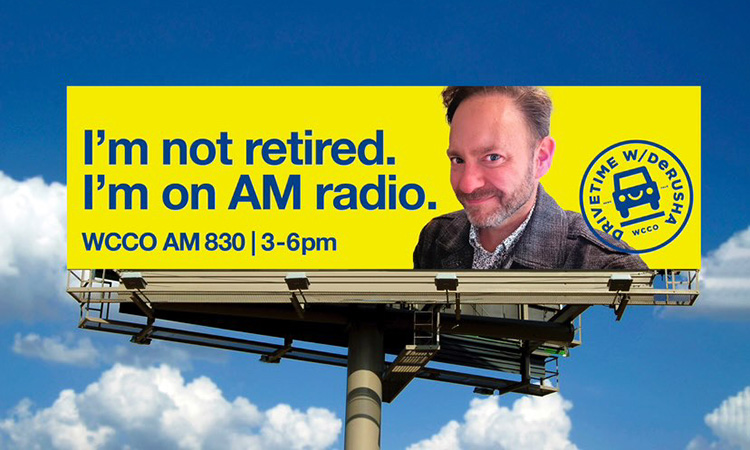
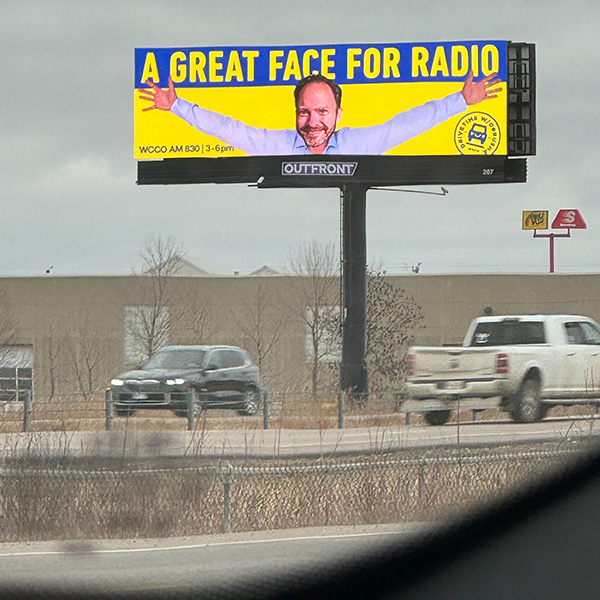
I can’t remember if I saw Jason DeRusha’s billboard on the freeway or on X, but the first thing that struck me was it didn’t have the normal branding and iconography you would find on an ad placed by WCCO Radio. But I was intrigued that the station chose to put rare marketing dollars behind its PM drive host, now in year two of his stewardship of the time slot.
When I heard last week that the billboards were in fact bought by DeRusha, the branding suddenly made sense. In decades of covering media business in this town I could not generate another example of such an act. Admittedly, local radio does a lot less advertising than back in the day. Many of us remember when KQ92 owned the sides of buses all over town, when morning drive radio advertised on TV and newspapers. Yet billboards were most common.
Today, the only local radio group that buys much media advertising is St. Paul-based Hubbard, which programs adult contemporary music format KS95, MyTalk (FM 107), and AM 1500 (ESPN sports).
One of the reasons radio buys less advertising is its stations are smaller economic engines than in previous eras, and another is how marketing has been sliced and diced since the advent of the internet and social media. Another is the prodigious debt loads most large radio companies carried in recent years. National concerns Cumulus Media, iHeartMedia, and Audacy Inc. (WCCO’s owner) control the bulk of the signals in town. All have been in bankruptcy (Audacy filed on Jan. 7) or teetered on the brink of it for parts of the last decade. When cash flow is a problem at HQ, local paid marketing becomes a luxury.
DeRusha says he was feeling adrift after leaving morning TV news two summers ago: “I think there are a fair number of people who don’t know what happened to me,” DeRusha said in an interview. “They ask, ‘How’s retirement treating ya’? In all seriousness.”
DeRusha’s not accustomed to marketing, mind you. “I’ve worked in local media for 20 years and other than one billboard from ‘CCO-TV, not a cent has been spent on marketing me.”
He believed a billboard reminding people that he hadn’t retired was good business. He began discussing it on-air in December, he says, and decided to take a flyer on it: “I called Clear Channel Outdoor [one of the two large billboard operators in town]. I wanted one billboard, to see if it builds any buzz, social media, [traditional] media.”
Clear Channel worked DeRusha like a traditional ad buyer, with multiple video calls and strategy conversations. DeRusha complained about the tediousness of the process on-air and a rep from Outfront Media, the other local billboard concern, messaged him on Linkedin, offering a streamlined effort.
A traditional billboard requires making a canvas wrap with added expense, so DeRusha decided on digital boards that rotate among different advertisers. A friend with branding agency Little helped mock-up 10 prototypes. Three made the cut. One contained DeRusha’s face overlaid on realtor Kris Lindahl’s trademark outstretched arms. Lindahl, a one-time sponsor of DeRusha’s show, found the bit humorous and agreed to license the image to DeRusha at no charge. Lindahl even offered to donate some spare billboard time his firm had bought.
DeRusha himself purchased one board, facing cars headed downtown on I-35W in northeast Minneapolis. It had the disadvantage of not being visible to PM drive commuters. He would not say what he paid for the board other than Outfront offered him a substantial discount because January is slow and in recognition that he was not a corporate client. “It was a negotiation,” he notes.
Now perhaps you’re asking why WCCO didn’t pay for the boards, after all, DeRusha is the station’s newest talent, its hot property. “It’s not that the station is not willing to spend money on advertising,” explains Brad Lane, ‘CCO’s program director, “it’s that we don’t usually do it around one personality. It’s about a promotion or morning drive.”
Lane says DeRusha consulted him about the billboard, and he applauds his initiative. Lane notes that WCCO is planning an outdoor campaign for later in the year. “We tell our clients you need to advertise, and we believe in the value wholeheartedly.”
DeRusha appreciates the nuance. “I can’t very well expect them to buy me billboards if they’re not buying them for Chad [Hartman] or Vineeta [Sawkar],” he says.
The boards are currently scheduled to be up for just a few more days. How will DeRusha judge their efficacy? If his ratings rise notably following the campaign. “Then I would absolutely do it again.”
And DeRusha rejects the idea the effort is little more than an ego trip. “I’m sending a message to my advertisers that I’m committed to building my show and audience,” DeRusha says. “I’m trying to get a return for them. There’s power in that message.”