Putting Down Roots in a Neighborhood With Potential
The Root District could be the next hot Minneapolis neighborhood you never knew existed. Best known for the Minneapolis Farmers Market, the area just west of downtown is dominated by warehouses and industrial lots.
But the area could be poised for a boom when it gets a stop on the Green Line of the Minneapolis light rail, scheduled to be completed by 2023. Jackson Schwartz saw the potential back in 2016, and he’s spent much of the pandemic prepping for the expansion of his own business and the surrounding neighborhood.
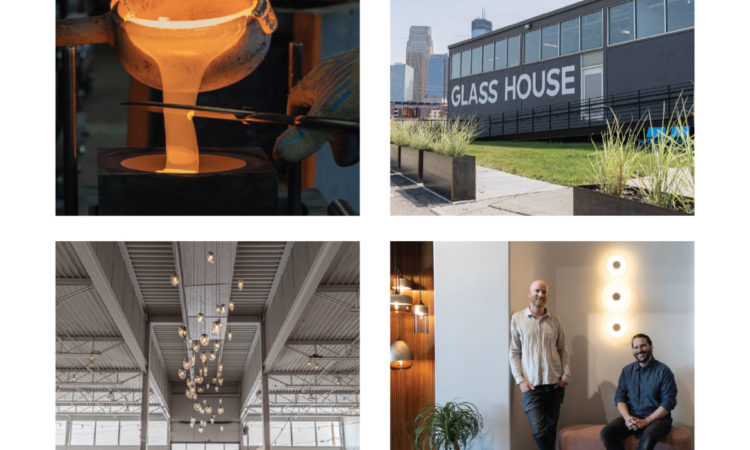
Schwartz owns Hennepin Made, a glass lighting company that started out in 2011 in Northeast Minneapolis. When the company outgrew its first space, Schwartz and co-founder Joe Limpert moved Hennepin Made to its current Root District location just around the corner from the Minneapolis Farmers Market. The 30,000-square-foot building opened in 1954 as a glass manufacturing facility. Hennepin Made is its third glass-company tenant—and the first to turn it into a neighborhood draw.
In 2018, months before the light rail funding was approved, Schwartz turned the front of his building into a café called Parallel. After the café opened, he began receiving requests to hold events in the adjacent room, a trendy, light-washed space that became The Holden Room.
Last year, Schwartz turned a room off the café into a lighting showroom, which can double as a second events space. He’s also adding an artist-in-residence program. The first resident artists are members of The Bureau—a Black collective and multidisciplinary creative media and design studio born after George Floyd was killed in May 2020; they are expected to host a number of installations and events in the space.
This fall, Schwartz rebranded the entire facility—manufacturing, café, event venue, artistic programming—as Glass House.
In November, Glass House will launch a weekly Sunday afternoon market, called Holden Street Market @ Glass House.
“It’s not going to be another farmers market or a craft market,” Schwartz says. “Imagine a more cosmopolitan vibe.” Expect music, art installations, prepared foods, a bar, and an open café, he adds.
Read more from this issue
He plans to start with roughly 50 vendors and wants them to settle in. “The goal would be that we get the audience built so that on Sundays, [vendors] know when they come here, they’ll make money.”
Schwartz intends to help by adding an incubator program to support vendor growth, and he hopes to establish partnerships with local organizations and businesses in order to do so.
Schwartz is also working with the Minneapolis Downtown Council (MDC) and is a co-convener of Partners, the council’s economic development organization for the west side of downtown.
Dan Collison, executive director of Partners and director of downtown partnerships for the MDC, believes Glass House is a perfect example of positive redevelopment for the area.
“Glass House’s role has been and will continue to be [serving as] a leading presence in the Root District,” Collison says. “They model inclusive hospitality, commerce, and artistic innovation. The many uses and programs within the Glass House building are meaningful in their own right. And, beyond that scope, Glass House continues to do outreach and activations. It’s definitely a hub in the district.”