Niron Magnetics Kicks Off Minnesota Expansion Plans
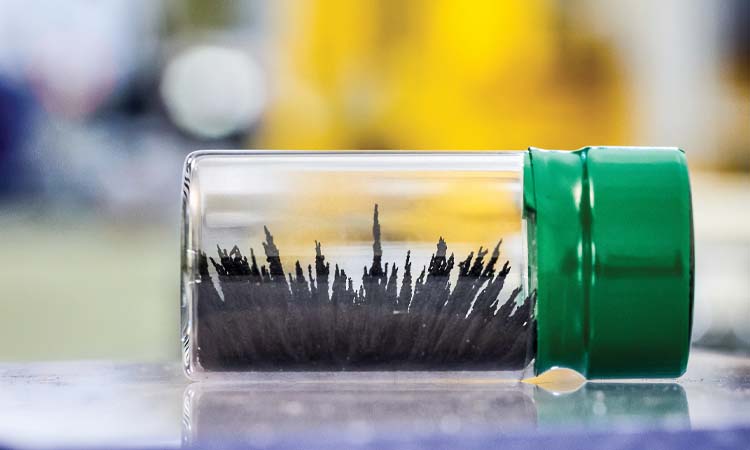
After 10 years of product development and fundraising, Niron Magnetics appears ready to kick into overdrive. The startup, launched in 2014 by University of Minnesota electrical engineering professor Jian-Ping Wang, has been working on developing permanent magnets, which are used in disk drives, industrial motors, refrigerators, audio equipment, and automobile components such as fuel pumps.
They’re also crucial components in electric vehicles. What has made Niron’s magnet technology attractive to investors is that they’re made from iron nitride, which is derived from readily available iron oxide (also known as rust). Currently, permanent magnets are made from rare earths, a family of metals whose production is dominated by China and typically generates huge amounts of toxic waste—thus Niron’s name for its technology: the Clean Earth Magnet.
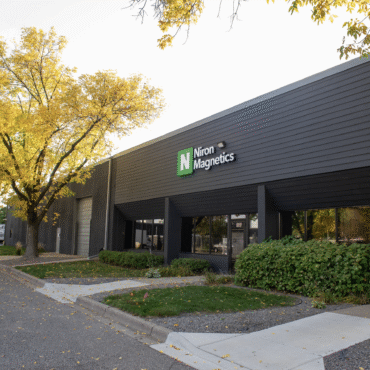
Last week, Niron cut the ribbon on a pilot manufacturing plant adjacent to its Northeast Minneapolis headquarters. Now, with the pilot plant’s opening, “we’re commercializing and scaling our technology,” says Jonathan Rowntree, who’s been Niron’s CEO since January 2023. The facility’s goal, he adds, is to produce magnets for client qualification trials leading to sales agreements covering Niron’s production capacity.
Since its founding a decade ago, Niron has received $109.6 million in funding from sources including the U.S. Department of Energy. Automakers GM, Volvo, and Stellantis, which are likely to be future customers, also have chipped in millions, helping Niron accelerate commercial development of Clean Earth Magnet technology.
Over the next 10 years, the number of magnets needed for things like electric vehicles, industrial motors, refrigerators, audio equipment, and automobile components will triple.
With the opening of the pilot plant, “we’re de-risking the scaling up of the technology,” Rowntree says. “We’re going from the lab to much more commercially available pieces of equipment. But the key thing for us is to produce enough magnets of the right size and shape that they go into end applications.” The customer can then test “fit, form, and function of our technology in their application and prove that it works.” Customers can also test the reliability of these magnets in their products.
Rowntree says he can’t name purchasing companies just yet, though he does describe them as “professional audio, automotive audio, and high-end consumer audio” companies. He expects that these audio customers will be the source of Niron’s first commercial sales, which he says will begin next year.
That’s not the only plan Niron has for 2025. According to Rowntree, the company plans to break ground on what he calls Plant 1, a large manufacturing facility that will allow Niron to ramp up production not only for its audio customers but also those in other industries, notably automotive.
Read more from this issue

Earlier this month, the Sartell City Council announced that it signed a purchase agreement with Niron for 79 acres of public land for the new plant. “We want our team to have the ability to drive to that facility,” Rowntree says. “We really would like to continue to expand here in Minnesota.”
Rowntree expects the Sartell plant to employ several hundred people (currently, Niron has close to 90 employees). The construction costs will likely be in the hundreds of millions of dollars, he adds. The company hopes to bring the plant online in 2026. Niron is applying for state and federal grants to help finance it.
“We really would like to continue to expand here in Minnesota.”
—Jonathan Rowntree, CEO, Niron
One of the selling points for those grants could be the fact that most of the materials Niron is using to make permanent magnets are available in Minnesota and nearby. These include nitrogen and hydrogen industrial gases and input materials, such as iron salts (which also are used in water treatment). “One of the great things about our technology is that it’s based on iron and nitrogen,” Rowntree says, materials readily available in the Midwest.
“Over the next 10 years, the number of magnets needed will triple, but there aren’t enough rare earths” to meet that need, Rowntree says. What’s more, “rare earths are environmentally very damaging.” Niron believes it has developed a technology that can overcome these challenges. “We’re proud to have done that in Minnesota,” Rowntree says. “And we want to scale this business here.”