 What’s this?
Next-Gen Healers: St. Kate’s Sets the Gold Standard with Simulation Education
When it was time for nursing student Jamie Kiefert to start her first clinical rotation, she felt prepared to hit the ground running. Extensive simulation-based training woven into her program at St. Catherine University provided many opportunities to practice skills, ensuring that she felt confident and ready to care for patients.
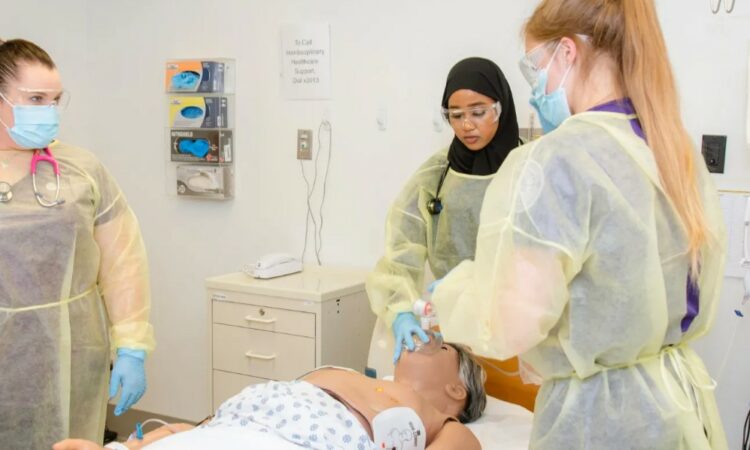
From developing aptitude in areas like dispensing medication and caring for wounds, St. Kate’s students start their hands-on clinical training with an advantage. They have already practiced these abilities individually, in pairs, and in interdisciplinary teams—engaging live patients and responsive mannequins before stepping into the field.
“When you go into live clinical experiences, we’ve had so many of those experiences in simulation that it’s really prepared us very well,” says Kiefert, who graduates this December. Having access to rigorous simulation-based education has been vital as she starts her first nursing job. “I was able to jump right into the clinical experience because I have these baseline skills and could quickly go to the next level.”
Simulation-based health care education has long been a tradition at St. Kate’s, which was among its earliest adopters. For nearly 20 years the university has provided simulation experiences to train students for diverse health science careers, says Krista Anderson, simulation director of its Institute of Simulation and Interprofessional Learning.
Expanding Real World Realism
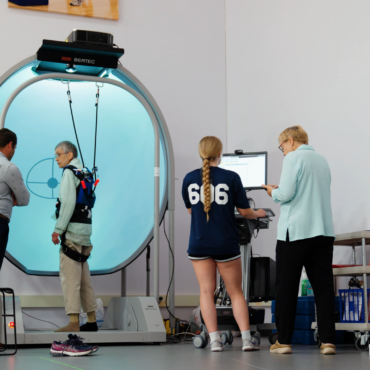
St. Kate’s began with nursing and now uses simulation for 21 health fields ranging from respiratory care to occupational therapy. Students take their classroom learning into the clinical environment, starting with basic skills and progressing toward more complicated procedures or patient scenarios. Through these experiences, they gain competence, confidence, and proficiency in providing safe, patient-centered care, Anderson says.

“Simulation is an interactive approach that gives students the opportunity to apply their skills in replicated real-life situations,” she adds. “It requires them to think and act just-in-time, followed by an opportunity to debrief and reflect on the experience with faculty and other students.”
As students master different skills, the simulations become more layered and challenging. For example, students might be practicing how to assess a patient, who happens to be deaf and accompanied by an ASL interpreter, who is also a St. Kate’s student gaining skills through simulation exercises. Other times, a patient might be experiencing a mental health crisis or a fetal loss.
Each year, St. Kate’s facilitates more than 300 scenarios that are integrated into various courses. More than 50 simulations involve students from multiple programs, teaching them how to provide team-based care. The fetal loss simulation, for example, unites students in sonography, social work, nursing, and advanced practice provider programs.
“We provide opportunities for students to come together interprofessionally to break down the silos of health care,” Anderson says. “We’re discussing the scopes of different professional team members where there are opportunities to engage sooner, with information that would be valuable to share about the patient to be efficient with our care delivery.”
This format often goes beyond clinical care to provide complementary training. Simulations frequently weave in leadership skills development, while others involve handling incivility or microaggressions. In another simulation, students in advanced practice programs engage in a legislative mock health policy hearing where they advocate for pro or con stances.
“The intentionality of simulation-based learning translates beyond the student level of learning to the practicing professional,” Anderson says. “St. Kate’s also collaborates with external partners to use simulation-based methodology to develop training opportunities to meet organizational initiatives and continuing education efforts.”