New Definition of American Whiskey Meets Minnesotan Opposition
Phil Steger can certainly get behind the idea of a new, legal definition for American single malt whiskey. He’s just worried about being boxed in.
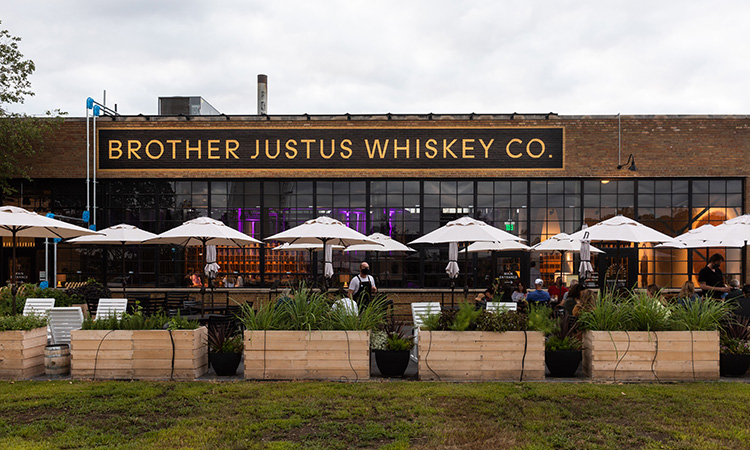
Steger, the founder and CEO of Minneapolis distiller Brother Justus Whiskey Co., is among three Minnesota whiskey producers who’ve voiced concerns about a new federal rule that’s set to go into effect Sunday, Jan. 19.
For the first time, the federal government will recognize American single malt whiskey as a distinct, legal category. On Dec. 18, the Alcohol and Tobacco Tax and Trade Bureau (TTB) – a federal agency that regulates alcohol – issued a notice of a new rule establishing a set of criteria for the liquor.

Under the new rule, a liquor can only be legally defined as an American single malt whiskey if it’s made from a fermented mash of 100% malted barley produced in the U.S.; is produced at a distillation proof of 160 or less at the same distillery (hence “single malt”); and is stored in specific types of oak barrels with a maximum capacity of 700 liters. The rule allows the use of caramel coloring if it’s disclosed on the label.
Proponents of the new rule say it’s the first time that the TTB is recognizing a new type of whiskey in more than 52 years.
Steger is on board with many of those criteria. His main sticking point, he concedes, is largely a technical one: limits on the distillation proof. “We totally get this feels like inside baseball,” he says. “Most consumers don’t know about distillation proof, and we don’t expect them to.”
This isn’t the bottled proof that consumers see in stores; producers make decisions about the distillation proof much earlier on in the process of making whiskey. The distillation proof is generally higher than what actually ends up in the bottle. But Steger maintains that putting limits on this component has a big impact on the flavor and other nuances of the final product. Steger likens the TTB’s new rule to forcing bakers to adopt strict conventions on, say, recipes for cakes.
Northfield distillery Loon Liquors LLC and formerly Wadena-based producer Little Round Still joined Brother Justus in opposing the limit on distillation proof.
Steger says by using a higher distillation proof, he’s been able to craft a unique whiskey that’s gone on to win multiple awards in the American Single Malt category, including a double gold medal in the San Francisco World Spirits Competition in 2024.
There are potential competitive concerns, too. In Brother Justus’ case, a higher distillation proof leads to a quicker time to market. “High proof distillation has a positive effect on barrel aging time because it decreases the number of years required to age the spirit,” Steger says. “The longer whiskey takes to age to taste good, the more cash pressure there is on your business.”
Over at Loon Liquors, the picture is a bit more nuanced. In an email to TCB, co-founder and COO Simeon Rossi noted that his company’s single malt whiskey would indeed meet the new standard’s limits on distillation proof. But he said that “we always appreciate the opportunity and ability to be creative and push the boundaries of traditional spirits flavor profiles.”
Strictly speaking, Rossi said he doesn’t actually object to the new standard, on the whole of it; he said he made his comments to the TTB in an attempt to “provide guidance that would allow for flexibility to produce spirits that highlight each distillery’s individual character.”
Setting a new standard
The quest for an official definition of American single malt whiskey has been many years in the making. The TTB received a formal petition that aligns with the new definition of the liquor back in 2018, but the movement started in earnest at least two years earlier with the formation of the American Single Malt Whiskey Commission, or ASMWC. It’s a group comprising over 100 distillers across the nation, from Arkansas to Wisconsin to Oregon.
The commission, obviously, is pleased with the TTB’s decision. “This is a landmark ruling by TTB and validation for years’ worth of work by American distillers to define American Single Malt,” said Steve Hawley, the commission’s president, in a statement. “We applaud TTB for formalizing the category which will signal to the world that not only do we believe in and support our own distilleries, but we also recognize that American Single Malt Whiskey is unique and deserves to be defined and protected as other American whiskey categories are. Most importantly, this new definition ensures that consumers worldwide can have every confidence that what they think is in a bottle of American Single Malt Whiskey actually is.”
Legally defining categories of alcohol is not unusual; it’s part of the TTB’s job. The bureau already has legal definitions for “Bourbon whiskey” and “malt whiskey,” for instance. The idea is to avoid confusion or deception for consumers. The tricky part is getting all producers on the same page.
And it’s worth noting that the three Minnesota distillers weren’t the only ones to voice opposition. The TTB said that five commenters in total opposed the 160 distillation proof limit. An Arizona distillery also voiced concerns about the proposed barrel size.
Most commenters, however, supported the distillation proof limit, according to the bureau.
“The ASMWC points out that, while the Scotch whisky regulations for single malt allow for distillation of up to 190° proof, they also require the use of pot stills, which according to ASMWC, are intended to ensure that more grain flavor is retained in the final distillate. ASMWC asserts that the same result is achieved by providing a lower maximum distillation strength of up to 160° proof,” the TTB said in its rulemaking.
The TTB will, of course, have a new boss starting Monday when Donald Trump returns to the White House. But it’s unlikely the returning president’s administration will quickly change course on whiskey definitions amid broad support for the new rule, not to mention a range of other more pressing domestic and geopolitical issues.
In an email to TCB, commission president Hawley said his group was conscious about drafting a standard that “left room for flexibility and creativity in production–a hallmark of the category and what we have to bring to the global conversation in single malt–while still maintaining the integrity of a definition for single malt that is embraced across the world.”
“Some things, however, are fundamental to both the global understanding of single malt and how our government qualifies whiskey in this country,” he said. “Distillation proof is one of those core tenets.”
Steger emphasizes that he’s taking a relatively non-combative tone in expressing his opposition. “We’re talking to the TTB, communicating by email to first of all getting clarifications on the rule,” he says. “We’re communicating super cordially.” If anything, he sees the new rule as a chance to educate consumers and distributors alike on the finer points of American whiskey.
Though the TTB’s new rule technically goes into effect Jan. 19, producers have a full five years to get into compliance to call their product an American single malt whiskey. In the meantime, Steger says Brother Justus will continue doing what it’s been doing for years.
“We’ll keep making whiskey our way,” he says. “To be legal, we’ll call it what we have to.”