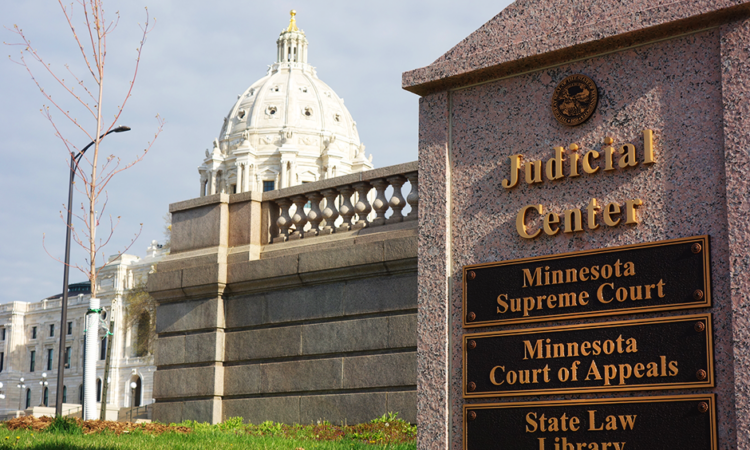
Minnesota Supreme Court Bows Out in Michelle MacDonald Case
It is not unusual for a member of the Minnesota Supreme Court to recuse themselves from a case where they believe they have a conflict of interest because of work they did before joining the court or relationships with parties to a case.
It isn’t even unusual for a sitting justice to recuse themselves from cases involving frequent judicial candidate Michelle MacDonald. Justices she ran against have stepped away from cases involving her, including a license suspension that remains in effect.
But for seven justices — the entire court — to recuse themselves from a case?

“To avoid any possible appearance of bias, the undersigned members of this court will recuse themselves effective on the filing of this order and will not participate in the consideration or determination of the merits of this case,” read the order filed Monday in the case MacDonald and Anunobi v. Steve Simon. The case challenges a decision by elections officials to bar the two judicial candidates from the ballot.
The order was signed by six of the seven justices currently serving. The seventh — Justice Anne McKeig — didn’t even take part in the decision not to take part because she is the justice MacDonald wants to run against.
So what happens now? The same order signed by the six recused jurists appoints five appeals court and district court justices to pinch hit. Court of Appeals Judge Francis Connolly will serve as acting chief justice for the case.
Herbert Kritzer, a professor emeritus at the University of Minnesota law school who has written extensively about judicial selection in the U.S., said it is unusual but not unheard of to have the entire court recuse itself.
One such case also involved a petition by a candidate for Supreme Court justice who challenged a governor’s decision to extend the term of a sitting justice to allow them to serve up until they qualified for certain retirement benefits.
That candidate — Alan Page — won his case and was allowed to file for the office in 1992, which he won. The other case mentioned in the Monday order is Clark v. Pawlenty, a case in 2008 that sought to keep recently appointed Justice Lorie Gildea from appearing on the ballot.
MacDonald does have a way of posing challenges to the judiciary. The last four times an incumbent judge was challenged over the last six election cycles, the opponent was Michelle MacDonald. But MacDonald is barred from running because her law license was suspended indefinitely by the Supreme Court for violations of the code of professional conduct.
Her two most recent election opponents — Justice Paul Thissen and Justice Margaret Chutich — did not take part in deciding that suspension.
So having Thissen, Chutich and McKeig beg off from the latest case is consistent with previous recusals. But why the rest? While justices announce that they won’t take part, they aren’t required to and rarely do say why. But Chief Justice Natalie Hudson was challenged by MacDonald at the 2016 election, which might explain her recusal, even though she is not recorded as having recused herself from the 2021 discipline of MacDonald.
When the court heard a case last November that sought to bar Donald Trump from the ballot because, as plaintiffs alleged, he has engaged in insurrection, two justices declined to hear the case. The two who sat out — Justice Margaret Chutich and Karl Procaccini — do not have to give reasons, but Chutich’s campaign chair is Charles Nauen, a partner in one of the firms bringing the petition. Procaccini had just been appointed by Gov. Tim Walz and could have similar campaign-related conflicts.
Related: Verdict is already in for almost all 2022 judge contests in Minnesota
But the only explanation for the three who had not been campaign targets of MacDonald was, as the order stated, “to avoid any possible appearance of bias.”
The order, however, notes that in picking the replacements the court wanted judges who themselves would not be in conflict. That is, since the case involves who can run against sitting judges, all five were picked because they are in their final terms due to mandatory retirement.
“Given the nature of the claims being raised in the petition, this case will be considered and determined by a court of five acting members, composed of court of appeals and district court judges, all of whom, based upon their term of office and by operation of the mandatory judicial retirement law … will never stand again for judicial election in the State of Minnesota,” the order states.
The underlying legal case involves decisions made by election officials to refuse to allow MacDonald to file against McKeig for state Supreme Court and to reject the filing of Eric Anunobi against District Court Judge Siv Mianger in 10th Judicial District in Washington County.
Both McKeig and Mianger are running unopposed this fall.
MacDonald argues that the state constitution requires only that candidates for judge be “learned in the law.” It is in statute where the requirement that they be admitted to the bar and be in good standing appears. The statute requires candidates to provide a copy of a current attorney license.
Anunobi, who withdrew his challenge July 3, made a slightly different argument — that he was in good standing with the bar but had not received his updated card that could be presented to elections officials. He submitted expired cards and a printout from the bar association lawyer registration site but was still prevented from filing.
Kritzer said MacDonald presents an interesting legal question as to whether laws can be passed that add qualifications or further define qualifications contained in the constitution. But Kritzer said a 1914 case by the state Supreme Court upheld a definition of learned in the law that said a lawyer must be licensed to practice.
“What does it mean to be learned in the law?” Kritzer asked. “Is it simply having a law degree, or what? And states have differed over the years over what that means.”
Correction: This story has been updated to show that Eric Anunobi, who had joined in the legal action June 26, asked that his challenge be dismissed and the court accepted his request July 16.
This article first appeared on MinnPost and is republished here under a Creative Commons license.