Minnesota Losing Out on Business Expansions?
Business expansion projects appear to be leaving Minnesota faster than they’re coming in.
That was one of the takeaways from a new report released by the Minnesota Chamber of Commerce on Thursday. From 2020 through 2022, Minnesota-based companies invested about $10.6 billion in 155 projects outside of the state, according to the report. At the same time, though, companies headquartered outside Minnesota invested just $4 billion in 101 projects here.
The report said that amounts to a $6.6 billion “net investment deficit” in Minnesota. Sean O’Neil, the chamber’s director of economic development and research, said it’s the first time his organization has attempted to quantify business investments coming into and out of Minnesota. He noted that it’s an area that’s not quite as well defined as things like unemployment rates, which are reported based on nationally accepted benchmarks.
But he maintains that the inflow and outflow of expansion projects is something that warrants further attention. Going forward, the chamber aims to release an annual report on the topic. “I think this is something for us to continue investigate further, to continue thinking about what that means for our economy,” O’Neil said in an interview Thursday morning.
For context, it is worth noting there’s been an uptick in business expansions throughout Minnesota and nationally since 2021. Minnesota is set to welcome at least two multibillion-dollar data centers in the near future, for instance. The report also calls out a $25 million plastics recycling facility set to rise in Rogers. Plus, just this week, Lockheed Martin announced plans to build a new St. Paul facility that will employ more than 100 people.
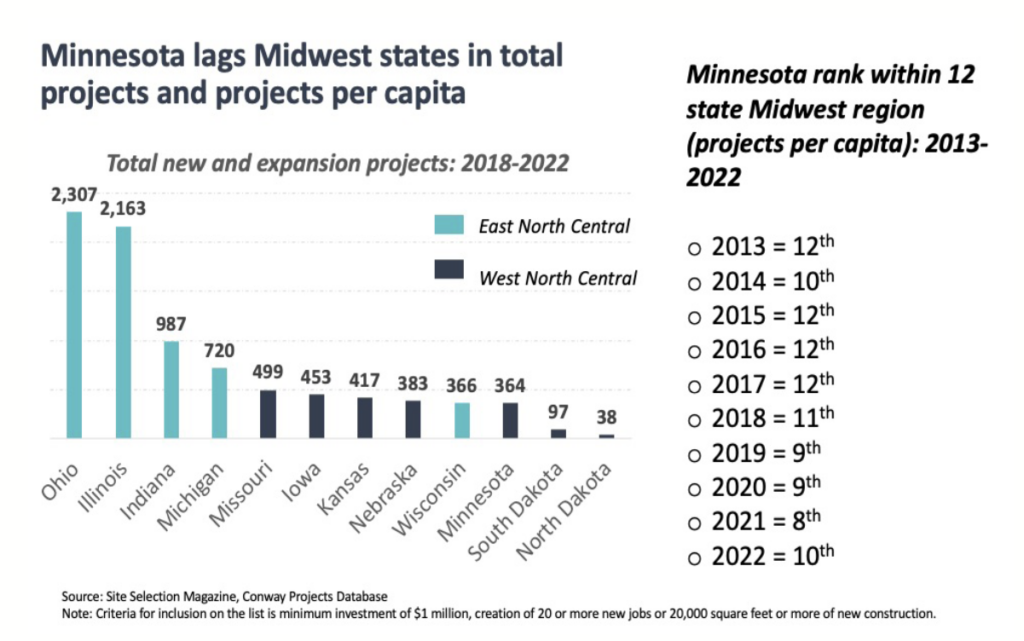
In the bigger picture, though, the report notes that Minnesota has been seeing fewer expansion projects than its peers in the Midwest, and nationally. Between 2018 and 2022, Ohio welcomed a whopping 2,307 new and expansion projects, while Minnesota welcomed just 383 during that same time period. Indiana and Michigan also brought in 987 and 720 projects, respectively.
“Minnesota lags its peers in the Midwest, consistently ranking near the bottom in both total projects and projects per capita,” the report stated.
On the flipside, O’Neil acknowledges that it isn’t necessarily a negative when Minnesota companies invest in other states. More revenue would theoretically mean more tax dollars for Minnesota, for example. “But you would expect that on balance, as companies are putting new projects elsewhere, that those same types of drivers would cause companies in other states to put projects in Minnesota,” O’Neil added. “That’s why we wanted to try to get a sense of this.”
The report, which was released through the chamber’s “Grow Minnesota!” economic development arm, also included results of an online survey gauging sentiments from 171 businesses around the state. According to the self-described “non-scientific survey,” about a third of respondents said they expect to increase automation if workforce shortages persist. Paradoxically, though, implementing more automated processes will likely require more workers and more training in the interim. “The pace of automation may be limited by the very staffing issues that firms are seeking to resolve through those investments in the first place,” the report noted.
O’Neil said that just points to the fact that automation isn’t a “silver bullet” to companies’ ongoing labor concerns.
The chamber’s survey also attempted to understand why Minnesota businesses do or don’t expand here. Of the respondents, about half said they expanded or “made major investments” in Minnesota recently.
“Comments from respondents suggested that many businesses expand locally as a default, as the owners and existing employees live here and have embedded operations in the community or have fundamental business considerations that drive their location decisions, such as proximity to markets or supply chains,” the report said.
That, too, isn’t necessarily a bad thing, as O’Neil sees it. “On the one hand, we can recognize that as a strength. We do have a lot of strong successful companies that started here and are embedded within their local communities,” he said. “They have a commitment to being able to stay and grow in their community, and that will naturally drive expansion activity over time.”