Minneapolis Institute of Art Staffers Allege Toxic Work Environment
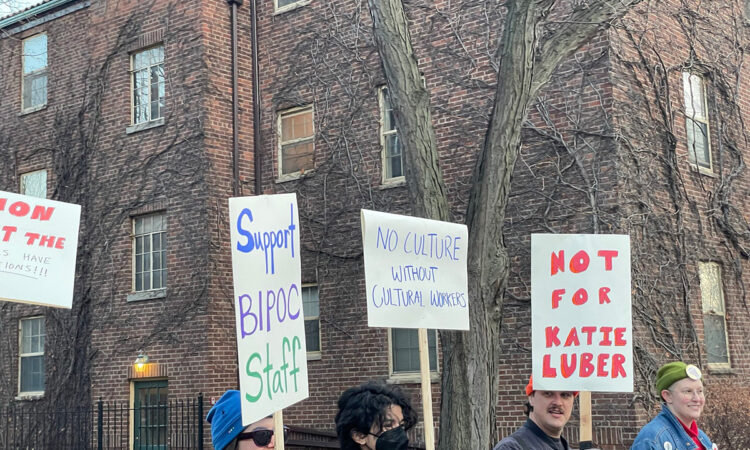
Groups of staff and community members congregated across from the doors of the Minneapolis Institute of Art (Mia) on Thursday to picket, citing poor leadership and the need for employee support.
Before the picket started, the Office and Professional Employees International Union (OPEIU) Local 12, a union that represents Mia staff, released a statement taking museum leader Katie Luber to task for a “work environment so toxic that more than 100 employees have left the institution” since she arrived in 2020. Luber is currently serving as Mia’s Nivin and Duncan MacMillan director and president.
The release also said that Luber has undone the work of Mia as an “institution at the forefront of decolonizing and anti-racist efforts in museums.”
Some picket signs had brightly scrawled words that directly renounced Luber, while other signs affirmed unity with Mia staff and its BIPOC and culture employees. Picketers also sported yellow buttons with “What About Bob” stamped across an image of Bob Cozzolino, a former curator at Mia and one of the latest employees to be terminated from the museum.
Mia’s management disputes the union’s telling of events, and maintains that Luber has improved the institute’s focus on diversity, equity, and inclusion.
On Jan. 9, Cozzolino was fired from Mia, where he’s been employed since 2016. Union members called his termination the “last straw,” and said it directly violated a progressive discipline clause defined in a recently negotiated union contract. OPEIU Local 12 filed a formal complaint citing unfair labor practice to the National Labor Relations Board that following Friday. The union filed another unfair labor practice charge the next week.
Bob Cozzolino is an outspoken figure known to be deeply invested in and respected by the local diverse arts communities, especially Native art. He joined Mia as the Patrick and Aimee Butler curator of paintings. His curatorial collaboration “Reimagining Native/American Art” is still currently exhibited at Mia.

Juan Lucero, a former Native fellow at Mia, attended the picket along with his children. He shared that Mia hasn’t been supportive of Native art, and that there aren’t many advocates within the community to begin with. “The great thing about Bob is that he really incorporated the voices of Native people in the community– he supported living Native artists and worked with them in different ways,” Lucero said.
In Cozzolino’s notice of employment termination, Matthew Welch, Mia deputy director and chief curator, said: “You have repeatedly failed to follow Mia’s established protocol for coordinating its communications with donors – in this case for a key donor – and your failure to accurately inform your colleagues of your interactions with him, combined with your misrepresentations and deliberately false answers to direct questions from Director and President Katie Luber and me.”
According to Cesar Montufar, an organizer at OPEIU Local 12, Cozzolino’s firing follows a long string of mistreatment toward Mia staff. Before Cozzolino was fired, staff had already been pushing for better working conditions due to high employee turnover, especially among BIPOC individuals. Last spring, unionized Mia staff picketed for better pay, marking their first labor event in at least 25 years. Mia staff first joined OPEIU back in 1974.
There are currently only 80 full- and part-time staff members, said Montufar.
“What we’re particularly upset about with Bob is that he was fired without warning–without any kind of discipline measure at all,” Montufar said in a call with TCB. “He was just called in and let go the very same day. There was nothing on his record to have indicated that this was either coming or warranted.”
In the summer of 2021, Cozzolino wrote a letter arguing that Luber’s leadership had undone the institution’s decade-long work that staff has put forward in equity, according to Montufar. “[Katie Luber] has been targeting Bob Cozzolino for a long time, because he’s one of the people who’s outspoken about what art should be for the BIPOC community and that the BIPOC community should have the right to a say in how things are being represented,” he said.
In an email to TCB, a Mia representative said that “Bob was terminated for cause, was given an opportunity to address the concerns prior to termination, and was provided with a detailed letter outlining the reasons for his termination.”
Currently, an online campaign called #WhatAboutBob is circling the local arts community and beyond, along with an open letter to Mia leadership in support of Cozzolino. The open letter has already garnered more than 500 signatures. Many of the signatures are from local arts institutions and artists, but there are also many others from The Art Institute of Chicago, the Smithsonian Institution, the New York Academy of Art, and the Pennsylvania Academy of the Fine Arts, where Cozzolino was formerly employed.
“We cannot sit silently and watch as the institution risks backsliding into outdated hierarchical models that will inevitably discredit the museum’s relevance locally and nationally,” stated the open letter.
There is also a vote of no confidence circling amongst Mia staff that will be released to the public once it’s reached all 80 members.
On Instagram, a post about Mia’s working conditions drew a comment of “Solidarity!” from the union representing workers at the Philadelphia Museum of Art, where Luber was formerly employed.
Thursday’s picket also coincided with a photography exhibit called “American Gothic: Gordon Parks and Ella Watson,” which celebrates the work of Parks, a Black photographer.
Mia employee Sam Molstad commented that the message of the gallery contradicts management behavior at Mia. “The Gordon Parks show–that’s specifically about labor by people of color. And the leadership at the institution right now is very comfortable completely disregarding the rights, dignity, and labor of people of color.”
Another employee added there’s a leadership focus instead on high-dollar donors through expensively ticketed events.
“It’s been clear since Katie’s arrival, that the section of the community that she wants the museum to cater to is the very wealthy,” Montufar said, noting that high-priced ticketed events weren’t as prioritized before she arrived.
A path forward
The same day OPEIU Local 12 released plans to picket, Mia fired back with a press release headlined: “A Track Record of Success: Diversity, Equity, Inclusion, Accessibility, and Belonging (DEIAB) at Minneapolis Institute of Art.”
The post details Mia’s initiatives since Luber’s arrival into her current position, saying that “the museum has methodically reshaped, expanded, and significantly increased its investment and activities in diversity, equity, inclusion, accessibility, and belonging.”
The post includes the museum’s new position of chief diversity and inclusion officer, occupied by Virajita Singh, along with its diverse hiring practices, exhibitions from diverse artists and communities, and union work.
“I am incredibly proud of and gratified by the DEIAB commitments and actions that the Mia team has taken since I arrived in 2020, which has affected every part of the museum, supporting the successes of our employees and the remarkable work they do every day to create meaningful experiences with art for our many audiences,” said Luber in the release.
Luber also emphasized the importance of public funding from donors to help keep the museum free and open to the public, and maintain the work of DEIAB and other key operations.
Still, some Mia staff have questioned Luber’s priorities, as many other departments like education and children’s programming have been shrunk or dismantled. “There’s been no consultation with the culture of the museum before [Luber] came in and just started drawing lines and rearranging things to suit what her vision was,” said Molstad. “I think a lot of people feel frustrated that they signed on to an institution that they had felt really good about.” 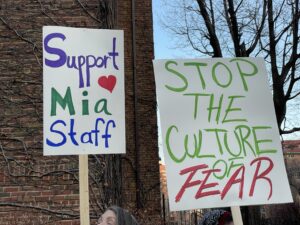
OPEIU Local 12’s release also called out Mia’s use of a voluntary separation program (VSP), allowing an employee to leave freely in exchange for severance, and NDAs to “rid Mia of employees who could no longer stomach Katie Luber’s vision.” The release also shared that it has depleted the museum of vital staff with years of experience and institutional knowledge.
“This is hundreds of thousands of dollars that the museum spent to basically drive people out,” said union organizer Cesar Montufar. “She created the environment where people were very bitter about their experience with her leadership, she made people upset, and then paid them to leave.”
Typically, it takes about 7–14 weeks for the NLRB to make a decision about the merits of charge, although certain cases may take much longer. Until then, the OPEIU Local 12 will continue working to publicize their working conditions at Mia.
In terms of what the union and Mia staff explicitly want? “We would love to bring Bob back, but we don’t think Bob is interested in coming back to the museum as long as Katie Luber is in power,” said Montufar. “I don’t see a positive future for this museum with her in place.”