“It won’t work.”
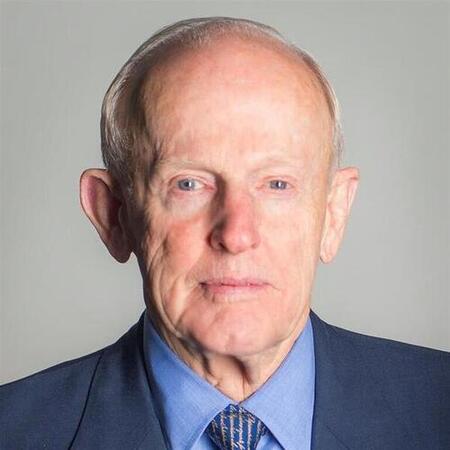
That’s what people always say about a new idea, according to Stanley S. Hubbard. As chairman and CEO of Hubbard Broadcasting, Inc., he has heard the phrase often—and ignored it each time.
Hubbard has spent the past 55 years transforming “unworkable” ideas into successful enterprises. Like his father before him (Hubbard Broadcasting founder Stanley E. Hubbard), he has pushed the family business to new frontiers, leaving less adventurous broadcasters scrambling to catch up.
Today, innovation remains the hallmark of Hubbard Broadcasting, whose operations include seven TV and three radio stations in Minnesota, one radio station in Wisconsin, four TV stations in New Mexico, two TV stations in New York, F & F Productions in St. Petersburg, Florida, and Re!z Channel, a 24-hour satellite and cable network scheduled to launch this September with 28 million subscribers.
Hubbard joined the family business at 18, working as a file clerk in the newsroom. His father didn’t give Stanley or his siblings any special treatment. “We were supposed to work longer hours, and harder hours,” says Hubbard, 73. “And we tried to do that.”
After about six months, he graduated to news photographer. ‘I had a four-inch-by-five-inch Speed Graphic,’ he says. ‘I’d listen to the police and chase ambulances, and chase fires, and chase shootings—chase all sorts of stuff. Just a lot of exciting things—and a lot of things that were pretty awful.’
Hubbard worked his way up the ranks, developing a management style that he says consisted of ‘being fair and honest with people, giving people a chance to do what they can do best, and hiring people who are smarter than you are—that’s the big secret.’
When he became president of Hubbard Broadcasting in 1967, he had big shoes to fill. His father’s list of firsts included the first TV station in the United States to have regularly scheduled daily local newscasts, the first station to color news and high-speed color film processing, and the first all-color TV station in America.
But Hubbard wasted no time in accruing impressive firsts of his own, beginning with WTOG-TV in St. Petersburg, Florida, in 1966. It became the first successful UHF station to operate in a VHF market.
‘Everyone said it wouldn’t work, because it hadn’t worked anyplace else,’ he says. ‘It didn’t make much business to figure out that everyone else had a very small tower, lousy coverage, and lousy programming. My theory was: We’re gonna get the best programming we can get, we’re gonna have the most power we can get, we’re gonna have a tall tower, and we’re gonna promote the heck out of it.’
In 1982, Hubbard formed United States Satellite Broadcasting (USSB), which received the first direct broadcast satellite (DBS) permit. He sold it to raise hundreds of millions of dollars to launch a satellite, he says. ‘We bet the whole farm on that deal. The cable companies were selling people that DBS stood for ‘Don’t Be Stupid.’ The networks didn’t want to see it happen.’
During the dozen years it took to get USSB off the ground, Hubbard, along with his son, Stanley E. Hubbard II, and their associates, created satellite newsgathering in 1984. ‘In order to do so, we had to build the trucks and put all the infrastructure together,’ Hubbard recalls. Hubbard Broadcasting demonstrated the vehicles at the National Association of Broadcasters convention, drawing TV stations stamped up for satellite newsgathering service through another Hubbard property, CONUS Communications. The association eventually purchased 125 stations and operated for 18 years. ‘We were just very happy to be in the business, because it was something very important: It made it possible for a local television station to send in—this is my son’s term I’m quoting—to write its own headlines. Every TV station can go out and get their own news, not the side of the city, or the other side of the country, or the other side of the world.’
In 1993, together with DirecTV, Hubbard Broadcasting launched its satellite. ‘Everyone said it wouldn’t work. Who’s gonna buy a dish? That was their theory,’ Hubbard recalls. ‘Now it’s in 25 percent of the homes in the U.S. If you have an idea, you’ve gotta be able to sell it. If you have a bad idea, you gotta know when to quit. But if you have a good idea, you’ve gotta persevere.’ (USSB merged with DirecTV in 1999.)
Hubbard says one of the things he’s best at is getting along with others—when he’s given the chance. ‘I try to be nice to people,’ he says. ‘But for some reason, a lot of people are intimidated by me. And I don’t know why that is.’
‘I think everyone who works for him probably goes through a period of being intimidated by him,’ says KSTP-AM host Joe Soucheray, who has worked for Hubbard for 25 years. ‘He’s a very proper and civil gentleman. He doesn’t come to work in his blue jeans. But when you get to know him, he’s just a wonderful guy, warm.’
Today, Hubbard calls himself ‘chief cheerleader’ of Hubbard Broadcasting. He’s especially proud of the way his five children have taken charge of the business. ‘The business is in good hands,’ he says. ‘But I’m still working all the time. I love it.”