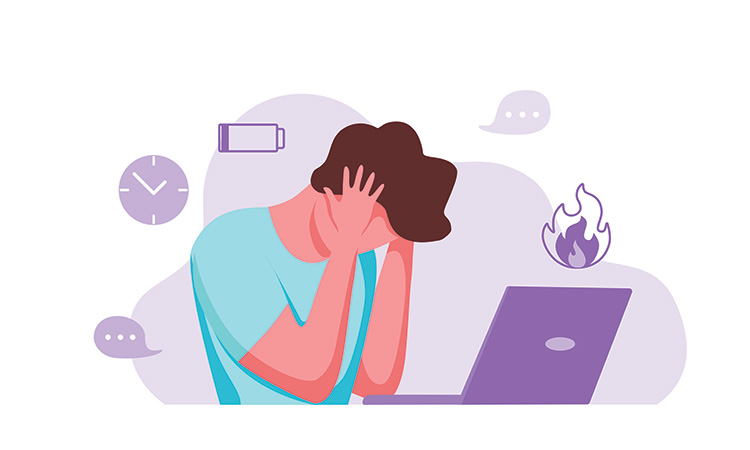
Facing the Crisis in Workplace Mental Health
Imagine having a mental health condition such as anxiety that stems from your job. It gets bad enough that you feel compelled to disclose your situation to your manager. Her first response is “I don’t like this mental health stuff.”
Of course, you, the employee, would rather be talking about anything other than your racing thoughts, chronic insomnia, and generalized fear.
To face such immediate rejection of the very notion of mental well-being in the workplace—not to speak of your own courageous but seemingly foolhardy decision to broach the topic—illustrates why many Americans are increasingly frustrated in their workplaces. They often encounter a perceived lack of support for, or even understanding of, their mental health.
Before the pandemic, employers who provided expanded therapy benefits, mindfulness programs, and the much-touted “mental health days” (no questions asked about your absence from work) could boast of their commitment to employee mental health.
According to recent research published in Harvard Business Review, however, those quick fixes are not enough to ameliorate serious mental health problems that workers feel forced to hide.
Mind Share Partners, a national nonprofit dedicated to “changing the culture of workplace mental health,” published its third Mental Health at Work Report in October. It surveyed 1,500 full-time U.S. workers in 2019, 2021, and 2023, on their experiences around mental health, stigma, and work.
Key to the importance of these findings is the insight into how the pandemic changed not only the obvious demand for remote work, but also an increasing employee expectation that employers would do something to make their jobs “healthier,” not just “better.”
The Mind Share Partners report noted the decline in how workers rated their personal mental well-being between 2019 and 2023.
In 2019, 78% gave ratings between 7 and 10 (highest). That rating dropped to 61% by 2023, with work itself, no matter the industry, cited as the most stressful factor in their lives—beyond finances, family, or community violence and disruption.
Of particular note was a reference to the World Health Organization’s definition of “burnout,” a common term mistakenly thought to be curable by taking time off or quitting rather than by changing the work environment itself.
Burnout, as described by the WHO, is “poorly managed workplace stress” caused by “unsustainable workloads, perceived lack of control, insufficient rewards of effort, lack of a supportive community, lack of fairness, and mismatched values and skills.”
Tackling the concept of an “unfair” workplace may best be left to union organizers. But enabling a sense of agency in team members with the goal of reducing stress should be achievable by virtually any employer, despite one unfortunate fact: the stigma of mental health issues.
Phrases like “You need to play hurt,” as if the employee were a pro football player, or “You knew this would be stressful going in,” (we warned you how much we value high achievers) are examples of common, if hackneyed, responses. Blame and responsibility lie with the worker, and success goes to the “toughest” among them.
Disclosing a diagnosis of depression has historically meant the worker is not only ill, but is destined to symbolize the bias (stigma) his company cannot overcome, namely, this person is weak.
In contrast, compare a reaction to disclosure of a cancer diagnosis to one of depression. With cancer—any kind of cancer—people tend to react to sharing of the news with empathy, because someone they know had it, died from it, or possibly overcame it. It really was not their fault, the thinking goes, even if, for example, the individual smoked for 40 years.
With a mental health disorder, the stigma permeates the cause, and is exacerbated by ignorance.
Read more from this issue

“I know people, especially younger people, who suffer from depression,” a manager might think. “But I can’t change what goes on in this employee’s head: only he can do that.”
On its website, Mind Share Partners offers a free 20-minute video and detailed worksheet on how best to “disclose a mental health challenge to your manager.” The nonprofit’s advice? Be prepared for one of three reactions to the news of your mental health problem: I don’t get it. I don’t like it. I don’t like you. And that’s just the start of the conversation.