‘Extremely Audacious’ Corporate Efforts to Rein in Climate Change
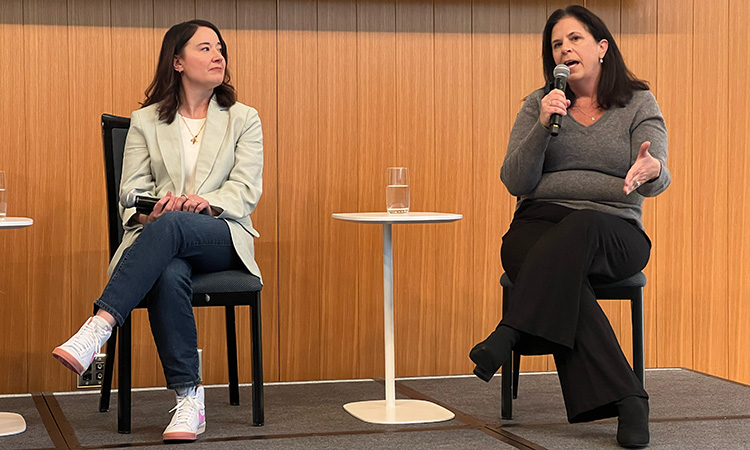
As temperatures hovered in the 30s on an uncharacteristically warm January afternoon, a trio of business leaders on Sunday gathered at the American Swedish Institute in Minneapolis to talk climate change.
Delta Air Lines, which has pledged to hit net zero emissions by 2050, and Target, which promises to do the same by 2040, each sent vice presidents to speak. A former sustainability chief from Best Buy also spoke at the event, which is part of the annual Great Northern Festival.
Peter Carter, Delta’s executive VP of external affairs, maintained that sustainability is “part of our core mission.”
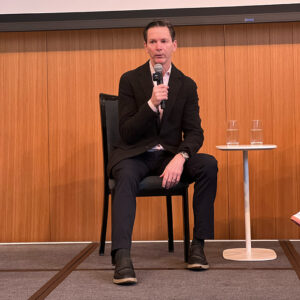
“We view ourselves as the ultimate globalists,” said Carter, a former Minnesota resident who now lives in Georgia. “We certainly can’t connect people around the world and hurt the planet.”
Still, getting a global airline to net zero is a tall order, and plenty of questions remain. The transportation sector broadly is responsible for the largest share of climate emissions in the United States, according to EPA data. At Delta, jet fuel is responsible for more than 90% of the company’s overall emissions. And, unlike the automotive sector, electrification isn’t even a feasible option for airlines. “The physics don’t support an electric aircraft for long-haul flying,” Carter said. “That’s not in our lifetime.”
But, in the meantime, Carter and the other speakers detailed how their respective organizations and clients are working to get climate change under control. Much of the work is largely experimental and unprecedented, and it remains to be seen whether their efforts will tangibly address global warming. Carter himself described Delta’s plans as “extremely audacious” and acknowledged that the company is essentially attempting to “create an industry that doesn’t exist today.”
The push toward net zero emissions will require large-scale cooperation – sometimes even among competitors, the panelists said.
As Target senior VP of corporate responsibility Amanda Nusz put it: “There isn’t a playbook to get a $110 billion retailer to net zero. We’re doing something that hasn’t been done before. We’re calling for innovation. We’re asking to partner.”
Carter pointed to the creation of a “sustainable aviation fuel hub” in Minnesota as one concrete measure underway. Formally announced in August, the initiative brings together Delta, Xcel Energy, Ecolab, and others on a plan to ramp up production of lower-carbon jet fuel made from ethanol, soy oil, or hydrogen. Carter said the effort aims to power every flight from MSP Airport with sustainable fuel to some degree. But that plan, too, is quite a long way off.
“Right now, all the sustainable aviation fuel in the world” wouldn’t be enough to fuel commercial airlines for even a day, Carter said. Yet he’s optimistic about the fuel hub, which, if successful, could become a model for other parts of the country and world.
Target, meanwhile, faces an entirely different set of challenges in paring back its carbon footprint. Unlike Delta, much of Target’s emissions footprint is beyond its direct control. “The majority of our emissions are actually our ‘scope 3’ emissions, which are not the emissions we control,” Nusz told attendees. “Those are the emissions that are either upstream or downstream within your value chain.”
Nusz said that Target in 2022 lowered its “scope 1 and 2” emissions — the kind caused directly by the company — by 35% compared to 2017. The remaining challenge is getting Target’s thousands of suppliers on the same page to tackle scope 3 emissions. To that end, Nusz said Target has asked all of its suppliers to set their own “science-based” emission reductions goals.
“That was just step one,” she noted. “The magic, now, is seeing what happens when they set the goal and actually build the activities” to reduce emissions.
Panelists agreed that it’s imperative to get entire workforces on board with climate change initiatives, too. “All jobs are sustainability jobs,” said Laura Bishop, Best Buy’s former chief sustainability and corporate responsibility officer who now works as an independent consultant.
At Best Buy, there was a “grassroots” effort on the part of employees to push toward sustainability, Bishop said. It’s something that any employee at any company can try.
Ultimately, sustainability needs to be baked into the purpose of a company. Pointing back to the thinking of former Best Buy CEO Hubert Joly, Bishop noted that the purpose of a company is not to make money. “That’s an imperative when you’re a for-profit company,” she said. “The purpose of a company is to do good in society and communities where you are doing business.”
To learn more about how other Minnesota businesses are attempting to fight global warming, read TCB’s October/November 2023 cover story.