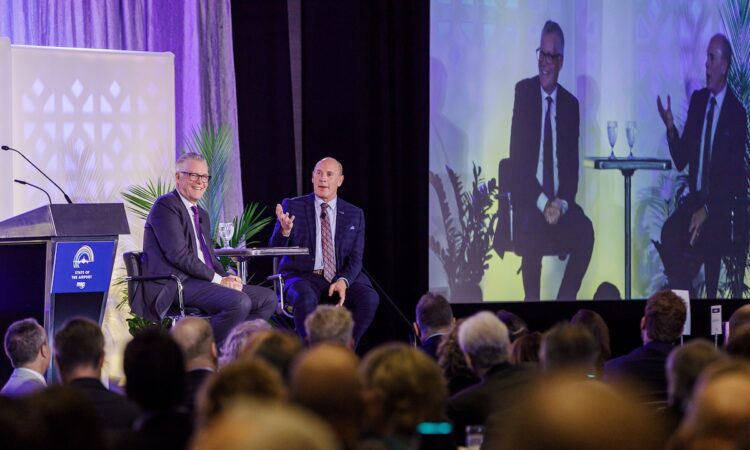
Delta’s Ed Bastian Promises More Investment at MSP Airport
The prognosticators were wrong, Delta Air Lines CEO Ed Bastian told the crowd of nearly 700 at Thursday’s State of the Airport lunch in downtown Minneapolis. Business travel is back to more than 100%, he said, quickly adding, “Thank God.”
In a conversation on stage with Metropolitan Airports Commission Executive Director and CEO Brian Ryks, Bastian praised MSP Airport—Delta’s second largest hub—and promised to continue investing in the airport itself. That could include building one of the airline’s most premium Delta One lounges for business class travelers at MSP. The first one opened this summer at New York’s John F. Kennedy International Airport featuring fine dining, a spa, shower suites, and luxe architectural details like white marble countertops in the bakery area and a gold leaf ceiling in the bar lounge. Delta One Lounges are under construction at Los Angeles International Airport, Boston Logan, and Seattle-Tacoma.
“MSP needs one,” Bastian said Thursday. “We’re working on it.”
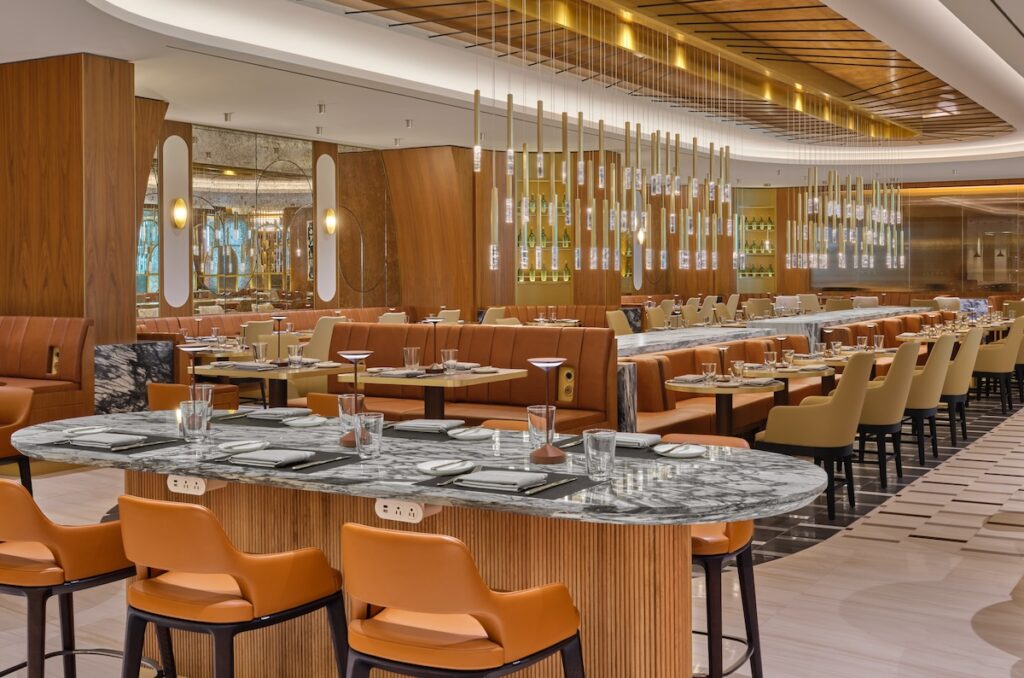
Delta’s chief talked about the importance of continually upgrading the airport experience.
“When people talk travel, they think planes. But we need to make sure the airports are another reason why people choose Delta, and choose MSP,” Bastian said. “This is a wonderful point of connectivity. We want the hospitality and amenities to all be top shelf.”
Speaking the day after MSP Airport received its first delivery of sustainable aviation fuel, made in part from plants grown in Minnesota and North Dakota, Bastian praised Minnesota’s business community, including Cargill and Ecolab, as well as the University of Minnesota and Gov. Tim Walz for taking the lead on the future of sustainable air travel. Currently, sustainable fuel costs five times more than jet fuel, he said, so research on making greener options more affordable is essential.
“Currently, there’s no economical substitute [for jet fuel]. We don’t want our customers to decide between seeing the world and saving the world,” Bastian said. “The world is going to come to Minneapolis to learn how we save transportation for our children.”
Bastian and Ryks also discussed technology as it relates to Delta Airlines—the good, and the bad.
Bastian called out updates on the Delta app that are “designed to put control in the hands of customers.” He made clear that Delta is not trying to eliminate direct contact between customers and airline reps; rather, delivering on what travelers want. “They don’t want to wait in a line to get a refund, or find out why a plane is late. That’s why we continue to invest in our app experience.”
The app couldn’t help in July, when a flawed software update by cybersecurity firm CrowdStrike crashed the airline’s system, grounding 7,000 flights over five days and costing Delta a reported $500 million. Other airlines were affected by the outage, but none took as long to recover as Delta. CrowdStrike’s CEO has pushed back on Delta’s threat to sue, saying the airline is responsible for its response to the outage.
“I’m sick and tired of big tech companies that run our life and don’t take accountability,” Bastian told the Minneapolis crowd on Thursday. “We are absolutely taking action. We are going to fight hard to get that money back, and make big changes when we do.”