D’Amico Arrivederci
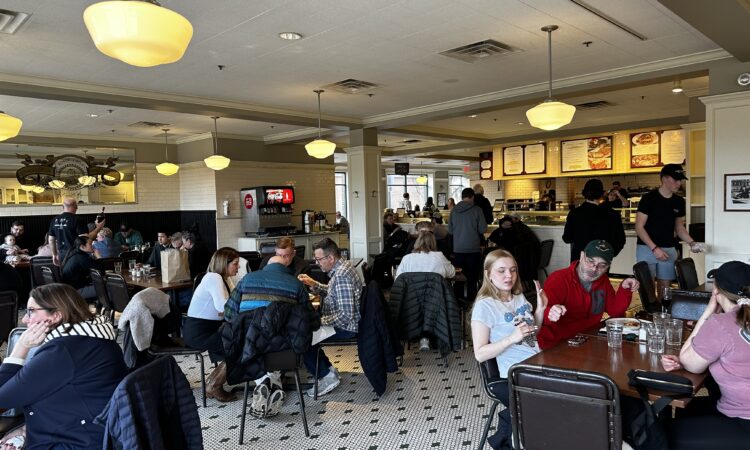
Everything ends. For businesses, especially restaurants, those endings can be abrupt and disappointing. Rarely do we get to watch a complete life cycle play out. But Saturday brought an ending that was a celebration, as the last two D’Amico & Sons cooked their final pizzas and pans of Bolognese. On hand was company co-founder Larry D’Amico, who had managed the fast-casual concept since its birth in 1994 and had come to town to offer hugs, sit with old friends, and share a slice.
“What a great life I’ve had,” he said. “And to think I almost stayed in Cleveland.”
Why now, with time left on the Edina and Golden Valley leases? D’Amico says Sons never fully recovered from the pandemic and the two D’Amico brothers—who still run the company but live predominantly in Florida—didn’t have the zeal for a re-concept. So they chose to bring the curtain down early with minimal flourish. Larry and Richard D’Amico now control a restaurant company that does business on a single street in Naples, Florida.
Richard came to Minnesota in 1975 to “escape the restaurant business”; his father was an accomplished Ohio restaurateur. The escape part didn’t work out. Once here, Richard bartended and consulted for other restaurateurs. He turned down an opportunity to return home and take over D’Amico’s in Medina, Ohio. Instead, brother Larry, who had been cooking in his father’s place, joined Richard in the Twin Cities. In 1982, they bid for the foodservice contract at newly opened International Market Square and added a sit-down restaurant there, Primavera, to show off their capabilities and attract catering jobs.
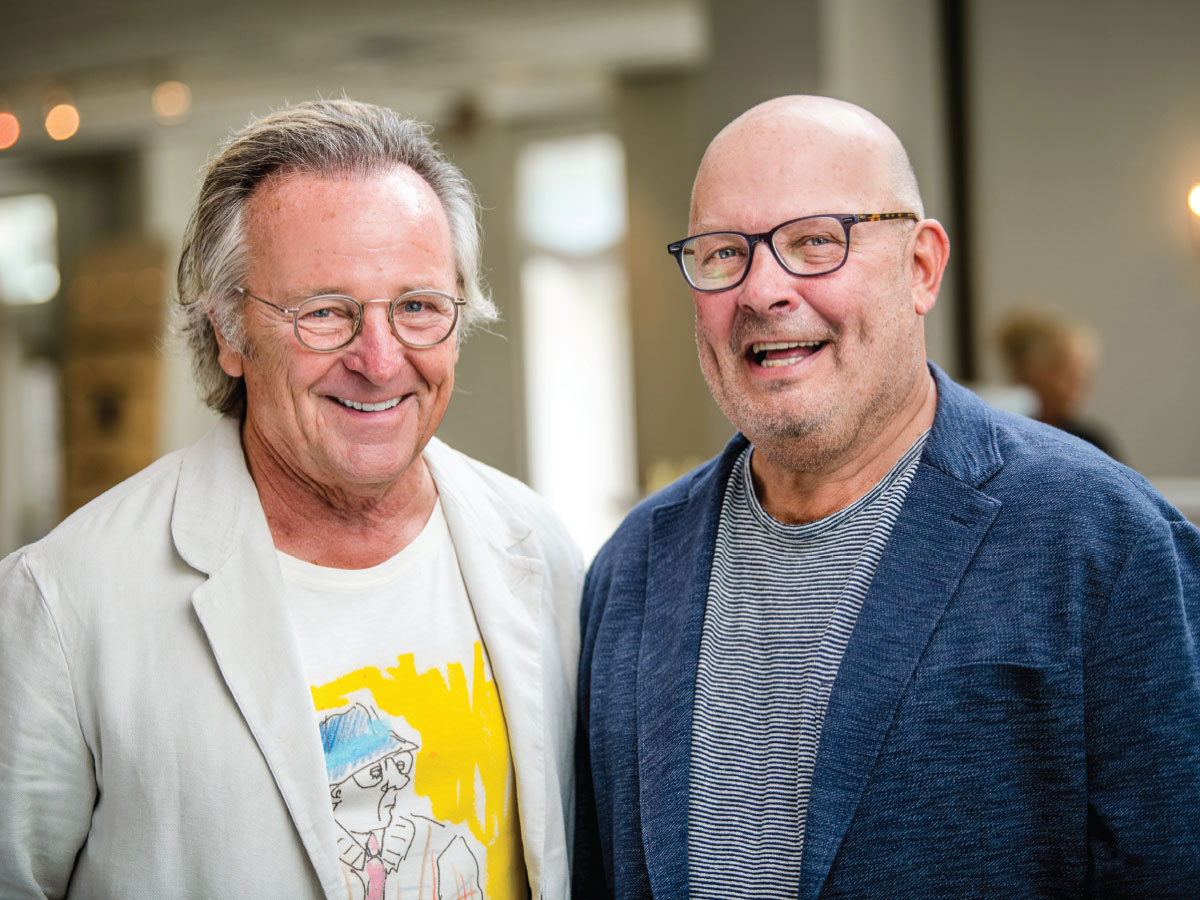
Primavera was the foundation of a business that birthed D’Amico Cucina, Azur, Toulouse, Bocce, Linguini & Bob, Campiello, a handful of D’Amico & Sons, Masa, and Parma 8200. A 1998 expansion to Naples, where their parents had retired, planted a second flag, where D’Amico + Partners still operates a Campiello and The Continental.
It’s worth looking back a moment to reminisce. In the 1980s and 1990s, D’Amico turned the Twin Cities from a stodgy meat-and-potatoes town to a place where great chefs wanted to work, which fast-tracked an evolution into a sophisticated food region. “Without Cucina and Azur and Masa,” said longtime chef, author, and food entrepreneur Andrew Zimmern, “you don’t have Alma or Spoon + Stable.”
It was still a provincial food town, cut off from coastal trends. “When I first started, [grocery stores] were selling arugula in herb containers,” says longtime D’Amico executive chef Jay Sparks, who now co-owns Lovechild restaurant in La Crosse. “We did a lot of reading and bootstrapping.”
They created a restaurant to suit every lifestyle and stage. Even the quick-serve Sons has a warm place in so many memory banks as a reliable go-to for parents with children, where everyone could eat well on a Sunday night.
Azur’s 1990 opening was breathtaking in its ambition: an elegant Provençal restaurant on the top level of the new Gaviidae Common, swathed in modern art and textiles—it set jaws dropping across the industry. The Minneapolis food scene suddenly had national ambitions, and its chefs were a force to be reckoned with.
“Richard and Larry were essential,” says Sparks. “I can’t think of another organization with the same vision or ambition. Richard was the whole package—style, food, service.”
He had no patience for clunky Minnesota earnestness or Continental formalities that defined local dining. “He wanted New York, Milan. We didn’t have that level of dining. We didn’t have the swag,” explains longtime local chef and restaurateur Scott Foster (Hazelwood Grill, Terza). “Richard put sexy into fine dining.”
For a period, D’Amico was opening a restaurant a year. “Richard saw these voids and had a team that could fill them,” explains Foster.
“You wanted to work there,” adds Sparks. “Larry and Richard gave us free reign. They wanted our best work.”
Larry, now 75, every bit the younger sibling, credits his big brother: “Most of it was Richard, his style, his taste.”
“That, and Larry has one of the best palates of anyone I’ve ever known,” says Foster.
Larry appreciates the plaudits but suggests he and “Rick” were merely in the right place at the right time: “It’s a great food town. [The evolution] would have happened with or without us.”
Foster doubts we will see another family leave such an impact on our way of eating. The food scene is now digital and nationalized, with ingredients and trends exploding on social media, seeding menus all over the country. (See the ubiquity of hot honey or burrata cheese.) “I don’t think you could do it again today,” Foster says. “Not here, not when the economics require you to do $6 million [in revenue] out of the gate, and that’s very hard.”
He says Larry and Richard are “relieved. They had a great run; they left their mark.” (D’Amico Catering, now D’Amico Hospitality, soldiers on, the last local presence of the name, now owned by longtime partner Paul Smith.)
Despite the stores’ scuffed walls and dinged-up tables, standards were intact to the bitter end. On the final weekend, Larry worried that the atypical crowds were causing the care taken in cooking to suffer, creating a subpar customer experience. He was confident it was the right time to close one door and leave another open.
“I’d like to thank all of our customers and employees over the years,” he said. “I hope you can come visit us in Naples.”