Commentary: A Borealis Reality Check
I’ve written about the much-heralded Borealis a couple times in the last year. As it approaches its first birthday, I finally had an opportunity to ride it.
I had to make a trip to Chicago to deal with the aftermath of a parent’s death. I bought a $108 Southwest ticket two weeks out. It took five hours door to door. Unsure how long I would have to be in the city I did not book a return.
Purchasing my return five days before travel pushed me to Amtrak, where my $158 business class fare was half what any flight would have cost. I chose business class because some friends extolled it from a previous trip, and I was not really in the mood for making small talk with a seatmate. Amtrak’s app told me I got the last seat, so I assume that’s about as expensive as business class gets. I chose Borealis over the later Empire Builder because I had to be home for my son’s birthday dinner at 7:15 p.m. in the North Loop. The business class ticket promised me a wider seat with no companion plus boarding niceties at Chicago Union Station (CUS).
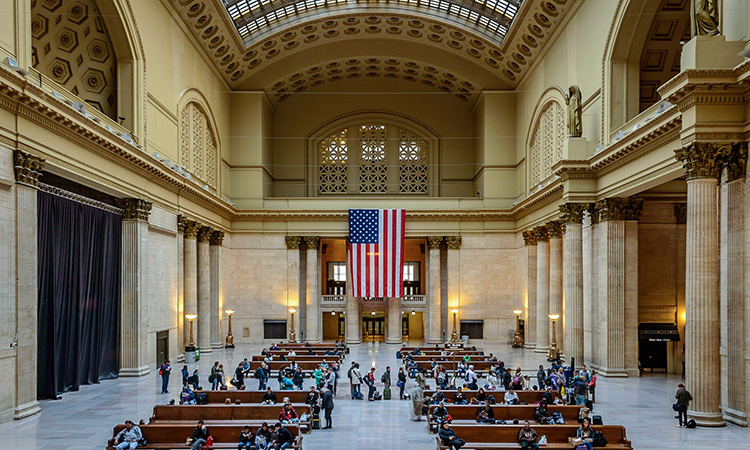
Arriving 55 minutes before the 11:10 a.m. departure, I passed through CUS’s great hall into the warren of always under construction low-ceilinged walkways to Amtrak’s boarding areas. Post-pandemic Union Station is almost devoid of commerce on weekends; it’s no longer a reliable place to pick up a basic meal or a newspaper for the trip. Even the McDonald’s has left. I knew that and came provisioned.
Amtrak uses a single boarding holding area for departures but does not allow passengers access to it until 30 minutes before their train. We were asked to wait in a line that snaked down the corridor. Apparently, my business class ticket entitled me to skip this line and gain access to the holding area, but there was no signage or information that indicated this. At 25 minutes before train time we were granted access, and business class passengers were sent right to track 28. There were no destination signs or wayfinding aids like you would find in an airport or were available in CUS in the heyday of train travel.
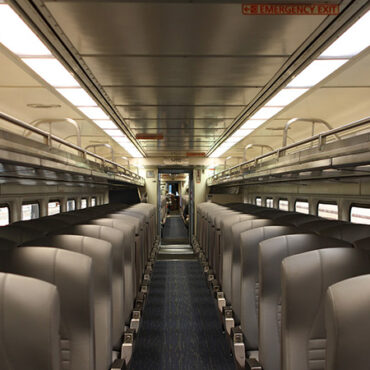
I was confused when reaching the train because it was a non-standard collection of three Superliner coaches not normally assigned to Borealis. These 1979-1981 built double-deckers typically operate on Amtrak’s long-distance trains and offer larger windows (albeit dirty) and second-level seating. The downside is this equipment does not offer the promised Amtrak Wi-Fi, meaning my plans to use my laptop were vanquished. (Reports from colleagues indicated Borealis’ cellular-based Wi-Fi works occasionally at best.) My rail car had recently been returned to Chicago from Amtrak’s Capital Corridor in central California. The snack car attendant said Superliners performed better in cold, snowy conditions than the 1980s Horizon and Amfleet cars normally on the run. The “café” on the lower level had no tables for eating and socializing as does the normal train.
Our conductor said this set of cars had been substituting for several weeks on the train, but the other set of equipment, running southbound from St. Paul that day, was the normal set. Superliner coaches are not equipped with business class and so I was seated in a restricted area of the snack coach with 2-2 seating, rather than the promised 2-1.
When I asked a conductor what the difference between business class and coach was, she said only the curtain separating it from coach; the seating, recline, and density was identical. I felt like I deserved a refund of the $108 extra I paid over coach. She suggested I call customer service and request a voucher.
We left Chicago a minute early but were quickly sandbagged by track work being done by Chicago’s Metra commuter rail agency. The train seemed to be oversold as coach passengers kept occupying business class when fellow passengers got up to use the toilet or visit the snack bar, requiring you to find an employee to reclaim your seat. (This ceased to be an issue west of Milwaukee.)
On leaving Chicago an Amtrak staffer announced the middle car of the three had inoperative bathrooms, meaning a third of the train’s bathroom capacity was unavailable (and would also be on the train’s return trip to Chicago on Sunday). Why Amtrak would dispatch a car with inoperative bathrooms on an eight-hour trip confounds me.
Business class was less than peaceful. Our conductors, seated in the section, spent much of the trip on their radio with the volume turned up. Being right behind the engine, the incessant blowing of the horn also mitigated against a quiet environment. The engineer’s radio failed outside La Crosse. One of a series of small delays that put us nearly 30 minutes late at Red Wing. Once the sun set, I realized my reading light was burned out. The bathrooms in the car were not kept clean and were pretty gross mid-trip.
I don’t want to be too hard on Amtrak. Its employees are mostly friendly and don’t stand on ceremony like airline employees. The snack car prices are more than fair. And most of the problems I encountered with the train are the result of decades of political indecision on keeping Amtrak in a good state of repair.
Borealis is an odd hybrid for Amtrak, which mostly runs short or long-distance trains. Borealis is a tweener and deserves equipment and food that suits a train that takes most of a day and overlaps two meal periods and whose riders seem to mostly travel from beginning to end. But that’s up to Minnesota and Wisconsin, who will eventually have to fund all of Borealis’ losses and equipment costs.
For now, the train is idiosyncratic basic transportation. Some days you get what you pay for, some days you don’t.
We arrived St. Paul at 7:01 p.m., 32 minutes late. Door to door, it was eight and a half hours.