
Child Care Providers Remain Optimistic Despite Industry in Crisis
Less than half of Minnesota family child care providers and roughly 60% of child care centers are optimistic about the future of their businesses. The kicker? It’s the best outlook the industry has reported in years.
Child care enrollment has largely remained stable or increased among providers in the last year, according to a survey conducted by the Federal Reserve Bank of Minneapolis in March. The survey gathered more than 1,200 responses from across the state, which showed despite increasing demand and continued efforts to support providers, 90% of respondents agreed the industry remains “in crisis” as providers struggle to stay afloat.
Child care centers are typical daycare providers with staffs and early education programs, while family child care providers are essentially daycare programs run out of individual’s homes.
After years of decreased enrollment, lack of funding, and meager pay for child care providers, First Children’s Finance Minnesota director Suzanne Pearl said Monday that any glimmer of hope is a welcome sign.
“The level of optimism, even if it’s just at 60% of centers saying they’re optimistic about their business, I think that’s something we would not have seen if we had asked this last year — and definitely not the year before,” Pearl said in a Monday webinar hosted by the Fed.
So, what’s wrong?
After American Rescue Plan child care funding expired last fall, the state legislature approved $1.3 billion in child care funding as a “Band-aid” for the struggling sector. Lawmakers directed $316 million of that to a new Great Start Compensation Program (GSCP) to increase employee pay and benefits over the next two years, with an additional $260 million for 2026 and 2027.
While 85% of respondents in the Fed’s survey reported hourly wage increases and higher rates of paid time off and bonuses as a result of that, Pearl said the funding is simply is not enough to keep the local industry afloat.
According to the state’s Department of Employment and Economic Development, the median hourly wage for child care workers in Minnesota in 2020 sat at $12.28 per hour — fighting among gaming writers, radio announcers, and coatroom attendants for some of the lowest-paying industries in the state. Additionally, even with GSCP funding, only about half of child care centers are able to offer critical benefits like health insurance or retirement plans, Pearl said.
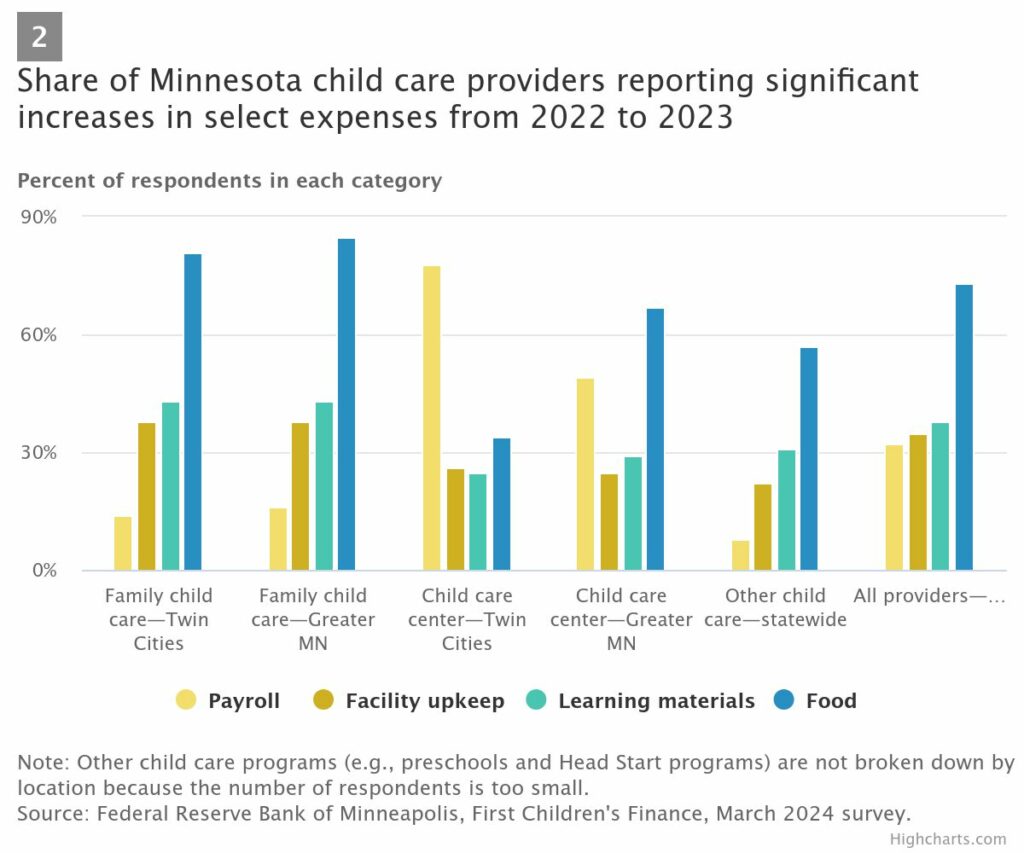
Reduced staffing has been felt throughout the state, as 42% of respondents noted having capacity limits due to a lack of staffing. According to the survey, more than 700 open teaching positions from respondents has translated to at least 2,000 unavailable child care slots.
“Over the past couple years, we’ve seen many centers operating with empty classrooms — they have the space, they just don’t have the people,” Pearl said. “Those unfulfilled child care slots are the result of difficulties in hiring or retaining staff and have a real, tangible impact on the availability of child care for Minnesota families.”
Providers have been forced to get creative to keep their doors open. Nearly all respondents reported using incentives beyond financial compensation to keep employees. About 15% of center directors and 23% of family providers are sometimes unable to pay themselves, and 30% of family child care providers used personal savings this year, according to the survey.
Although fewer centers than last year raised tuition, family providers are continuing a steady trend of price increases that for many families turns the necessity of child care into a luxury they cannot afford.
As any parent will agree, caring for a child is not cheap. In order to pay the nearly $40,000 in annual expenses to operate family child care businesses or nearly $1 million for centers, Minnesota families can expect to spend on average $1,021 per month for preschool care and $1,341 for infants, according to a report presented to the Minnesota House of Representatives last fall.
As a result, more than half of family providers said their program damages their household income as more families become priced out, according to the survey.
Parents are not the only ones who suffer due to inaccessible child care. Research has shown that the first 1,000 days of life are critical for a child’s physical, mental and emotional development. According to a report from the U.S. Office of Disease Prevention and Health Promotion, early-life stress or a lack of support can have consequences for kids such as cognitive development delays and the creation of unhealthy coping skills.
Even later in life, those in their 30s who had participated in comprehensive child care programs were at lower risk of heart disease, high blood pressure obesity compared to those who had not.
According to Pearl, Minnesota’s child care market was broken long before the pandemic and continue to negatively impact both workers and families. As enrollments continue to rise and more support is given to providers, Pearl said the industry is ready to cling on to whatever glimmers of hope they can.
“It’s a note of positivity about the future,” Pearl said. “While the business side of child care can be a real struggle, we hear all the time from child care providers that they love their work. They love the kids in their care and the families they serve, and they understand very well how important child care is not just to those families, but to the rest of us in Minnesota and the health of our state’s economy.”