Business CEOs Fight for Minnesota’s Low-Income Children
We read with great interest Liz Fedor’s excellent TCB article “Are CEOs Walking Away from Civic Leadership?” It raised important questions for Minnesota’s business community to consider.
One major area of civic leadership was only briefly mentioned in the article—the drive to improve early learning for low-income Minnesota children. We wanted to explain this case study both to give credit where credit is due and to inspire other business leaders to do similar work in the future.
In 2005, major business and civic leaders did something extremely unique and effective when they created the Minnesota Early Learning Foundation (MELF). MELF was led at the board level by then-Cargill CEO Warren Staley and at the staff level by former Minnesota Business Partnership executive director Duane Benson. It involved a jaw-dropping “Who’s Who” of business and civic leaders.
MELF was created to get Minnesota’s most at-risk children prepared for kindergarten and all that follows. Business and civic leaders were paying close attention to emerging brain development research showing that critical aspects of brain development happen by age 3. They were seeing that too many young Minnesotans in low-income families weren’t able to access high-quality early learning programs during those formative early years, and were arriving in kindergarten unprepared to succeed.
The business leaders who founded MELF recognized this as a huge problem, because those left- behind children are much more likely to start kindergarten behind, fall into achievement gaps, and often not graduate from high school. Ultimately, these individuals are not prepared to join the state’s ranks of highly educated workers that Minnesota businesses increasingly need to compete and win in the global economy.
Beyond the business workforce implications, research shows that children who miss the opportunity of attending a high-quality early learning program need more state-funded supports over their lifetimes. Those supports include special education, social services, health care supports, and economic assistance.
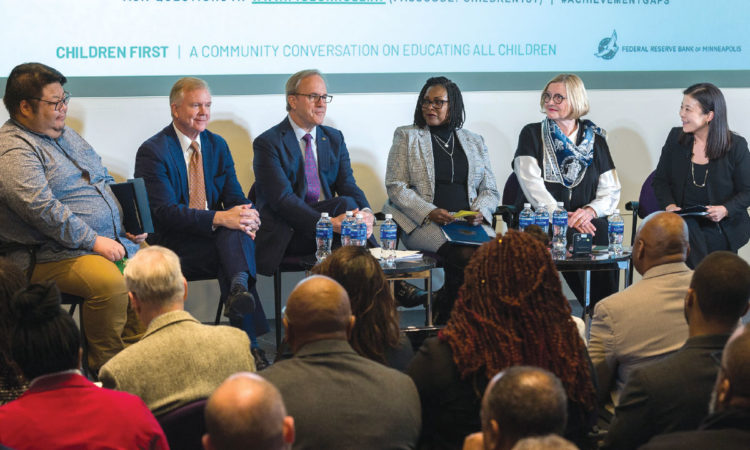
For that reason, Rob Grunewald and Art Rolnick, one of the authors of this commentary, conducted research at the Federal Reserve Bank of Minneapolis that found that every $1 invested in helping children in low-income families access high-quality early learning programs yields up to $16 in taxpayer benefits. We still don’t know of another public investment with a return-on-investment (ROI) that strong.
MELF leaders did more than talk about this issue. They sprung into action. For starters, they raised about $20 million in private funding to research, develop, and evaluate a better way to empower families to access high-quality early learning programs for their children. To help MELF get off the ground, politicians offered to give the group $1 million. But MELF leaders rejected that taxpayer money because they wanted to be “honest brokers” and operate independently above the political fray.
Through the use of pilot programs in Minnesota communities, MELF leaders found that giving children flexible, parent-driven Early Learning Scholarships enabled Minnesota’s most vulnerable children to access the state’s best programs. At the same time, the MELF-piloted Parent Aware ratings helped all families identify programs in their community using research-based kindergarten-readiness best practices.
This was not a case of CEOs sitting passively on a board. This involved CEOs actively raising funds, shaping the pilots, and building the political support necessary to bring the program statewide. Partly because of CEO lobbying on this issue, today’s scholarship program likely has more bipartisan support in the Minnesota Legislature than any other social services program in Minnesota.
Between MELF and successor nonprofits that also worked to expand Early Learning Scholarships and Parent Aware, about $30 million in private funding was invested in the initiative. Over time, that private investment has led to the public sector cumulatively investing about $1 billion for Early Learning Scholarships and Parent Aware. More importantly, this programming has touched the lives of 100,000 children.
Some of the CEOs mentioned in the TCB article were central to MELF, such as former CEOs Doug Baker of Ecolab, Ken Powell of General Mills, and Mary Brainerd of HealthPartners. Many corporate leaders who were not listed in the article also were major contributors. That includes Cargill’s Staley, attorney Michael Ciresi, Liberty Diversified International chairman Mike Fiterman, former Best Buy CEO Brad Anderson, and the Minnesota Business Partnership’s former executive director Charlie Weaver.
Moreover, a new generation of leaders has stepped in to continue to move this work forward, this time under the umbrella of Minnesota Business for Early Learning (MNBEL). Original MELF leaders now have been joined by members of the current CEO class, such as Medtronic’s Geoff Martha, HealthPartners’ Andrea Walsh, Red Wing Shoe Co.’s Allison Gettings, and the Minnesota Business Partnership’s Kurt Zellers.
This kind of sustained business leadership is critically important for Minnesota. But we’re not done yet. Minnesota still has about 8,500 low-income children who can’t access high-quality programs due to lack of state funding for Early Learning Scholarships.
Unfortunately, the program has been relying on one-time funding. If no action is taken by Gov. Tim Walz and the Legislature this year, it will be cut by $100 million per year and the number of left-behind children would balloon to 15,000. That can’t be allowed to happen. Indeed, we need more funding for Early Learning Scholarships to support our children and their families and to strengthen the Minnesota economy.
Who will be at the forefront to fight for these children this legislative session? The older generation of CEOs that was there 20 years ago to launch the remarkable MELF initiative as well as a new generation of CEOs. They are trying to prevent political backsliding and finish the job. It’s an incredible case study for a new generation of business leaders to study and follow.
Art Rolnick is an associate economist at the University of Minnesota and former research director at the Federal Reserve Bank of Minneapolis. Ericca Maas staffs the Minnesota Business for Early Learning (MNBEL) initiative.