


What Big MN Businesses Could Have Said About Aggressive ICE Actions
By the time citizen Renee Good was shot and killed Jan. 6 by an ICE agent in Minneapolis, many Minnesotans already felt unsafe in their neighborhoods.
Operation Metro Surge, which began Dec. 1 and brought 3,000 federal immigration enforcement agents to Minnesota, caused fear and terror. Masked ICE and Border Patrol agents were conducting massive sweeps and arresting people of color, regardless of whether they were in the U.S. legally.
Agents went about smashing the windows of people in their cars, dragging people out of homes without warrants, shipping children off to detention facilities in Texas, and using chemical irritants on observers or protesters, even if they were behaving peacefully.
Minnesota Business Partnership Response
- The Jan. 25 letter was a joint effort among the Minnesota Chamber of Commerce, the Minnesota Business Partnership, and Greater MSP from the start. All three organizations worked collaboratively to develop the letter and secure signatures from our respective memberships. The Chamber handled media distribution, which was a logistical decision—not an indication of who was solely behind the effort. Our own posting on mnbp.com makes this partnership structure clear.
- As the TCB piece notes, 56 of the original 64 signatories are MBP members, and 17 of our 20 Executive Committee members signed the letter. That data speaks to how central MBP was in driving this response—not the opposite.
- The decision to speak as a unified coalition rather than release separate statements was intentional and strategic. A single, coordinated voice from the state’s business community carries more weight than fragmented statements from individual organizations. As the letter referenced, there were weeks of direct, behind-the-scenes engagement with the Governor, the White House, the Vice President, and local mayors.
- We’d also like to address the comparison to MBP’s 2020 response following the killing of George Floyd. These were fundamentally different situations. The 2020 response addressed state and local policing policy, where MBP could advocate for specific legislative reforms within Minnesota. Immigration enforcement involves federal policy and operational decisions that fall outside the scope of what state-level business advocacy can directly influence. The two situations required different approaches and comparing them as though they called for the same playbook doesn’t reflect that complexity. Those approaches are driven by the views and positions of our members.
Citizens across the United States and friends of Minnesotans living abroad could hardly believe the steady stream of horrible videos posted from Minneapolis and surrounding communities. Some scenes looked like war zones instead of Midwestern residential streets.
Even police officers weren’t exempt from the random roundups by federal agents. At a Jan. 20 news conference, Twin Cities police chiefs reported that some of their officers were being stopped by federal agents when they were off duty. Brooklyn Park Police Chief Mark Bruley said federal agents were targeting police officers of color who are citizens.
The heavy-handed tactics of federal agents meant many people were afraid to go to work or take their children to school because they could be arrested and sent out of state or spend some time shackled in the Whipple Federal Building, near the Minneapolis-St. Paul International Airport. Meanwhile, the chaos and disruptions to daily lives meant people were staying away from stores and restaurants. So, the immigration enforcement operation was hurting local businesses and the Minnesota economy.
What did leaders of Minnesota’s biggest businesses say about these problems in the public arena? Very little.
Some posted comments of support for their employees on social media.
But there was a noticeable public silence from most big businesses until after the Jan. 24 shooting death of citizen Alex Pretti by two Border Patrol agents.
On Sunday, Jan. 25, the Minnesota Chamber of Commerce released a letter that was signed by more than 60 business and nonprofit leaders.
In the three-paragraph letter, business leaders said they had been working behind the scenes for weeks with public officials to advance solutions. “We call for peace and focused cooperation among local, state, and federal leaders to achieve a swift and durable solution that enables families, businesses, our employees, and communities across Minnesota to resume our work to build a bright and prosperous future,” the letter said.
Many Minnesotans posted on social media that they viewed this letter as too little, too late.
A 2026 alternative business letter
Here’s what they could have said:
“We have long valued the contributions of immigrants to Minnesota’s workforce, business ownership, and culture. We are greatly disappointed in the decades-long inability of the federal government to enact meaningful immigration reform. Congress should pass legislation to make it possible for more immigrants to legally become citizens in a timely manner or obtain work permits. The U.S. and Minnesota economies need immigrant workers to allow companies to grow and prosper.
“We are disturbed by what we’ve seen of how Operation Metro Surge is being conducted. The deployment of up to 3,000 federal immigration officers in Minnesota isn’t proportionate to the central mission—locating and apprehending undocumented immigrants who’ve committed serious crimes. Instead of increasing public safety, the excessive deployment of federal officers has caused chaos.
“We believe in upholding the U.S. Constitution, we believe that due process is a fundamental right that must be preserved, and we want to join with other community leaders in restoring a sense of normalcy in our communities.
“Random sweeps of people of color won’t make our communities safer, and those actions conflict with our core values as Minnesotans who support the dignity of all human beings. We recognize the importance of professional immigration enforcement by the federal government but believe it should be carried out in Minnesota with a much smaller contingent of agents. As business and community leaders, we stand ready to work with other stakeholders and elected leaders on crafting and building political support for responsible immigration reform.”
It’s perplexing that big businesses waited until Jan. 25 to collectively speak out, and then do so in an extremely limited fashion.
MN Business Partnership showed leadership in 2020
It’s in stark contrast to what the Minnesota Business Partnership did in 2020 after the killing of George Floyd while he was being restrained by a Minneapolis Police Department officer.
Floyd died on May 25, 2020. By June 10—less than three weeks later—the Partnership came out in support of 13 specific recommendations on police reform.
In addition, the Partnership urged consideration of three other policies.
One was repealing state law that “mandates binding arbitration for law enforcement officers accused of misconduct.” A second was to “change laws governing collective bargaining agreements that impede discipline of officers who seriously betray the public trust.”
Those proposals were more controversial than publicly declaring that the number of federal immigration agents in Minnesota should be drawn down to restore order in communities. Following several weeks of upheaval in Minnesota communities, federal border czar Tom Homan announced Feb. 12 that Operation Metro Surge would end and that agent withdrawals would continue into next week.
The CEOs of Minnesota’s public companies have played big roles within the Business Partnership.
During the early months of the Covid-19 pandemic, former Ecolab CEO Doug Baker worked with the Walz administration and other big companies to help secure badly needed personal protective equipment.
Charlie Weaver, an attorney, former legislator and state agency commissioner, and former chief of staff to former Gov. Tim Pawlenty, was executive director of the Minnesota Business Partnership for 20 years.
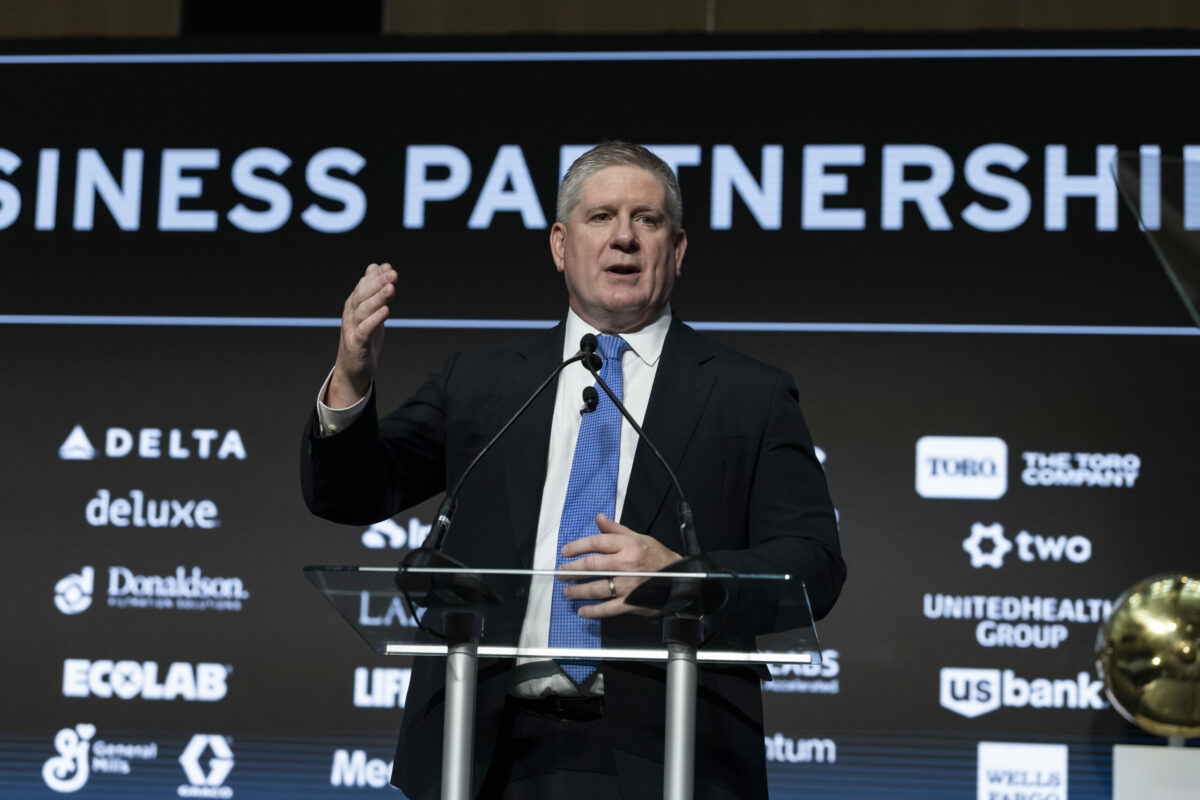
Kurt Zellers, who served as Minnesota House speaker for the 2011 and 2012 sessions, succeeded Weaver in 2023 in the top staff job that’s now called CEO. Zellers has a communications and public affairs professional background.
The person who is chair of the Partnership changes every few years and is held by one of the CEOs. The current Partnership chair is Medtronic CEO Geoff Martha, who brought corporate CEOs to his company’s Fridley campus last summer for a New York Stock Exchange event.
It’s unclear why Zellers and Martha didn’t develop a letter from Minnesota’s largest employers about the ICE/Border Patrol surge and immigration reform. They were both signatories to the letter released by the Minnesota Chamber of Commerce.
What business community is speaking?
On its website, the Partnership lists 96 members who lead the state’s largest employers.
The Minnesota Chamber of Commerce has about 6,300 members and represents small, medium, and large businesses from all corners of the state of Minnesota.
When the Minnesota Chamber released its letter on Jan. 25, which called for “an immediate de-escalation of tensions,” its news release said the “Minnesota Chamber of Commerce released this letter.”
That’s also the case with the Chamber’s posting on its website.
If you go to the Business Partnership website, you’ll see the letter, with this description: “The Minnesota Chamber of Commerce, in partnership with the Minnesota Business Partnership and Greater MSP, released this letter on behalf of more than 60 CEOs of Minnesota-based companies today.”
There are 64 businesses and organizations who signed the letter released by the Chamber.
Large public and privately held companies typically are members of the Minnesota Business Partnership and the Minnesota Chamber of Commerce.
Among the oddities about the Jan. 25 letter is that it wasn’t clear which business community was speaking when it was released. There were no quotes from anybody in the news release, and there was no attempt to characterize what segments of the Minnesota business community were represented by the signatories.
Many people who read the letter probably scanned the list of signatories and noticed they mainly came from the state’s largest companies.
Among the 64 signatories, 56 of them are members of the Minnesota Business Partnership. What’s more surprising is that 17 of the 20 Partnership Executive Committee members signed the letter.
It’s puzzling as to why Zellers and Martha didn’t advance a more specific and stronger statement from Minnesota’s largest employers, who are better positioned than small companies to take a risk and speak on somewhat controversial public policy issues. Why didn’t the Partnership’s leadership weigh in on Operation Metro Surge well before the Chamber’s Jan. 25 letter?
Brooke Lee, CEO of Anchor Paper, is the Chamber’s new board chair, and she signed the Jan. 25 letter. So did Ross Widmoyer, president and CEO of Faribault Mill, and the Chamber’s board chair-elect. But the 64 signatories didn’t represent a cross-section of the small and medium-size businesses that make up a large portion of the Chamber membership.
Doug Loon, veteran president and CEO of the Minnesota Chamber, can be credited with ensuring that some key Minnesota companies made some type of statement relating to the immigration enforcement action.
Loon also met with Vice President JD Vance on Jan. 22. Following that meeting, Loon’s statement was: “Our goal is clear: to help engage federal and Minnesota public officials [to] de-escalate the current situation and put our communities back on track.”
In recent years, Minnesota’s GDP has been growing more slowly than the national GDP. The chaos and safety concerns caused by Operation Metro Surge created a setback for the state’s economy.
To ensure a healthy recovery, Minnesotans need their business associations to advocate for reasonable policies that will spur growth.
Company CEOs are busy running their companies. But when profound challenges surface within the state, it’s important for big-company CEOs to lend their intelligence, reputational capital, and collective political clout to advocate for effective solutions through public communications.
Citizens need business leaders who aren’t afraid to take on public issues and challenges. Minnesotans need them to embrace their roles as community and statewide leaders, who are looking out for citizens, community institutions, and the private sector.
Of course, some candid conversations are best held outside the public view. But in times of crisis, there’s a need for clear, thoughtful, and specific public statements. On the immigration enforcement surge, the Minnesota Business Partnership missed the opportunity to be a strong, collective voice.