U.S. Bank Renews Downtown Lease, Will Leave Richfield Office
The office reshuffle has continued to unfold in the Twin Cities metro. But with U.S. Bank’s recent resigning of its lease for its downtown Minneapolis headquarters, the company has indicated it is committed to the city center as it downsizes in the suburbs.
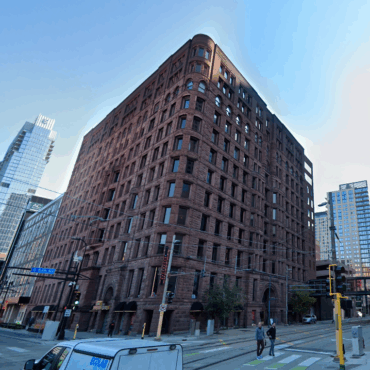
Last week, the bank announced that it has resigned its long-term lease for 447,000 square feet in the downtown building at 800 Nicollet Mall, a space it has occupied since 2000. The company also announced it will not renew its lease at Meridian Crossing in Richfield, noting that, like many companies, the way people work at U.S. Bank has shifted in recent years.
“Downtown Minneapolis is home to us. We’re pleased to sign a long-term lease on Nicollet Mall and remain committed to being a key part of the business community here,” president and CEO Andy Cecere said in the release. “It’s important to us that we contribute to the ongoing resilience of downtown and we believe this decision demonstrates that.”
In a news release, U.S. Bank officials noted that the company is “one of downtown Minneapolis’s leading employers and that isn’t changing.” Historically, U.S. Bank has consitently ranked among the top 10 employers in downtown Minneapolis.
With an increase in hybrid and remote work, the company is moving out of its 340,000-square-foot Meridian Crossings location in Richfield at the beginning of the coming year. Though hundreds of the 1,400 employees in Richfield will likely move downtown, the company expects most will move to its Excelsior Crossings facility in Hopkins, U.S. Bank spokesman Jeff Shelman said in an email to TCB.
“While we said that we expect some employees from Meridian Crossing to move downtown, we won’t exit that building until early in 2024. Because of that we have not determined exactly which groups will move where,” he said. The goal is to also allow some teams that currently sit in different buildings to be at the same location.
U.S. Bank joins a growing list of Twin Cities companies that have significantly downsized their suburban footprints.
Since late 2022, U.S. Bank has asked employees in hybrid roles to return to the office three days a week. Some employees are able to work remotely as well and others have returned to the office 100% of the time,
U.S. Bank also has locations in St. Paul: an operation center in Energy Park, an office building at West Side Flats, and the U.S. Bank Center in downtown St. Paul. The only lease that is coming due next year in St. Paul is the U.S. Bank Center. The company owns the Energy Park building and has a long-term lease at West Side Flats.
Minnesota has 15 Fortune 500 companies within the state that employ hundreds of thousands of people and occupy large swaths of office space. However, this also means the impact of remote and hybrid work on the office market has a larger impact on the direct communities within the metro, Doug Fulton, principal for Avison Young, said during a recent Economic Club of MN panel discussion.
Specifically, Fulton said a stabilized office market has leeway for about 15% vacancy. But, with the current hybrid working model, vacancy has increased by about 10%, Fulton said, noting that in the Twin Cities area office market, this equates to about 8 million square feet of space.
“So if you look at the top three of the top five Fortune 500 companies in our market – United Healthcare, Best Buy, and Target–between those three companies, they’ve given back almost 3 million square feet to the market, either in space they’ve moved out of that was leased or space they’ve moved out of that they own,” he said.
In the case of owned space, many employers either opt to lease it or sell it. Some buildings will be converted for reuse, others will simply take a while to lease, he said.
Avison Young’s Minneapolis-St. Paul office report for the third quarter of this year showed a 31.5% decrease in lease size from 2020 to 2023.
“There’s not enough demand to fill these buildings. So, for the economy, it’s going to be how do you create an environment that can either convert or figure out how to put employees back in these buildings,” Fulton said.