Twin Cities Train Routes Stuck in Purgatory
In early February, the St. Paul City Council passed a resolution supporting the creation of a passenger train from St. Paul to Kansas City. Such a train would connect with several Amtrak trains serving the West without requiring a backwards connection in Chicago, and it would connect the Twin Cities with Des Moines and KC, two regional centers Minnesotans travel to in volume.
The train is a priority of All Aboard MN (AAM), a passenger rail advocacy organization. The group recently issued a report suggesting MNDOT prioritize the train in the new State Rail Plan, to be released in March. The resolution garnered substantial media coverage. It led some to ponder how imminent such a train’s arrival might be.
The successful debut of Amtrak’s Borealis nearly two years ago gave many the impression that the Midwest was on the precipice of a rail renaissance. The reality is that government processes established in the Biden administration to streamline and accelerate regional rail creation have proven slow moving, due to cumbersome bureaucracy and the possibility that the Trump administration is uncommitted to the program, known as Corridor ID.
Corridor ID was designed to bypass Amtrak’s historic disinclination to add regional trains and the federal government’s disinclination to fund them. Under Corridor ID, the feds pay many startup costs, but eventually the states fund all losses. (Passenger trains lose money the world over.)
Borealis was a nearly decade-long effort that bore fruit without the Corridor ID program’s help. It was a comparatively easy lift because its entire route already hosted Amtrak service. So, stations already existed and the track was aligned for passenger train speeds. Plus, the Canadian Pacific Railway, which owns most of the route, was motivated to minimize typical objections to the new train because it was asking the federal government to approve its merger with Kansas City Southern.
The new routes AAM is focused on are comparatively more challenging. MSP-KC and the long-discussed NLX train to Duluth both require new infrastructure. They also demand the concurrence of a railroad that currently doesn’t have to host passenger trains on the route. (Freight trains operate more slowly and are often unscheduled, meaning they delay passenger trains without precise dispatching.)
NLX is the only Minnesota-based effort currently in Corridor ID. Even though the Minnesota legislature clawed back some NLX funds (for passenger train equipment), state funding to convert the BNSF route to 110-mph passenger standards remains intact.
Still, NLX is awaiting Trump administration approval to move to stage two of the three-stage Corridor ID process, whose endpoint is readiness to build.
Stage two creates a service development plan, but MNDOT needs federal funds and authorization to begin. This has been pending since May. “Our estimate is NLX is 7 to 10 years out,” says AAM’s Brian Nelson.
“Corridor ID moved very slowly under Biden. Many states were frustrated by the slow pace,” says Ian Weisser, analyst for the Wisconsin Association of Railroad Passengers. “It’s gotten worse under Trump. … NLX submitted its stage-one documentation to the Federal Railroad Administration in December of ’24. It was accepted in May. MNDOT has still not gotten approval to move to step two, which will take roughly 18 months to complete.
“My concern,” Weisser continues, “is that the civil servants [at the Federal Railroad Administration] are being told to make as little progress as possible.”
Weisser notes that 69 projects were accepted into Corridor ID in 2023, its first year. Four made it to stage two under Biden. None so far under Trump.
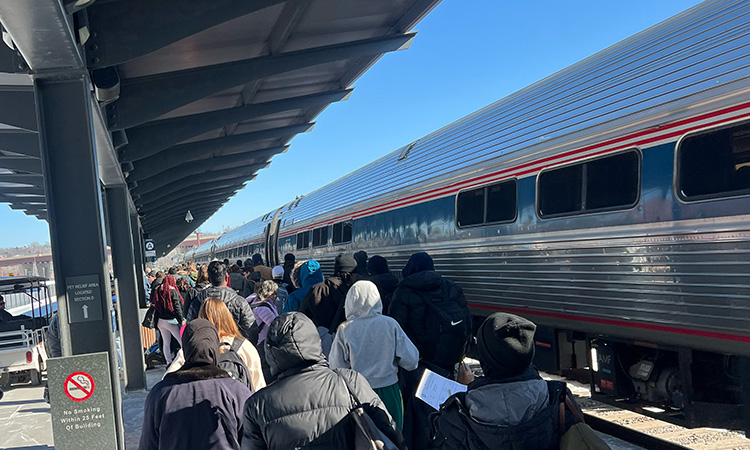
New Equipment Needed
There are other local rail projects in Corridor ID, but they are multi-state projects not led by MNDOT. Two were recently sent back to square one for remedial work: a commuter type proposal, from MSP to Eau Claire, and a train that would serve southern Montana from the Twin Cities and is coordinated by Montana interests.
AAM would like to see MNDOT apply to Corridor ID for two other routes: the aforementioned KC train and MSP-Fargo. The latter, like Borealis, follows the existing route of Amtrak’s Empire Builder, so it is passenger ready. AAM believes Fargo could operate as an extension of Borealis and would not require additional equipment. That’s good, because Amtrak is starved for it.
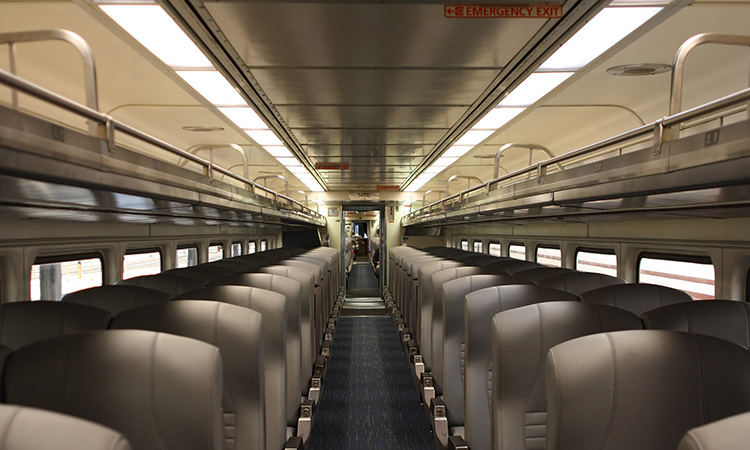
Most of Amtrak’s fleet dates from the 1970s and ’80s. New equipment is on order, and some of it is already operating on Midwest routes. But Minnesota has not bought into the Midwest equipment pool, so those trains cannot operate on Borealis, nor on any other Minnesota-based trains.
Amtrak’s equipment shortage has caused a shortening of Borealis and the discontinuance of business class and Wi-Fi. Weisser estimates the earliest that Amtrak will have surplus equipment for Borealis will be 2028.
“Equipment is a critical issue,” echoes AAM’s Nelson. “We don’t see the current situation resolving itself favorably. We would like Minnesota to buy into the Midwest car pool.” The new Midwest cars, built by the Siemens automation company, have proven problematic in extreme cold and snow operating out of Chicago corridors to date. Weisser notes Siemens has a five-year order backlog, were Minnesota to order compatible cars.
AAM would like to see MNDOT reprioritize MSP-KC in the new State Rail Plan. Nelson says it has worked with legislators in both state houses on the introduction of legislation that would require MNDOT to begin the Corridor ID process for Fargo and Kansas City.
As for Borealis, it faces challenges besides a lack of capacity and tired Superliner equipment from the late 1970s. The train is stored overnight outside Union Depot in St. Paul, which has led to freeze-ups on cold winter mornings (meaning no water or bathrooms). Advocates would like to see Amtrak park the train overnight at its old Midway station, where the train could remain powered for the roughly 16 hours it sits in town.
Finally, once certain funded infrastructure works happen in the Milwaukee area, the states of Wisconsin and Illinois will add an eighth Hiawatha frequency between Chicago and Milwaukee, possibly causing Borealis to be re-timed. This could yet happen in 2026.
There is a bit of good news in all the hurry-up-and-wait. Amtrak confirmed recently it was in negotiations with local officials to use the ex-Northstar station in Anoka to add a north metro stop for the Empire Builder after it leaves St. Paul.
But the larger message for advocates of passenger rail is that key stakeholders remain unmotivated. Adding even a second Borealis, although justified by patronage, remains a years-long effort with no discernable endpoint, while new trains remain dreams beyond the horizon.