


Twin Cities Business Person of the Year: Rob Vischer
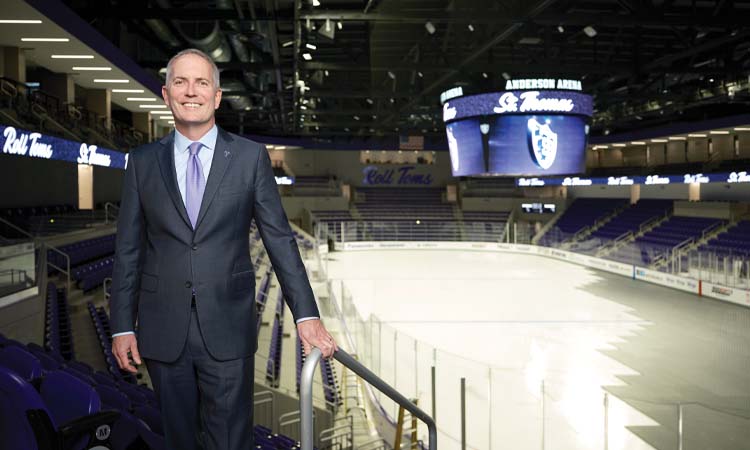
The opening of the Lee & Penny Anderson Arena is a key accomplishment of University of St. Thomas president Rob Vischer. Photographs by David Bowman
After earning a Harvard Law School degree and practicing law at Kirkland & Ellis, the nation’s largest law firm, Rob Vischer was a young man with many promising and lucrative career options. In 2005, Vischer accepted a position teaching law at the fledgling law school established in 1999 by the University of St. Thomas. Vischer and his wife, Maureen, both Midwest natives, decided they wanted to raise their young daughters in the Twin Cities.
Two decades later, Vischer is president of the university. For the fall of 2025, St. Thomas welcomed its largest freshman class in history, at 1,677 students. Total St. Thomas enrollment grew 4.6% from a year earlier to 9,876 students. For the fourth consecutive year, St. Thomas is on pace to raise more than $100 million from donors and benefactors. In October, St. Thomas opened a new $183.4 million arena in St. Paul, a testament to its success in leaping from NCAA Division III to Division I in college athletics.
Vischer wants his faculty to deliver exceptional academic experiences. However, he knows it’s critical for students to learn to adapt as technology and workforce needs change over time. If Vischer were the CEO of a for-profit business, his peers and competitors would acknowledge his company is having a good run. But Vischer isn’t producing manufactured goods or providing professional services. He is leading Minnesota’s largest private university that’s educating tomorrow’s workforce, and he recognizes that its students need more than discrete sets of skills to build long careers and lead fulfilling lives.
“What you find with high-achieving students is they’re picking up cues from the broader culture that they should always be thinking about what’s next,” Vischer says. It could be the next achievement or line on a resume.
Vischer wants St. Thomas students to also reflect on how they are growing as people, how their character is developing, and the virtues they need to incorporate in their lives. Going beyond what students are learning in their classes, Vischer says, “this is also a time of growth and development, where I want our students to be cognizant of asking themselves not just ‘What am I going to do next?’ but ‘Who am I becoming?’ ’’
Pat Ryan, chairman of Ryan Cos., says that Vischer’s intellect, leadership, and communication skills make him an excellent fit to lead a high-quality university, but Vischer also helps students understand what it means to be compassionate and involved community leaders beyond their professional lives.
Ryan is a member of the St. Thomas board of trustees and served as chair when Vischer was chosen to become president. Vischer’s term began Jan. 1, 2023. Vischer and Ryan repeatedly talk about how the St. Thomas mission guides faculty and administrators.
Ryan defines the mission as “to embrace young people with Catholic social teaching to do good in the world in whatever professional career they choose.” (Ryan is referring to Catholic values, not Catholic religious practices.) “We’re teaching the whole person,” Ryan says. “Our job is not to educate these kids just to get a job.” He also wants them to learn about their responsibility to “do good and contribute to a broader society.” Ryan says, “We’ve got to have great degrees that attract a lot of employers, but we want our students to become leaders in this world.”
“He’s really good with building consensus and bringing all parties along. That’s a strength today in a polarized environment.”
—MayKao Hang, dean, Morrison Family College of Health
D1 for Long-Term Success
While St. Thomas long has had a reputation for graduating large numbers of business students with bachelor’s and master’s degrees, it remains a private liberal arts school with a Catholic history. As demographic trends lead to fewer high school students, St. Thomas will be competing with other private colleges for those students.
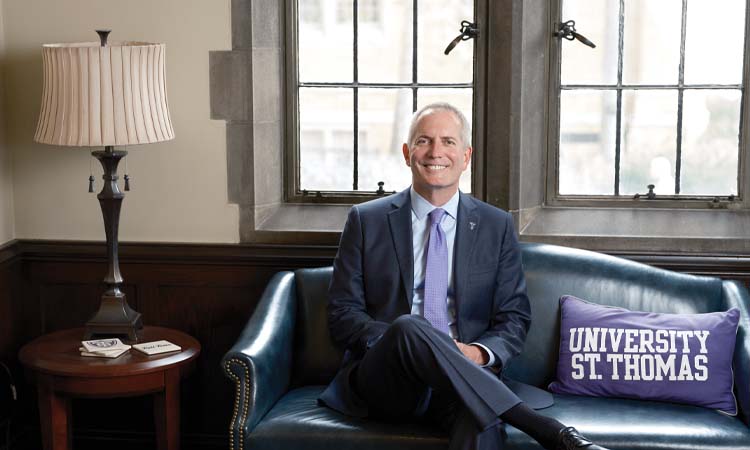
“Higher ed is now entering a winner-takes-most market,” Vischer says in an interview in his office in Aquinas Hall on the St. Paul campus. “We’re in a sweet spot in the market.” At just under 10,000 students, St. Thomas isn’t too small or too large, he says.
If you walk across the St. Paul campus, you’ll see many venerable buildings clad in gold-colored Kasota limestone. You’ll also see the Schoenecker Center, which was built for $110 million and opened in 2024. It now houses STEAM academic programs—science, technology, engineering, arts, and mathematics. The exterior is a collegiate Gothic style to mirror older campus buildings.
Many students don’t want to attend a college that is smaller than their high schools. “They want to have more externship opportunities, employment possibilities, on-campus activities, alumni engagement, and Division I athletics. We’re a good option,” Vischer says.
“At the same time, if they don’t want to go to a 50,000-student campus, where they have 300 students in their intro-level courses, we’re a good option,” he says. “We need to keep those small class sizes, that really strong faculty-student ratio, but we don’t want to get smaller, because there’s a scope and scale that is very attractive to prospective students because of the energy it brings and the opportunities it presents.”
A blast of St. Thomas energy was on display in late October when university students and alumni celebrated the opening of the 250,000-square-foot Lee & Penny Anderson Arena with men’s and women’s hockey games. Construction of the new arena was a huge milestone in the St. Thomas journey to move from D3 to D1 in college sports. The NCAA announced in June that St. Thomas had completed all the requirements to be reclassified as a D1 school.
Read more from this issue
Julie Sullivan, the previous St. Thomas president, started the process of transitioning to D1 and handed the baton to Vischer when she left Minnesota in 2022 to become president of Santa Clara University in California. 2025 is a watershed year for St. Thomas because it now can fully market itself as a D1 school with modern facilities for its hockey and basketball teams.
“We got kicked out of Division III,” trustee Ryan says bluntly. Because of its large student body and campus resources, several MIAC colleges argued that St. Thomas held an unfair advantage and was too dominant in the conference.
“Division I, for us, is a heck of a lot more than athletics,” Ryan says.
“We’re very fortunate that Division I gives us the opportunity to have a more national presence,” Ryan says, adding that St. Thomas can’t primarily rely on attracting students from Minnesota communities. “That population isn’t growing in Minnesota,” Ryan says. In 2025, about 79% of St. Thomas students are from Minnesota.
Ryan is proud that the current St. Thomas student body includes people from 48 states, three U.S. territories, and 103 countries. “We’ve got a long way to go, but I would hope within the next 10 years, we’ll have fewer than 60% of our students from Minnesota,” Ryan says.
Phil Esten, St. Thomas athletics director, says that Vischer immediately recognized the importance of becoming a D1 school. Several years ago, when Sullivan announced St. Thomas would attempt to qualify for D1, Esten says Vischer reached out to him. Vischer asked Esten to speak to law school supporters about what the D1 transition would mean for the entire university. “Both [Sullivan and Vischer] understood that athletics can play a role in helping to advance institutional priorities,” Esten says. “It isn’t just winning games at a Division I level. It’s how we can leverage the microphone and platform of Division I athletics to share some of the great things that are happening on campus—academically, socially, residentially, and otherwise, and engage our alumni and business communities.”
Quiet Boy to Harvard Law Student
Vischer was born in Muscatine, a little town on the Mississippi River in southeast Iowa. His parents got divorced when he was in grade school. He and his mother, and older brother and older sister moved to Glen Ellyn, Illinois, when Vischer was in the third grade.
“I was always a good student. I always loved to read and write,” Vischer says, as he recalls his public school education in a Chicago suburb. “When I was younger, I lacked confidence in who I was. So I didn’t actively participate in class or volunteer for speeches or things like that,” he says. He wasn’t the type of student who frequently raised his hand to answer questions posed by teachers. “I was preoccupied with not looking foolish and not making mistakes,” he says. “I tell my students today that the key path for growing and developing is a willing embrace of vulnerability, which I definitely didn’t have when I was younger but developed it as I got older.”
For much of Vischer’s childhood, his mother was a nurse and his father worked in marketing. As he got older, his mother returned to school and earned a master’s degree and a doctorate and became a college professor.
Vischer became editor of his high school newspaper. “I loved writing opinion pieces,” he says. “I also was interested in civics and government and politics.”
When it came time to select a college, he left the Midwest. “We didn’t really have any college savings, and I was leery of debt. So I ended up going to the University of New Orleans because they had a very good scholarship program that allowed me to go without taking on any debt.”
He graduated summa cum laude with a bachelor’s degree in political science. But that wasn’t his only academic interest. “I’ve always enjoyed theology and grappling with religious questions,” he says. “When I was coming out of college, I was trying to decide between graduate school in political science, graduate school in theology, or law school,” he says. “I decided law school would give me the most options on the other side.”
He was accepted at Harvard Law School, where he found his voice and gained the confidence he had lacked in boyhood. He was an editor of the Harvard Law Review and benefitted from the access that Harvard provided to prominent legal figures.
He recalls a memorable anecdote from the criminal law class he took from professor Alan Dershowitz, long before Dershowitz became a controversial political figure. “He would always use [U.S. Supreme Court Justice] Antonin Scalia as a foil, because Dershowitz had a very progressive understanding of the law and constitutional interpretations.”
A fellow classmate circulated a letter that Vischer and his peers signed to invite Scalia to debate Dershowitz in his class. “They did it, and it was spectacular,” Vischer says. “That was the kind of thing that was so cool about being at Harvard.”
After graduating from Harvard, Vischer had several clerkships with judges across the United States, and did corporate litigation work for the prestigious Kirkland & Ellis law firm in Chicago.
He distinctly remembers volunteering to judge a moot court competition at the University of Chicago Law School. Following the event, a law professor encouraged him to consider teaching. “After I gave feedback to the students on their performance, she commented that I seemed to be a natural teacher,” he says. “It was probably a two-minute conversation, but it meant a lot that this professor was affirming the teacher she saw in me.”
Vischer continued to practice law and started teaching as an adjunct faculty member at DePaul University College of Law in Chicago. “I was energized by teaching, and I missed being able to write about things that I was passionate about,” Vischer says, so he decided to pursue a career as a law professor. He had two more clerkships and then landed a job at St. John’s University School of Law in New York City, where he spent three years.
St. Thomas Enrollment on the Rise
The University of St. Thomas increased overall enrollment and freshman enrollment in the fall of 2025.
- Total enrollment (including graduate programs): 9,876 students, up 4.6%
- Freshman enrollment: 1,677 students, up 5%
- Top six undergraduate majors by enrollment: Business, engineering, nursing, biology, computer and data sciences, psychology
- Top three graduate programs: Juris Doctorate, business administration, data science
Vischer’s Rise to President
While he was at St. John’s, Vischer learned about an opening at the University of St. Thomas School of Law in Minneapolis. “I knew a couple of the founding faculty members [at St. Thomas],” Vischer says. “They were doing law school in a totally different way. Traditionally, law school can be a very isolating experience [for students]. They were putting relationships at the center of it.”
Vischer says that his wife wanted to avoid moving every few years and wanted to find a community where they could raise their daughters. “The more I learned [about St. Thomas], the more I thought it’s a place you can put down roots and make a difference,” he says. Vischer joined the law school faculty in 2005.
What does it mean to teach in a law school at a Catholic university as opposed to a secular law school? “It’s expanding the conversation in ways that connect with students, whatever [faith] background the students are coming from,” Vischer says. His tort class examined the infamous Ford Pinto case.
Ford analysts had written a memo in which they acknowledged “there’s some susceptibility to explosions on rear-end impact,” Vischer says. They noted that the problem could be remedied by installing a plate next to the gas tank. Analysts calculated the financial exposure that Ford likely would have for wrongful death cases. He adds they also estimated the cost of a recall and installation of the plates.
Even though Ford understood the risks of leaving defects in the Pinto design, the company put the car in the marketplace. Ford faced multiple lawsuits after people were badly burned or killed from rear-end collisions.
In his class, Vischer says, students were asked to look beyond the lens of “economic efficiency” and do readings from the perspectives of Catholics and other people on the topic of “human dignity.” Vischer explains, “I never prescribed what students should conclude, but we had a much richer conversation because they had these other resources that gave them language to articulate how a commitment to human dignity could be a path to rethinking Ford’s analysis.”
After several court losses, Ford recalled 1.5 million Pintos in 1978, and it stopped making the vehicle in 1980.
Vischer became dean of the law school in 2013. In a St. Thomas publication, the university noted that law students had twice chosen Vischer as their professor of the year. The article also referred to two books Vischer wrote: Conscience and the Common Good: Reclaiming the Space Between Person and State, published in 2010, and Martin Luther King Jr. and the Morality of Legal Practice: Lessons in Love and Justice, from 2013.
While he was law school dean, one of Vischer’s key priorities was helping graduates get jobs in the legal field. “If you don’t present a strong economic return for students, nothing else matters,” he says.
Vischer wanted the St. Thomas School of Law to be known for a high job placement rate. “The legal industry was dramatically impacted by the Great Recession, and hiring was down,” he says. “We had a laser focus on doing whatever we could to marshal the whole building to understand that everybody has a role in helping equip and empower our students for success in the job market.”
As president in 2025, Vischer holds a universitywide commitment to ensuring St. Thomas students land good jobs. “We place our students everywhere in all of the big companies,” he says.
“We do very well on employment outcomes,” he says. “Five years after graduation, our alumni have the highest average salaries of any college or university in Minnesota.”
Vischer got his opportunity to pursue the top job at St. Thomas in 2022. President Julie Sullivan resigned so she could move to California to lead a Catholic university with a Jesuit tradition and be close to her family.
Vischer was appointed interim president, and the St. Thomas trustees selected him in late 2022 to become the university’s 16th president.
Amy Rauenhorst Goldman, CEO and chair of the GHR Foundation, co-chaired the presidential search committee that evaluated candidates from across the nation. “Julie had started St. Thomas on a strategic plan and a trajectory to be a national university,” Goldman says. “We needed a president who could continue on this very aspirational path for St. Thomas.”
Looking back at his three years as president, Goldman says that Vischer has thrived in the job. She notes that Vischer, working with other St. Thomas leaders, shepherded the university through a $131 million fundraising campaign for the new arena as well as NCAA approval for the transition to D1. “It is proof positive that St. Thomas grabs opportunities,” she says.
In his presidential role, Goldman says, Vischer has formed authentic relationships with many constituencies—from donors to students. She lauds his “ability to listen deeply, ask profound questions, synthesize information,” yet reach decisions quickly.
Building Programs for New Student Populations
On Sullivan’s watch, St. Thomas opened the Dougherty Family College in 2017 on the Minneapolis campus. It’s designed to provide extra support for students, so they can earn a two-year associate’s degree and prepare for the rigors of a bachelor’s degree program. About 93% of those served by Dougherty are students of color. Through Dougherty, Ryan says, St. Thomas can educate students who historically “haven’t been in the pipeline.”
Some colleges won’t survive the coming “deep demographic drop” in high school students, Ryan says. When the trustees were contemplating Sullivan’s successor, Ryan recalls thinking that St. Thomas was at a transition point. “We’ve had plenty of innovation around here,” Ryan says. “We need execution. The way that you successfully execute is by getting people behind the why—why the university has done this. You align it with your mission, and then you’re going to get multiple people to execute.”
In 2019, St. Thomas launched the Morrison Family College of Health on the St. Paul campus. The demand for health care workers is growing, and Ryan says the College of Health is poised to meet the demand and to do so with a “community health” perspective.
In both cases, he says, Vischer has done a “marvelous” job of communicating what St. Thomas is doing in these distinctive programs and how they can benefit students and the communities where they work and live.
MayKao Hang is the founding dean of the Morrison Family College of Health. Hang says she spent an entire year meeting every other week with Vischer and other key leaders to map out a 10-year business plan for the college. The mission, she says, is to “move us towards whole-person health, and that would be physical, mental, social, and spiritual health.”
Hang has known Vischer as the law school dean and president. “He’s really good with building consensus and bringing all parties along,” she says. “That’s a strength today in a polarized environment.”
When he’s speaking, Hang says it’s clear that Vischer always understands who is in his audience. “Rob is a really good storyteller,” she says. She also appreciates his commitment to equity. “[He has an] understanding that there are differences in what we need to invest in students, systems, and people,” she says. “Rob is good with sharpening up the vocabulary for what we’re intending to do, and making everybody understand that so we can move forward together.”
“Higher ed is now entering a winner-takes-most market. We’re in a sweet spot in the market.”
—Rob Vischer, president, University of St. Thomas
Creating a Culture of Encounter
Athletics director Esten uses the word “inquisitive” to characterize Vischer’s state of being. “He’s very much a leader who is trying to learn every single component and capacity of the organization,” Esten says.
In today’s work as president, Vischer continually poses questions to students and faculty. But he also has a history of introspection. “I grew up as an evangelical Christian,” Vischer says, and he was confirmed in the Catholic Church when he was in his mid-30s. “That faith journey has always been important to me.”
Now 55, Vischer is still wrestling with big life and leadership questions, and he expresses his thoughts in regular Sunday reflection columns that he writes and sends to about 1,500 St. Thomas faculty members, staff, and board trustees. “It’s a reflection on some aspect of our mission as it connects with the world today,” Vischer says. On some Sundays, he adds, he writes about “how I’m prioritizing my time and spending time with students, and not just the shiny, high-achieving students.”
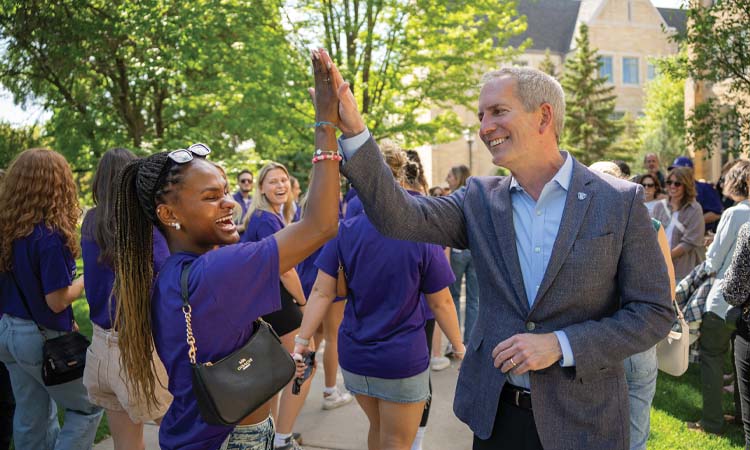
He makes time to listen to students and talk with them about the importance of human connection and civil conversations. “Even in his inaugural address, he highlighted that a theme of his presidency was going to be building a culture of ‘encounter,’ ” trustee Goldman says. “Rob has embraced that as a way to run a university, and I think that’s absolutely brilliant.”
Trustee Ryan also is a big proponent of this cultural approach during a time of deep political division. At its core, he says, people readily engage with others—from different races, religions, and political backgrounds—and they encounter other people “not with the intention of persuading, but with the intention of understanding.”
A culture of encounter creates civility on campus, but it also supports good, respectful relationships. More conversation is also a way for Vischer to address a high rate of loneliness among young people. “When I am in healthy relationships, when I know people and I am known, it’s also when I do my best work. It’s also where I draw my energy,” Vischer says.
“When I was younger, I so appreciated the connections that more senior people would make with me, to go out of their way to encourage me, to bring me to lunch, or to go get a cup of coffee,” he says. “I try to notice those [students] who might seem like they feel invisible or are just kind of drifting.”
As he prepares students for careers at all levels of organizations, he’s critical of workplaces that fail to affirm people to be themselves. “It can be so demoralizing where you feel like you’re checking yourself at the door of the office and then just becoming this fungible worker drone who is accomplishing tasks but not bringing your identity into the work you do,” Vischer says.
By candidly talking about these types of issues, Vischer hopes to model healthy workplace behavior and enlighten future business and nonprofit leaders about how to create environments where people want to be. In addition, he’s describing how to lead an integrated life in which the same personality shows up with family, co-workers, and in the community.
“We are made for connection, authentic connection,” Vischer says, “where you’re bringing your best self forward to meet someone else where they’re at.”
View Rob’s on-stage interview from our Dec. 3 event: