
Study Probes Converting Empty Offices Into Dorm-Style Units
Could dormitory-style housing help revitalize downtown Minneapolis? A new study looks into the feasibility of converting unused office floors into rows of very small, mostly single-occupant residential units with communal kitchens and bathrooms.
Just how small? Where a typical studio apartment might span around 450 square feet, these proposed “coliving” spaces would measure just 150 feet apiece. Each unit would have space for a bed, desk, nightstand, minifridge, and microwave, not unlike a college dorm room. Residents would then have access to a shared kitchen and bathrooms in the center portion of the floor.
The study, conducted by the Pew Charitable Trusts and San Francisco-based architectural firm Gensler, evaluated the possibility of converting commercial properties into coliving projects in Minneapolis, Denver, and Seattle. The study’s authors say the conversion could solve two problems at once: a glut of empty office buildings and a growing affordable housing crisis. It’s a novel, if untested, answer to twin real estate crises that have so far evaded any easy solutions.
“We’re talking about much lower rents than we would with anything else in the market,” said Alex Horowitz, project director for Pew’s housing policy initiative, in a webinar with reporters. “Adding housing in a market – of any kind – improves affordability by adding supply, but adding low-cost housing could be especially effective here by creating a new rung on the housing ladder.”
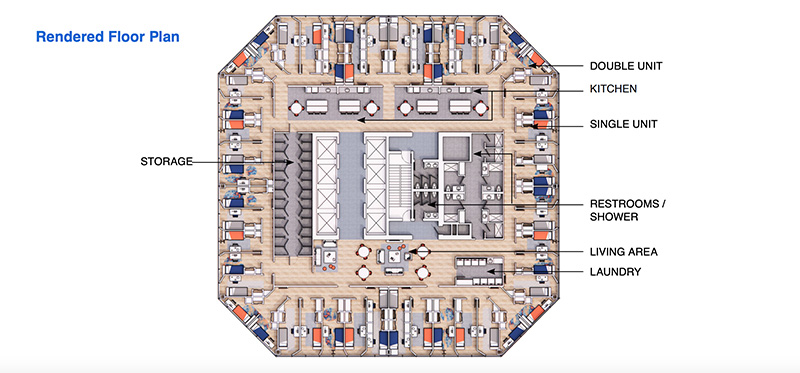
In Minneapolis, the estimated cost of rent for a single unit could be between about $500 and $1,000, according to the study. That equates to about 20% to 50% of local area median income levels for single-person households.
The report also looked into construction costs for developers and potential business models for coliving projects. In Minneapolis, the total cost for such a conversion would be upwards of $180 million, not including any additional government subsidies. Wes LeBlanc, principal and strategy director at Gensler, said coliving projects have an operating model that could be “appealing to both the investment side and the nonprofit operator side.”
“There’s an opportunity for an investable product here in many cases,” he said.
To be sure, office-to-residential conversions have been discussed for years, even before Covid-19 emptied central business districts around the nation. But the standard office floorplate doesn’t generally lend itself to traditional apartment units, which each require their own plumbing and other fixtures. Coliving projects would theoretically circumvent that problem through communal spaces.
But who would live in these coliving units? Horowitz said these projects could work with a “broad range of tenants,” in addition to lower-income residents.
“Maybe institutions would rent a whole floor of a building,” he suggested. “A hospital, a university, a city that’s looking for supportive housing, because every floor of the building would be secured with key card access and is therefore a little community.”
Horowitz said that coliving projects could also decrease homelessness, which reached a record in 2022.
The concept of coliving spaces isn’t entirely new; “single-room occupancy” units were once commonplace around the nation.
“In the mid-20th century, most cities in the U.S. were characterized by an abundance of lower-cost housing typologies, particularly single-room occupancy (SRO) dwellings,” the report stated. “Starting in the 1950s, restrictive zoning and building codes and financial incentives resulted in the elimination of SROs as an affordable housing alternative. Between the 1970s and the 1990s alone, it is estimated that the United States lost 1 million SRO units to conversions and demolitions.”
The study noted that SROs are permitted in the downtown Minneapolis zoning district, and said that regulatory barriers in the city are relatively “low.” In addition, the study’s authors noted that Minneapolis councilmembers in June introduced a new ordinance aimed at facilitating the conversion of office buildings.
“Proposed updates include accelerating review process timelines and eliminating the need for public hearings and other steps of the review process,” the study said.