Red Lake Nation College to Open Downtown Minneapolis Location
Red Lake Nation College is set to open a new location in downtown Minneapolis, marking the first tribal college located in a major urban area.
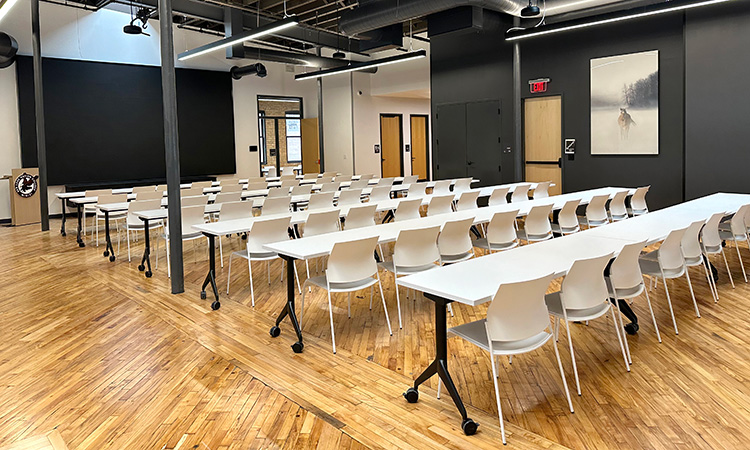
With construction completed on the new $16.2 million site, classes are set to begin at the three-building campus. RLNC began offering classes in Minneapolis through distance learning and temporary classroom locations in fall of 2022.
The college will host a formal opening on June 6 at 900 S. 3rd St. Minneapolis. The new location sits one block north of the U.S. Bank Stadium in the former Tiger Oak Media headquarters.
“We need doctors, lawyers, teachers, social workers, business managers, accountants,” said RLNC President Dan King. “Education is such an important way for us to ensure our survival as a tribe.”
The expansion was financed by the college’s fundraising, federal funding, and a $3 million grant from the state of Minnesota after the project cost continued to grow during the Covid-19 pandemic, King said.
Native-owned firm Full Circle Planning and architecture firm Firm Ground were involved in the design and planning of the new site.
King said the college will have an additional revenue source from renting out the building for corporate meetings, weddings, or Vikings events, given its proximity to the stadium.
The expansion was prompted by demand from members of Red Lake Nation living in the Twin Cities for a tribal college they could attend close to home, King said. Half of Red Lake Nation’s 16,000 members live outside of its reservation in northern Minnesota, and most are in the Twin Cities metro area.
Ojibwe language, culture, and values are weaved in the learning at RLNC, King said.
“A lot of our Native people —and this is true all around the country — haven’t usually had a good experience with education,” King said. “Our history and our language is totally left out.”
Seventy percent of the college’s staff and faculty are Native. For many of the students, it’s their first time having an instructor who is also Native, King said.
Bringing a culture-based education option to Natives in the Twin Cities has helped RLNC grow enrollment by about 35% per year, King said. Enrollment is open to anyone with a high school diploma or GED, and thanks to online-flexible class formats, the college also serves Native students as far away as New York, Florida, and Michigan.
King said he thinks the college will continue to grow at its current rate for a few years, likely leveling off at 500 or 700 students per year to maintain small class sizes and one-on-one attention.
RLNC offers a dual-enrollment program for high schoolers to start earning college credit, King said. Its partnership with Red Lake High School enrolled about 45 students at one point prior to the Covid-19 pandemic. The Robbinsdale and Roseville school districts are currently partners in the college’s postsecondary enrollment option program in the Twin Cities. King said the college aims to expand to work with other districts.
Many students come in with ninth or tenth grade level educations, and King said the college spends time playing catch-up to ensure they can graduate with an associate’s degree and enter the workforce or transfer to schools like the University of Minnesota, Augsburg University, and Dartmouth College.
“We don’t want them to just get a two-year degree and stop. We want them to get a four-year, a master’s, or a professional degree, and then come back and help their communities,” King said.
Many students from the Red Lake campus go on to study within the Minnesota State University system, while Metropolitan State University and Augsburg University are common transfer outcomes in the Twin Cities, King said. RLNC has transfer articulation agreements with all public universities and some private colleges in Minnesota, allowing students to apply all earned credits to their new degree program.
Augsburg University offers free tuition for Native students, and those enrolled at the University of Minnesota with household incomes below $125,000 can also attend for free.
The college’s higher learning commission accreditation means they have to meet the same standards as schools like the University of Minnesota.
“We want to make sure that our students aren’t wasting their time, and anything they get here, they can transfer it to wherever they want to go,” King said.
After graduating, all students have either transferred to a four-year school or started a job and earned $10,000 more per year than when they first enrolled, King said.
Students with college graduates in their family can ask for help filling out forms and navigating classes, but many RLNC students are the first-gen and lack that support, King said.
“Our staff and faculty are like the uncles, the aunts, and the parents who went to college. We all help,” King said.
Part of that close connection is having small classes — 12 to 15 students on average — as well as having each student assigned to a staff member for individual meetings to ensure they are doing well academically and personally, King said.
“Our secret recipe is one-on-one attention,” King said.
King said students from other tribes share many of the same values and are welcomed as much as members of the Red Lake Nation, and after they graduate, they’re encouraged to go back and help their communities.
“It’s a win-win situation for all of us,” King said.
[Editor’s note: This story has been updated to reflect Firm Ground Architects & Designers’ involvement in the project.]