Q&A: MN Cup Winner Dori Jones
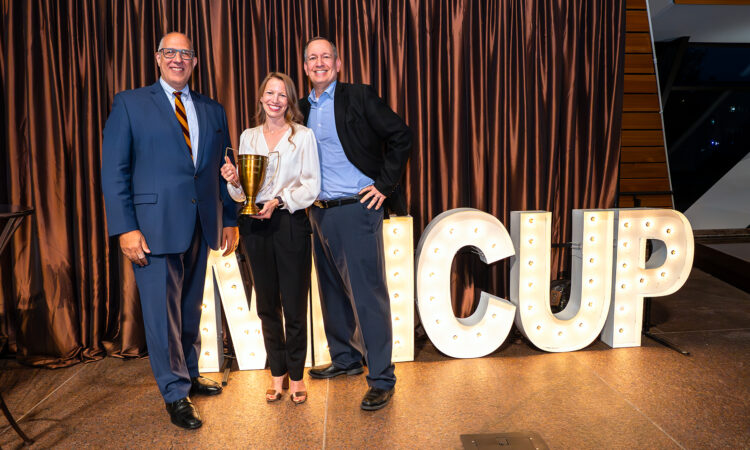
Not many businesses are dedicated to pediatrics, says CEO Dori Jones. “A lot of companies view it as a small market.” Jones’ business doesn’t, which is one reason she says AcQumen Medical stands out. The Golden Valley-based company also just won the $50,000 grand prize at this year’s MN Cup.
It earned $100,000 total. AcQumen netted $25,000 by winning in the “Life Science & Health IT” division of the annual statewide startup competition. And Jones won another $25,000 in the category of women-led businesses. During MN Cup’s finale on Oct. 6, AcQumen presented for 12 minutes to a review board at the McNamara Alumni Center on the University of Minnesota campus.
“I always like to share that my personal story is part of who we are as a company,” Jones adds, “being the mom of a NICU baby and pediatric ICU patient.”
AcQumen picked up the top prize for its device that monitors blood flow in infants—crucially, in a noninvasive way. “The current solution is an invasive catheter procedure,” Jones says.
Jones’ background is in engineering, and she has spent her career in cardiac and critical care devices. She formed AcQumen in June with four co-founders. One of them, chief technology officer David Lerner, approached Jones several years ago, she says, with the idea to combine two technologies—ultrasound and impedance—to improve the accuracy of blood-flow monitoring.
At the time, she was in and out of the hospital with her son, who had been in the neonatal intensive care unit (NICU) as a baby. “I said, ‘We have to look at pediatrics,’” recalls Jones, who has worked mostly in adult technologies. Interviewing clinicians, she heard about an unmet need for noninvasive blood-flow measurements for children and infants.
AcQumen’s device, UltraTrac, taps decades-old technology known as impedance cardiography. The idea is to use electrodes on the skin, a la an EKG, to measure blood flow across the chest and then calculate cardiac output, or how many liters of blood per minute are pumping through the body—which is as important to track as blood pressure and heart rate, she says, if not more. But it’s “really difficult to obtain.”
The AcQumen team’s innovation is to make up for the shortfalls of impedance technology using ultrasound. “Each of the two technologies that we’re combining addresses the limitation of the other,” she says.
The company designed a custom ultrasound sensor—a miniature one, applied to the neck. “But the magic is in the algorithm that combines those two signals,” she says. “That’s what’s really new and novel.”
MN Cup this year saw a record 1,297 applications, eventually narrowed to nine finalists. Swinergy, a Minneapolis-based startup converting livestock waste into energy, was the runner-up.
This interview has been edited for length and clarity.
Do you have an idea how you’re going to spend the money?
Absolutely. We start clinical studies this month, so that is going to directly support our clinical research of UltraTrac [and] the materials required. Part of our revenue model is that we have single-use electrodes, so we’ll be providing that for this study. And there are still some development efforts, as we learn from these clinical studies, to be able to refine things like the user interface, to make sure that our device is really designed for our users.
Through this process with MN Cup, what have you learned, or what will stick with you?
First, I feel like we entered this competition at such a perfect time for our company. We had an investor pitch deck. We had financial projections. We had a business plan. But the feedback that we got from the judges made our material so much better. Just by the nature of the deliverables that were required for Minnesota Cup, it really accelerated our business in a lot of ways.
As an engineer and as somebody that’s worked in medical devices for 18 years, I get very excited talking about the problem and the solution, but Minnesota Cup really helped me refine my messaging around AcQumen Medical as a business and the excitement of our revenue model and the opportunities that we’ll have for growth in the future.
How does the company’s work with clinical partners contribute to its success?
AcQumen is part of several pediatric device consortia around the country, and they offer grant support. They offer resources, almost like an accelerator—so, access to support for regulatory and reimbursement and a lot of nuanced services that are required when you’re developing a medical device but, specifically, with people that understand pediatric health care, which is unique from adult technologies and adult health care systems.
They really want us to succeed, and that now includes not just our partners through these [pediatric device consortia] but also clinical partners at academic children’s hospitals that are really driven to help us create this solution for their patients. I’ve worked most of my career in adult technologies, and I’ve never experienced the level of enthusiasm as I have with this company and what we’re developing.
They’re helping to support us with early clinical validation studies. We’ve gotten access to hospitals. So, we’ve spoken to doctors, nurses, but also administrators, chief financial officers, chief nursing officers, clinicians that sit on value analysis committees. So, we really have access to a lot of different people within these hospitals, because, as I said, they want us to succeed.
How has AcQumen raised capital? What channels have you gone through?
We are initially founder funded. We did a small pre-seed convertible note round to get some initial capital. We have several non-dilutive grants and awards, MN Cup being part of that—but a handful of others, as well. That has funded us to this point of getting to clinical studies, which means not just the partnerships that we’ve built, but we’ve developed a clinical-grade, working version of UltraTrac in just over a year’s time. So, that’s really exciting.
We are currently doing a seed freeze, but I’m very sensitive to SEC regulations and so not looking to share specific details about that. But we have gotten some traction with some venture capital and angel groups. Actually, our lead investor is a Minnesota VC, which is fantastic.