Minnesota Chamber Calls on State to Fast-Track Environmental Reviews
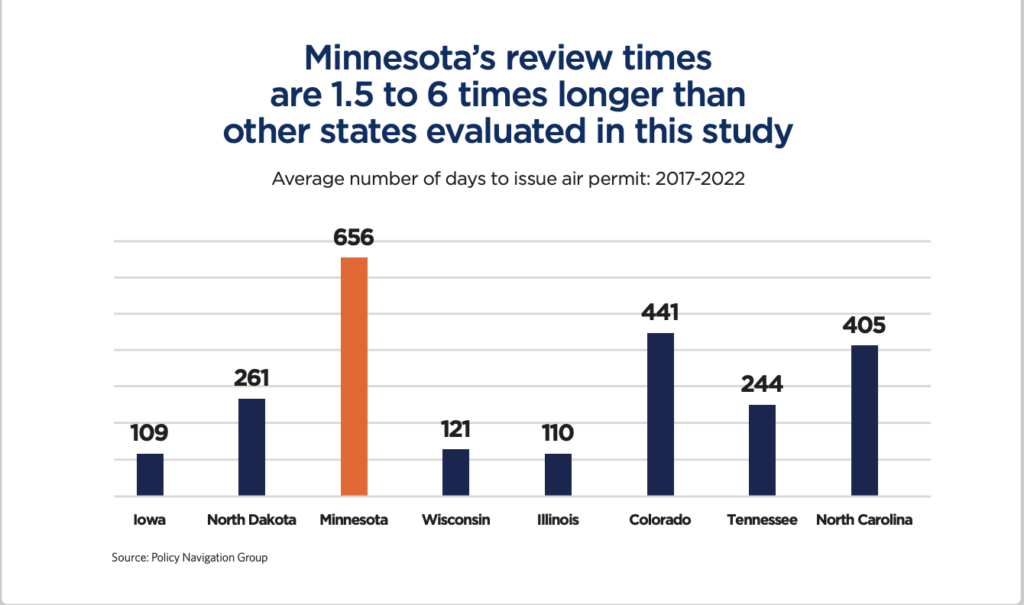
656 days. That’s the average length of time it’s taken to issue an air emission permit in Minnesota, according to a recent study by the Minnesota Chamber Foundation.
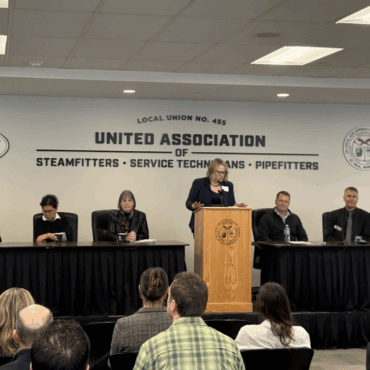
For perspective, that’s almost six times as long as it’s taken to issue the same kind of permits in Illinois, Iowa, North Dakota, and a handful of other “peer states,” the report stated. In a web call with reporters on Thursday morning, Minnesota Chamber leaders joined the state’s largest construction union to call for ways to “streamline” environmental processes here.
The report evaluated permitting processes in Minnesota and seven other peer states over the last five years. The Minnesota Chamber Foundation, the nonprofit research arm of the chamber, tapped Barr Engineering, the Policy Navigation Group, and law firm Squire Patton Boggs to produce the report.
Minnesota’s lengthy permitting process, the chamber argues, is having a detrimental effect on the state’s economy and sending lucrative projects to other states. According to the report, Minnesota stands to gain somewhere between $260 million and $910 million in “annual economic output” if its air permitting processes matched its peers. Last year, the chamber issued another report warning that business expansion projects are leaving Minnesota faster than they’re coming in.
Paradoxically, Minnesota’s environmental processes have even slowed down or scared away projects that could theoretically lower carbon emissions, chamber leaders said on Thursday.
Still, at a time when the effects of global warming are top of mind for legislators and citizens alike, calls to speed up environmental permitting are sure to be met with skepticism. Doug Loon, the chamber’s president and CEO, was careful to say that his group isn’t asking state lawmakers or agencies to lower standards, but instead to make them more predictable, transparent, and timely.
“We’re not looking to compromise Minnesota’s high environmental standards,” Loon said. “We expect to protect our air and water. These are cherished assets. These are items that are important to our citizens.”
So how exactly can Minnesota speed up environmental review processes without unleashing environmental disasters? The report spells out more than 30 recommendations, largely focused on updating sluggish administrative protocols. For air permits, for instance, the report suggests that the Minnesota Pollution Control Agency, or MPCA, “review and revise the approach to completeness evaluations.”
“A common perception among permitting consultants and applicants is that the MPCA staff conducting completeness reviews are exceedingly strict, and frequently the ‘deficiencies’ identified are minor issues that could easily be resolved with a brief conversation,” the report stated. “The MPCA could encourage these staff to contact applicants before deeming an application incomplete, and potentially reduce rework for both the applicant and MPCA staff.”
The report also recommends that Minnesota issue separate permits for construction and operating. The chamber pointed to Illinois, which “has one of the shortest average permitting issuance durations, and used to have a combined permitting program like Minnesota but now issues separate construction and operating permits.”
“Permitting issuance durations could be shorter if the MPCA issued separate construction and operating permits,” the report said. “A standalone construction permit could focus only on the new or modified equipment and could be a streamlined document compared to the combined (construction and operating) permits the MPCA currently issues. A shorter, more focused document may provide benefits to the general public, applicant and the MPCA.”
The chamber’s report said that MPCA should aim to issue “Tier 2” air and water permits within 150 days. These types of permits are for larger facilities and require public comment periods. The average time to issue a “priority” Tier 2 industrial water permit in Minnesota was about 476 days over the last five years. Some Tier 2 projects have taken over 1,000 days to get a permit.
Compare that again to Illinois, which has similarly robust environmental protections as Minnesota, but averaged 110 days to issue federal air permits within the last five years. “Other states have proven that high environmental standards and efficient decision-making are not mutually exclusive,” the report said.
The report notes that MPCA already issues most Tier 1 permits – those for “lower-impact” projects that don’t require public comment periods – in about 90 days.
A prominent labor group backs the Minnesota Chamber’s suggestions. Jason George, the elected business manager and financial secretary for International Union of Operating Engineers Local 49, said that Minnesota’s review processes are putting thousands of “good-paying union jobs” at risk. The union, which George said is the largest for construction workers in the state, represents 15,000 workers.
“There’s tremendous opportunity in this country right now for private development, private business, and private industry to grow and build, and it’s not happening here in Minnesota,” George said. “That’s really disturbing to me. It should disturb and be raising red flags and alarm bells for everybody in this state.”
Loon said that the chamber has visited with MPCA staff to discuss review processes, and George noted that both that agency and the Minnesota Public Utilities Commission have “acknowledged” there are issues in the current framework.
In an email to TCB, a spokesperson for MPCA agreed that “applicants should not wait years for a new permit.”
“The Minnesota Chamber Foundation’s permitting report provides an important snapshot of the MPCA’s permitting process. Behind each data point, there is an impacted community and facility — each with unique circumstances that may require data analysis and thoughtful solutions to complex problems,” the MPCA spokesperson said. “We look forward to working with all Minnesotans, including the Minnesota Chamber of Commerce and policymakers, to find common ground to further improve the state’s permitting process and protect our environment and human health. ”
George with the Local 49 said he doesn’t believe “there’s much disagreement that we have an issue. My point of view is that this is urgent. This needs to be a priority.”