Minneapolis Company Proposes Alternative to Drug Take Back Programs
With much of the country stuck inside for the foreseeable future, the potential for prescription drug abuse has grown significantly. In early April, members of the Trump administration said the Covid-19 pandemic could turn back the clock on efforts to curb the opioid epidemic. And like scores of other events across the country, the Drug Enforcement Administration’s national drug take back day—originally scheduled for April 25—has been postponed until emergency guidelines are lifted.
But one Minneapolis company says it has a solution in the interim: A way to destroy drugs without leaving home.
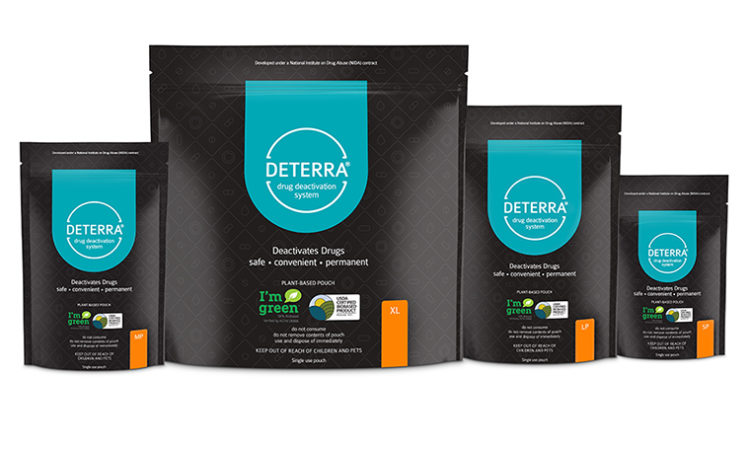
Jason Sundby, CEO of Minneapolis-based Deterra, says he’s teamed up with national nonprofit SAFE Project to distribute his company’s drug-deactivation pouches to households across the country. The campaign, which is providing the pouches for free, started April 24 and runs through May 10.
“Any abusable drug in your home can be a recipe for disaster,” Sundby said. “It only takes about four days for the brain chemistry to change to become addicted to opioids.”
Deterra’s pouches use activated carbon to render drugs inert. After medications are placed into the pouch, the user adds some water and then throws it away in the trash as normal. Sundby says the system destroys drugs without any adverse environmental effects.
Of course, there are a handful of similar drug disposal pouches on the market, but Sundby says his “uniquely focused” on environmental concerns. He launched parent company Verde Environmental Technologies Inc. in 2011.
“We didn’t want to work on the opioid crisis and neglect the environmental contamination piece,” he said, noting that the pouches are mostly composed of sugar cane.
Though Deterra is a private, for-profit company, Sundby maintains that the company has an altruistic bent. He said he’s able to distribute the pouches for free through donations from his own company and from the SAFE Project. The campaign, known as Gone For Good, marks the first time Deterra has partnered with SAFE Project, which was founded in 2017 by a retired Navy Admiral and his wife after their son died by an accidental opioid overdose.
As for Deterra’s typical customer base? Sundby said it’s primarily composed of large-scale pharmaceutical companies and health care providers, such as McKesson, Cardinal Health, and OptumRx, UnitedHealth Group’s pharmacy benefit manager.
“We sell to pretty much every market segment that touches pharmaceuticals,” Sundby said.
He declined to share specifics about Deterra’s financials, but he noted that the company has grown from the six-figure range to more than eight figures. Finances aside, the company’s larger mission is to help alleviate the country’s prescription drug crisis, Sundby said.
And in the face of mass unemployment, the crisis could get even worse: Sundby said that for every 1 percent that unemployment grows, opioid deaths grow by more than 3 percent.
“Experts are predicting that there’s going to be a large spike in overdoses because we’re driving people in when they’re fearful and stressed out,” he said.
For Sundby, that underscores Deterra’s larger purpose.
“The idea is to get rid of unused and unwanted medications from medicine cabinets,” he said. “We’re a company with a mission.”