Inside Duluth’s New Hospital
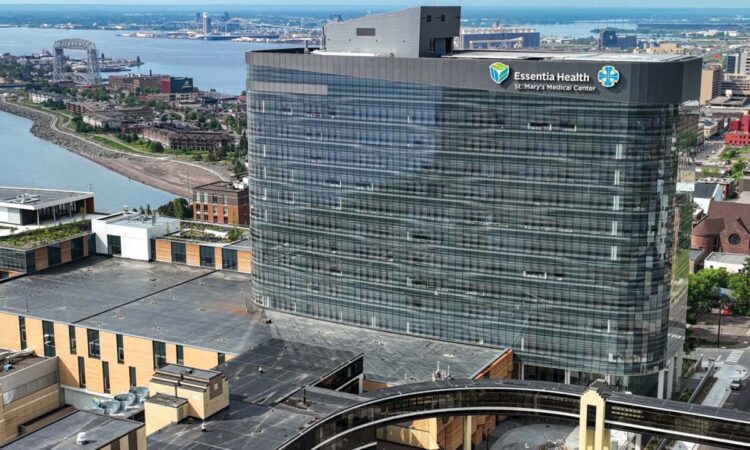
Visitors to Duluth can’t miss it: An 18-story glass structure looming over downtown, just off I-35. St. Mary’s Medical Center, the primary hospital of Duluth-based Essentia Health, opened this past summer. At 344 beds, it’s not quite on the scale of Mayo Clinic’s Destination Medical Center project or any Twin Cities-metro hospital. But it will have a similar impact on the northern Minnesota health care market. TCB spoke to Jan Schade, senior vice president of operations at St. Mary’s, about the game-changing structure.
“The biggest thing is that we are now able to provide patient-focused care with private rooms,” Schade says. The previous facility had double rooms with shared bathrooms. “Particularly during Covid, we struggled with maintaining proper air exchange for patients with respiratory infections,” she adds. Private rooms allow the hospital to change the airflow—it can close off a room, an entire floor, or the entire building.
The new St. Mary’s has incorporated sustainability elements, including LED lighting and water waste-reduction technologies. Windows have been designed to prevent bird strikes. It earned Best in Competition recognition at the 2023 International Interior Design Association Healthcare Design Awards.
Despite its eye-catching design, the new St. Mary’s is actually a little bit smaller than the hospital it replaced. “The actual number of functional beds is about the same,” Schade says. The old hospital had grown in stages and spurts. “Every floor was different; every layout was different,” she notes. In the new facility, every floor is laid out the same way. One advantage: The hospital can program robots to deliver equipment and supplies.
- The new hospital provides a number of technology enhancements:
- Staff and providers use smartphones instead of pagers.
- Parents can watch on their devices as babies are treated in the neonatal ICU.
- Badges with wireless functionality allow staff to summon emergency help within seconds.
- Medical residents and nursing students can observe surgeries remotely, out of the way of the surgical team.
Essentia could have built its new hospital up over “the hill,” where the land is flatter and more hospitable to construction. Instead, it chose to stay downtown. With its challenging topography and massive amounts of subterranean rock, Schade notes, “it’s not easy to build on a hillside on the shore of Lake Superior.”
By the Numbers
Square footage: 942,000
Number of rooms: 342 single-occupancy
Number of floors: 18
Cost: $900 million
Patient market: West to Detroit Lakes, north to the border, east to Michigan’s Upper Peninsula, south to the Brainerd lakes