Economic Empowerment: SHEletta Makes Me Laugh
Being quiet has never been Sheletta Brundidge’s style.
Since Brundidge was a young girl in Houston, she was “always energetic, always a talker, always fun,” says her sister, Darcea Handy.
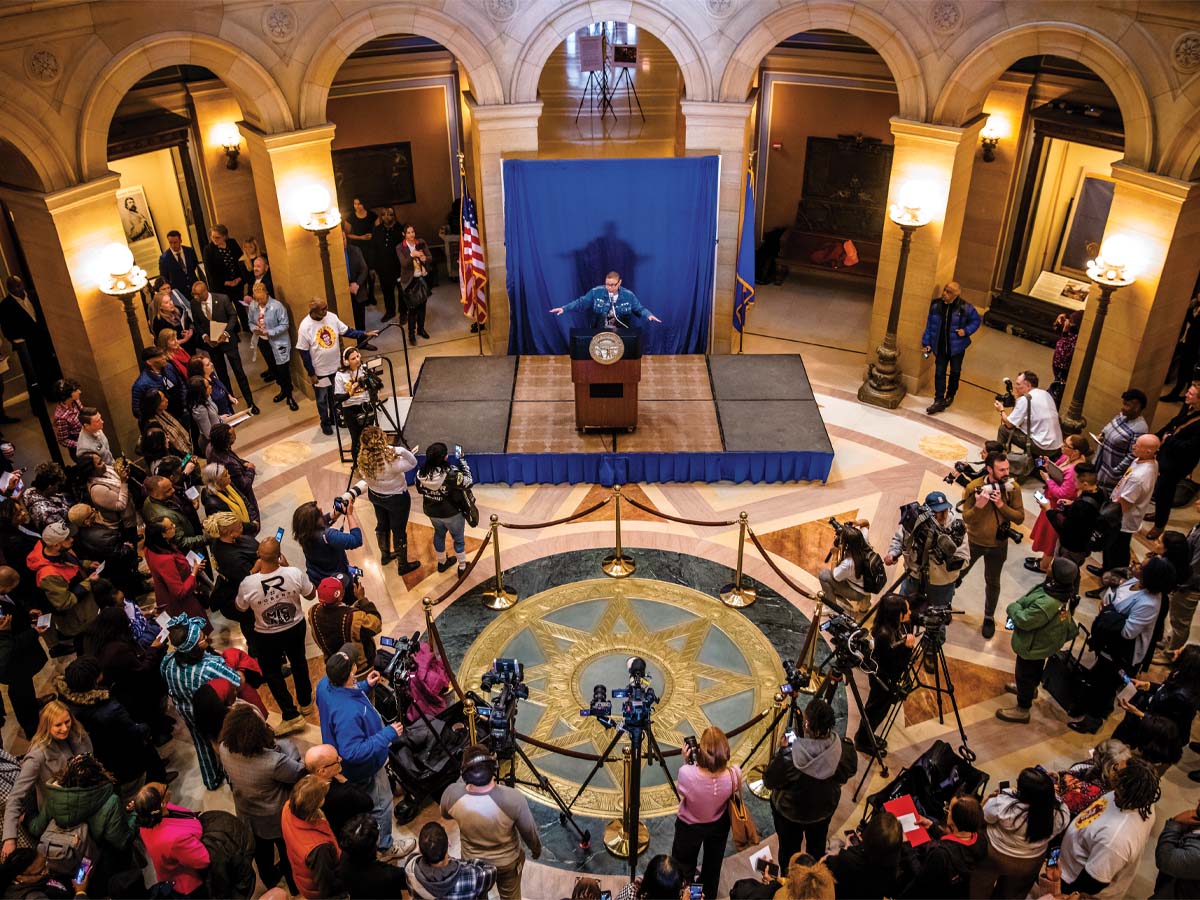
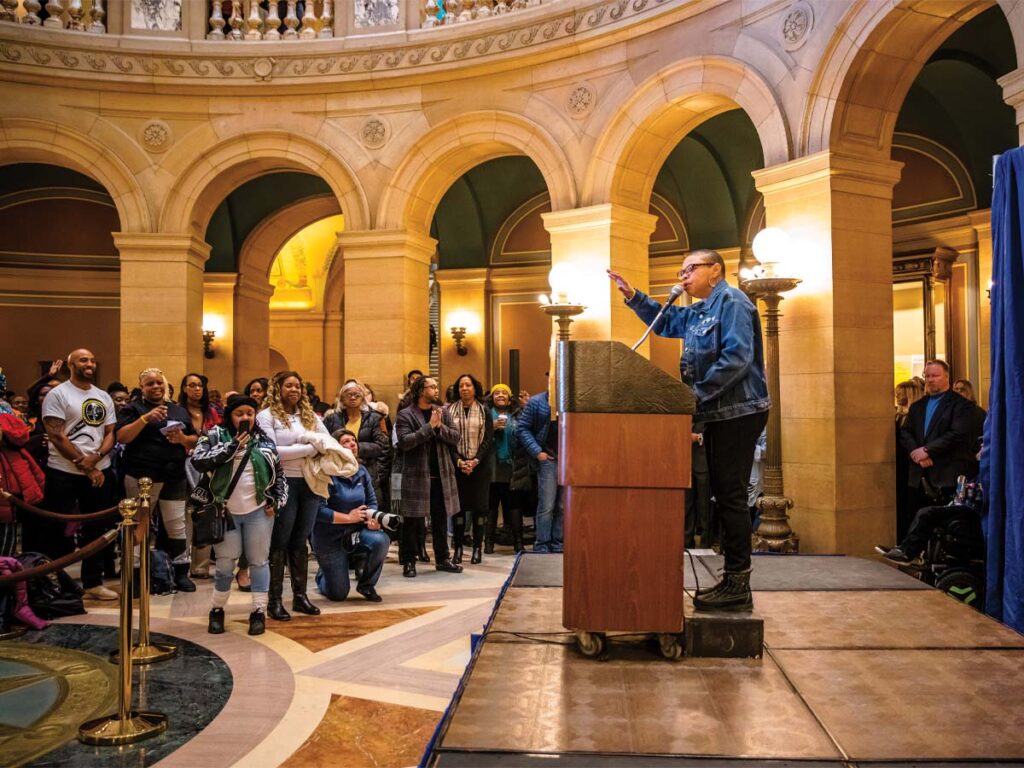
Those qualities were on full display on a mid-February day when Brundidge presided over Black Entrepreneurs Day at the Capitol in St. Paul. Despite the chilly forecast, she attracted a crowd of nearly 500 for a rally in the state Capitol rotunda.
Clad in a jean jacket, Brundidge—short in stature and equipped with a booming voice—climbed onto a step stool to position herself behind a podium centered on a stage. Standing under the ornate dome, she warmly welcomed the attendees. “Y’all look so good, it looks like Easter Sunday over here.”
In an instant she had connected with her audience. “Money has been flying over our heads for far too long,” Brundidge said. “We’re gonna reach up and grab some.”
She decried the lack of a lobbyist for Black entrepreneurs. “We needed to fix that,” Brundidge exclaimed to the assembled businesspeople. “I’m deputizing each and every one of you. You are your own lobbyist. You speak up for you. You speak up for your business. You make your voice heard, because today is our day.”
Before the entrepreneurs left the rotunda to meet with their legislators, they heard from the Minnesota Senate majority leader, House speaker, lieutenant governor, and other politicians and event business sponsors that included Comcast. Speakers at the one-hour rally demonstrated how Brundidge has made inroads into Minnesota’s political and corporate power structures.
Those relationships helped her build her own business, SHElettaMakesMeLaugh.com, which she founded in 2020. The company hosts a podcasting platform, does multimedia commercial production work, and offers integrated marketing services. Brundidge also has elected to spend substantial time connecting other Black entrepreneurs to the people and resources that can propel growth in their businesses.
Often, she says, Black people couldn’t access the capital they needed to finance businesses, and they’ve been shut out of professional networks that frequently generate new business. “My job is to pull down the systems that have structurally been in place to prevent Black people from thriving,” Brundidge told TCB during an interview in her Cottage Grove home.
Brundidge was selected for a TCB Community Impact Award because of her work to economically empower a range of people. In addition to advocating for Black entrepreneurs, she’s planned and hosted a job fair to expand employment options for adults with autism. She has elevated Black voices through the podcasts on her platform. She regularly informs BIPOC people about educational, financial, and business opportunities through broadcasts of The Sheletta Show, which she hosts Saturdays on WCCO-AM.
“She’s using her superpowers for good. She’s changing lives in the trajectory
of black businesses on a daily basis.”—Tasha Harris, Kobi Co. co-founder
‘A seat at the table’
Brundidge, 52, started her own business because she thought Black people needed additional visible platforms to weigh in on issues and showcase their expertise.
She also wanted to help Black entrepreneurs expand their political power, so she conceived the idea of Black Entrepreneurs Day at the Capitol. Before holding the first event in early 2023, she turned to lawyer and lobbyist Brian McDaniel for some advice.
“I helped demystify the Capitol,” says McDaniel, a Republican, who volunteered to help Brundidge carry out her second Black Entrepreneurs Day event. “She has found a way to transcend [partisan] politics,” he says. “She has taken the politics out of this and is working solely for the purpose of making government work for everybody.”
Following the first entrepreneurs day last year, Brundidge and the small-business people felt they got results. On Feb. 16, she reminded the crowd that Gov. Tim Walz and Lt. Gov. Peggy Flanagan, both Democrats, took some action in 2023. “They made sure we had access to 8,000 loans,” Brundidge said. “They earmarked millions of dollars for startups. That was based on what they heard from Black entrepreneurs last year.”
Throughout the rally, Brundidge thanked politicians, business sponsors, the entrepreneurs who showed up, and an ally who couldn’t attend.
“While we are fighting for a seat at the table, state Sen. Kari Dziedzic is at home fighting cancer,” Brundidge said. She recalled how Dziedzic, a Minneapolis DFLer, went to bat for her to make sure legislators were available and willing to meet with the entrepreneurs in 2023. At the time, Dziedzic was Senate majority leader.
Her counterpart, House Speaker Melissa Hortman, returned for the second entrepreneurs day in February. “For too long our economic disparities have been persistent between the races in Minnesota, and we need to invest and put an end to that,” Hortman told the crowd. She noted that a good chunk of last year’s budget surplus was used to tackle disparities, and she added, “We know there is more work to do.”
Senate President Bobby Joe Champion, one of the highest-ranking Black politicians in the state, told the audience to be direct with state legislators: “Tell them that it is good to invest in Black entrepreneurs because what’s good for Black entrepreneurs is good for the rest of the state.”
Gate crasher for marginalized groups
Watching the speakers near one of the rotunda pillars was Tasha Harris, a co-founder of Kobi Co. with her daughter, Kobi. The company sells hand-poured luxury candles and pairs them with playlists, which Harris says places it at the “intersection of scent, sound, and self-care.”
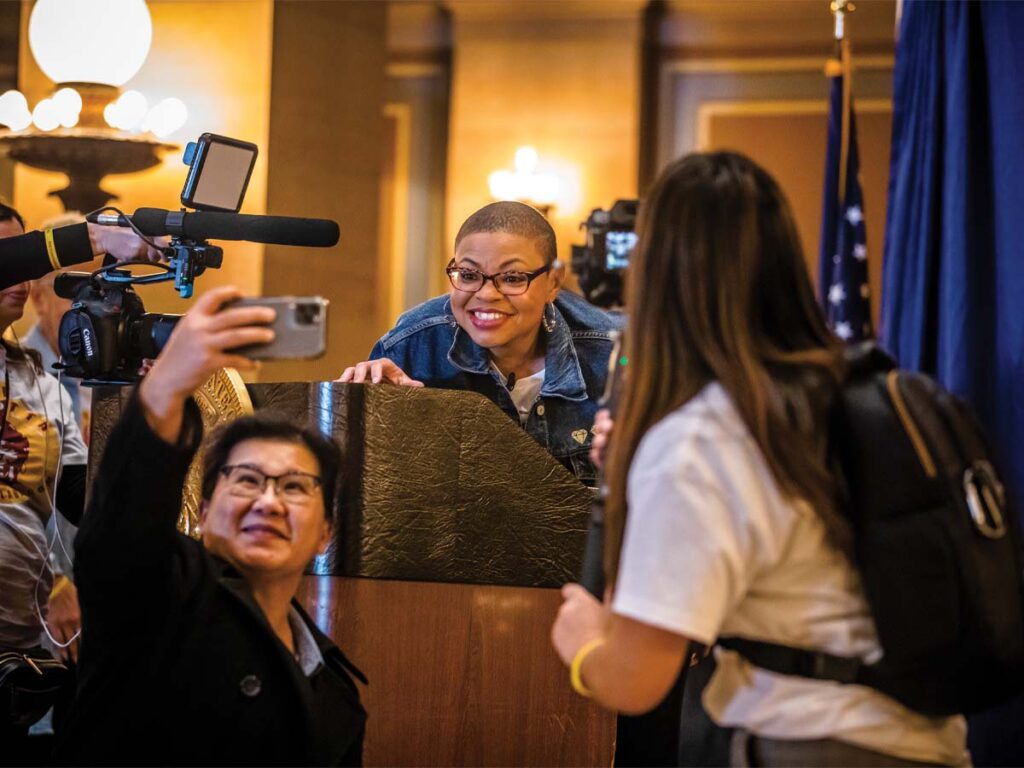
She had an excellent vantage point to observe Brundidge, who hugged virtually every speaker she introduced, broke into a dance once in a while, and tossed in some humor for the audience.
“She’s using her superpowers for good,” Harris says. “She’s changing lives in the trajectory of Black businesses on a daily basis. She’s a force to be reckoned with. I don’t know that there’s anyone else who could bring such a group together.”
Tatiana Freeman, founder and CEO of Nosh Posh, a health-conscious snack food business, met Brundidge in 2023 when she attended a social media workshop that Brundidge conducted.
“I was just so impressed by how direct she is and clear with how you should manage your brand and personal identity,” Freeman says. She came to Black Entrepreneurs Day to learn more about resources for startups. “[Sheletta is] unapologetic about who she is in using her voice,” Freeman says. “She’s always bringing visibility to more people. I really appreciate that, particularly for Black women and Black founders.”
As a Black woman, Brundidge says she’s been passed over for job opportunities. Ultimately, she decided to exercise control by being her own boss.
“I might as well be loud. I might as well be bold. I might as well get out front,” she said in an interview with TCB in her living room. “I’m blowing up gates,” Brundidge added, referring to her fearlessness in trying to take down barriers that she thinks hurt people.
That was the case in 2015 when she and her then-husband, Shawn Brundidge, returned to Minnesota from Texas because it had good services for children with autism. (The couple later divorced.) By her own admission, Brundidge was “demanding” in getting the best therapy for her youngest three children with autism. Her relentless approach worked for the health and development of her children.
Role of white allies
Brundidge is proud that several high-profile businesses in Minnesota are sponsors of her podcast platform and support her other activities. UnitedHealthCare, Bremer Bank, and Delta Dental are among the sponsors she lists on her website. She’s also had a long-standing relationship with the Hy-Vee supermarket business.
But it took her a while to establish those business partnerships. She cites four white allies who played pivotal roles in helping leaders recognize what she could do for them.
After she created her podcast platform, in the early months she couldn’t pay her podcasters. “We worked like a dog for a year and didn’t have a sponsor,” she says.
Then Blois Olson of Fluence Media told her that he wanted to come with her when she went to her next five business meetings. “Blois saying, ‘She’s OK; she’s good’—it opened the door for me to get Hy-Vee,” Brundidge says. “I keep getting blessed by good, wholesome white folks who are accomplices and allies.”
Following the 2016 police shooting death of Philando Castile, Brundidge says the oldest of her four children, son Andrew, now 17, wrote a letter to Gov. Mark Dayton. In response, Sen. Kari Dziedzic met with the entire family to understand their concerns, and Brundidge said the senator became a friend.
Many years ago, Cathy Wurzer, co-host of Almanac on TPT, invited Brundidge to do a humorous monologue on the public affairs show after they were co-panelists for an event.
“Being on the show has given me credibility with white people,” Brundidge says. “When you have credibility with white people, you have less gatekeepers. When you have less gatekeepers, you have more opportunities.”
At WCCO-AM, Brundidge previously worked as an overnight producer. A few years ago, veteran host Chad Hartman pressed management to give Brundidge her own show. “I would still be working 8 p.m. to 4 a.m. if Chad Hartman didn’t go in and make some noise,” Brundidge says.
“You’ve got to stand up for people,” she says. “That’s probably why I stand up for people, because somebody stood up for me.”
Future of Brundidge’s company
Brundidge shared with her fellow Black entrepreneurs that her business surpassed $1 million in revenue last year. She and Shawn Brundidge, operations and grant manager, are the only two employees of SHElettaMakesMeLaugh LLC. They have several contractors and expect to hire employees as their revenue expands.
The company is “poised to make a major leap in 2024 and 2025” through project initiatives and because of the “altruism that the company displays,” says Shawn Brundidge.
He was among 45 volunteers who worked on Black Entrepreneurs Day. Sheletta’s sister, Darcea Handy, was also in St. Paul to volunteer, along with five other Black women friends of Sheletta Brundidge’s who live in the South.
“She’s always stepped out there and helped people,” Handy says, but she was amazed to observe her growth as a leader. “It’s just very inspiring, and I’m getting choked up,” says Handy, who flew to Minnesota from Houston.
Brundidge says she’s become a “trusted messenger” in the local Black community. In addition to connecting businesses to Black residents in Minnesota, she says that now she’s also helping government agencies communicate more effectively with Black residents. In a recent example, Metro Transit contracted with her to boost ridership on small buses that offer customized services.
The Brundidges plan to add two more podcasts to their network and expand their roster of sponsors. Through her big public profile, Sheletta Brundidge wants to maximize her impact.
“If you watched Dr. [Martin Luther] King march, he was marching for Black people,” Brundidge says. “But he was marching with everybody,” people of all races and religions.
“I want to bring that back today,” she says. “Where we all come together, we’re all working together, for a common good.”