 What’s this?
Attracting New Students to an Age-Old Area of Study
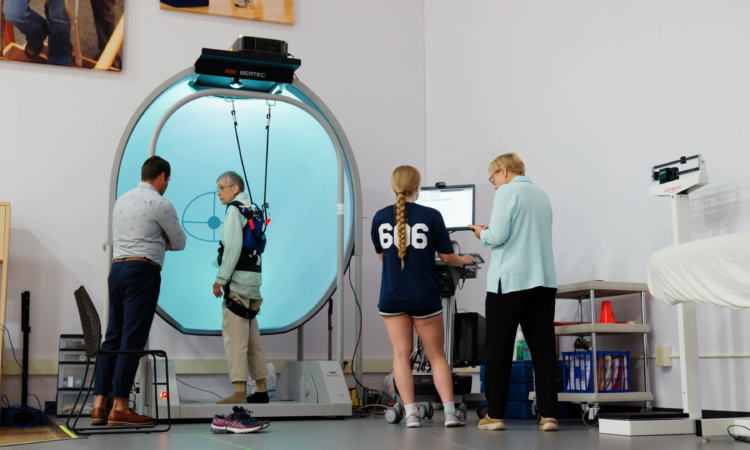
Longevity and aging may be the buzzwords of the year, but St. Catherine University was ahead of that trend when it launched Katies for Aging Research and Equity (KARE) in 2019, a program that empowers underrepresented women and gender-diverse scholars to pursue careers in age-related research, thanks to support from a National Institutes of Health grant. Students don’t just enroll—they dive in early, often as first or second years, and stay deeply engaged through graduation. Along the way, they pursue a cross-disciplinary Longevity and Aging minor, engage in intensive research, and make some real, substantial contributions to the broader field of geroscience. As a testament to the program’s success, the NIH renewed its funding so KARE can continue its work for another five years.
“There is a clear gap in health care equity as evidenced by the waning interest in pursuing the profession of geriatrician and the increased ageism that we see in all facets of our society,” says Josh Guggenheimer, PhD, co-principal of KARE and associate professor of exercise and sport science at St. Kate’s. “Here in the US, we tend to relegate our elders to the sidelines and forget about them—we’re hoping to address that in KARE.” Through training and professional development, KARE aims to increase the representation of students in the fields of aging research and care.
Support from Start to Finish
KARE admits 6-12 first- or second-year students annually, supporting them from early college through graduation. Among the program graduates is Shavonnye Rath, who transitioned her involvement into a professional capacity, now serving as KARE’s full-time grant coordinator. “The program was appealing to me as an undergraduate STEM student for so many reasons,” she says. “I was looking for opportunities to further explore my passion for research, and KARE offered not only research but also mentorship.” She was also inspired by peers she admired in science classes who were already a part of the program. “Joining seemed like the perfect way for me to learn from and with them,” Rath says. “I could tell from the very beginning that KARE was empowering and motivating STEM students to pursue their unique passions—and I wanted to be part of that.”
Guggenheimer says that being a minority-serving, women-centered institution is what makes St. Kate’s uniquely qualified to lead an initiative like KARE. “The grant is uniquely suited to work with these students as we have earmarked financial support to prepare these students to be successful in the field of aging,” he says. Historically, research has centered older white men as its standard bearers. Guggenheimer says KARE aims to combat this by training underrepresented women to become leaders. “Our institution’s mission is ‘to educate women to lead and influence,’ and we are doing exactly that through the KARE grant and wonderful opportunities it provides for our students,” he adds.
Above the Curve
Since its launch, KARE students have earned a Goldwater and Truman Scholarship, and produced seven student-authored publications and 34 student-authored conference presentations. Just this January, a small group of KARE scholars presented aging research findings at the National Conference on Undergraduate Research, giving light to the program’s emphasis on academic rigor, real-world relevance, and student-led inquiry. Most recently, the Council on Undergraduate Research recognized KARE as part of its 2024 Campus-Wide Award for Undergraduate Research Accomplishments, awarded to St. Kate’s—one of only two schools nationwide to receive the honor.
“KARE equips students with tangible skills to enter advanced careers,” says Rath, “but just as importantly, it builds the confidence to succeed in spaces where people from underrepresented communities have often been left out.”
Guggenheimer says the most rewarding part of his work is watching students evolve into skilled, confident researchers. “Many of them come in pretty green, lacking in confidence and research acumen, but over the years they transform into these powerhouse leaders in the realm of aging research,” he says. “It’s amazing to feel that sense of validation knowing that the work we’re doing may truly have significant impact on the future care and health equity of our communities around us.”
Success for KARE, he says, looks like a steady pipeline of students who go on to pursue grad school and make a difference in aging-related careers. “If we can change people’s perception of aging and how we treat the aging population, we can provide better care and better policies that impact that care.
“Taking care of our community means taking care of our elders.”