Public media stations often buy national programming from producers like NPR and PBS to fill air time. In many cases, they do so with part of their CPB grant.
TV stations can spend as much or as little of the grant as they wish for that content. But for radio stations, almost 30% of their grant is mandated to be spent on national programming, or on producing shows for a national audience.
NPR fundamentally benefits from that mandate.
In Minnesota, so does American Public Media Group, MPR’s parent organization. It produces national shows like “Marketplace” and distributes audio work from publishers like the New York Times to other stations.
If CPB cuts and other financial factors lead stations to buy less national programming, APMG could lose more than $5 million annually in licensing and distribution alone, Drew said.
NPR and PBS were in the crosshairs of Trump’s May 1 executive order addressing, in part, that national spending.
The executive order told the CPB to stop direct funding to NPR and PBS, and to make sure local stations don’t indirectly support them by spending CPB funds on their programming.
NPR and PBS both filed lawsuits against the executive order. Notably, Lakeland PBS, the public television station serving north and central Minnesota, joined the PBS lawsuit.
Lakeland PBS declined to speak with MinnPost. But its court filing explains just how important that national spend is to local stations.
“Lakeland PBS relies heavily on PBS’s roster of quality programs: 56% of programming on Lakeland-Prime (Lakeland PBS’s main channel) comes from PBS, and 100% of programming on Lakeland-PBS Kids (Lakeland PBS’s 24/7 educational channel) comes from PBS,” it said.
As a result, the executive order’s ban on indirect PBS funding is an “existential threat.”
According to the filing, Lakeland PBS receives about $1 million of its $2.7 million budget from the CPB, with almost half the grant going to pay national PBS member dues and access programming.
That’s not funding Lakeland PBS can make up on its own. The station’s sponsorship revenue is down more than 5% over the last decade. Foundation grants, meanwhile, are “increasingly difficult to obtain,” lawyers wrote.
But on the radio side, because of the CPB mandate, spending on national programming is more complicated.
Joel Glaser, CEO of the Association of Minnesota Public Educational Radio Stations (AMPERS), has long disliked the mandate. AMPERS works with 17 community radio stations in Greater Minnesota, including KAXE.
“My responsibility is to ensure the survival of my stations, and I need them to be getting as much money as they can receive,” Glaser said.
To Glaser, the mandate complicates the work of local stations. If they have to buy and run national programming, much of which is from NPR or PBS, then accusations of liberal bias more easily filter down to the local stations.
Glaser is advocating for CPB to lift the mandate, which he also sees as a way to disarm lawmakers who want to defund public media.
“I think that may actually appease some who are on the fence, that are saying, ‘this money is going to liberal programming,’ and instead, hey, the money is actually going to the local communities,” he said.
The mandate is in the law that created the CPB, so only Congress can change it — the CPB doesn’t have the authority to do so. But Glaser thinks the CPB could still find ways to encourage a change.
Not having a mandate could let stations invest more of the CPB grant into their own work. Or they can still acquire national programs, just with the flexibility to spend less.
“There’s plenty of content out there that’s a fraction of the price,” Glaser said. “Not just OK programming, but good programming.”
Caution on the air
As stations weigh how to respond to potential federal cuts, there’s a fine line between ringing the alarm and crying ‘wolf.’
After all, federal funding of public media has been under threat many times over the past few decades — but each time, Congress has continued funding the CPB.
There’s a broad recognition that this time is different. But that doesn’t necessarily make messaging to audiences any easier.
MPR and Twin Cities PBS (TPT) were relatively explicit about CPB cuts when fundraising (one TPT fundraising email had the subject line, “You know what’s at stake”). TPT declined to speak to MinnPost.
“I think our audience wants to know how we’re actually doing,” Drew said of MPR’s messaging. “They’d be upset if we had significant restructuring without their having a sense of the challenges we were facing.”
Bignall doesn’t think that kind of approach would work for KAXE’s more conservative audience.
“We live in a very purple county, and the tone in which [MPR and TPT] have gone about it, would have been very off putting to a good portion of our listeners,” she said.
It’s also harder to pitch audiences when “there’s been a lot of threats at this point in time, but nothing has flushed its way out.”
Another consideration for stations: The Federal Communications Commission and the Internal Revenue Service are now part of the multi-pronged campaign against public media.
Trump has threatened to use both agencies against organizations that draw his ire. Public radio and television stations, as nonprofits, could have their status revoked by the IRS, or broadcast licenses cancelled by the FCC.
“I’m not willing to risk our FCC license,” Bignall said.
“Part of that says that we can’t be advocating for political causes,” she said. “And while you might look at CPB funding and First Amendment rights [as nonpartisan] — in this day and age, it’s a political topic.”
Cloudy with a chance of meatballs
For the moment, public media is strapping in with no clear answers.
Even if one federal funding threat is addressed — say, if the NPR and PBS lawsuits successfully block the executive order — Congress can still cancel CPB funding, and the FCC might continue to target stations.
Other federal funding, like a U.S. Department of Education grant to PBS for kids’ programming, has already been cut. That led TPT to furlough some staff.
And any lawsuits could potentially drag on for months or even years, effectively freezing funding along the way.
For Drew, the main focus at MPR is on expanding Greater Minnesota coverage, and continuing to evolve as technology and audiences change.
“We’ve got a bunch of other [financial] asks out, both to individuals as well as to institutions that will, in the end, affect what we’re able to do and what we can’t do — or can’t do in the same ways,” he said.
APMG, MPR’s parent organization, is already seeing some belt tightening, though the moves aren’t necessarily tied to potential federal cuts. “Marketplace” restructured and laid off seven people, which Drew said was about helping the show reach digital audiences more effectively.
“It wasn’t simply an exercise to remove costs,” he said.
As for the sustainability of MPR’s current messaging around CPB cuts, and whether members will support MPR to the same extent as this recent spring fundraiser, Drew isn’t sure.
“Time will tell,” he said. “We’re not screaming, ‘The sky is falling,’ and we’re not pretending that it’s no big deal, either.”
Glaser, meanwhile, is telling AMPERS stations to be ready to operate without CPB funding for up to four years. If that happens, some stations will shut down, but he thinks most will make it.
He’s optimistic that if the CPB is dismantled or its funds revoked, Congress may bring it back in a few years.
There are also state funding sources to worry about. Minnesota funds public media programming, including through the Legacy Amendment. But this year, with a projected budget deficit, state lawmakers reduced that funding.
MPR’s allocation was cut from $4 million to $2 million for the next two years. Meanwhile, AMPERS saw a roughly $30,000 cut per station. More cuts could come next year, depending on how lawmakers are feeling about the state budget forecast.
And the potential loss of CPB funding could snowball for smaller stations into the complete loss of state support. Minnesota statute requires public media stations to have two full-time staff, or the equivalent in part-time staff, to be eligible for state funding.
“A number of our stations are right there,” Glaser said. “If they lose the CPB funding…potentially, a $90,000 or $100,000 cut could easily become a $200,000 or $225,000 cut.”
Pioneer 90.1 radio in Thief River Falls is one of those stations. It has two-and-a-half employees and 15 volunteers, with 40% of its budget supported by a CPB grant.
Fifteen years ago, CPB funding helped the station transition to a digital multicast signal, digitize its popular polka records, and launch a 24/7 polka music channel for listeners.
The station is a stalwart in an area of Minnesota where local news and programming is otherwise dying.
Mark Johnson, Pioneer 90.1’s general manager, has been hesitant to talk about the risk of CPB cuts with his audience.
“I wanted to be really careful about not ringing that alarm bell until it’s necessary,” he said. Still, it’s clear that without CPB funding, “the future of the station would be in question.”
But now, with the news that Trump will soon ask Congress to cancel CPB funding, Johnson thinks it’s time to speak up.
“It’s stressful, of course, but it’s times like this when you find out how important [your work] is to people,” he said. “When people know that this is serious and that it will actually impact this station, I think that they will step up and help out.”
This article first appeared on MinnPost and is republished here under a Creative Commons Attribution-NoDerivatives 4.0 International License.


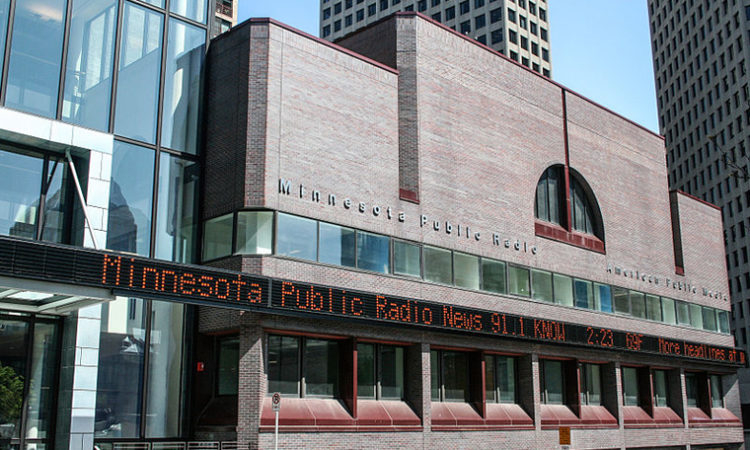
 Minnesota Public Radio blew past a $1 million goal for its spring member drive in mid-May, raising a little over $1.5 million.