A Bid for Better Pelvic Exams
It all started with a taped-out visualization on Ann Gilligan’s kitchen floor. The RN who’s worked in the health care industry for 35 years and has a background in labor and delivery wanted to create a device that would be gentler on women’s bodies during pelvic examinations.

Gilligan says she first hatched the idea eight years ago. She started out by measuring her daughter’s bottom pelvis bones and then mapped out an idea for a wedge-like device that could be placed underneath women during pelvic exams. She went on to share the idea with a mechanical engineer friend, who created a CAD design of the device.
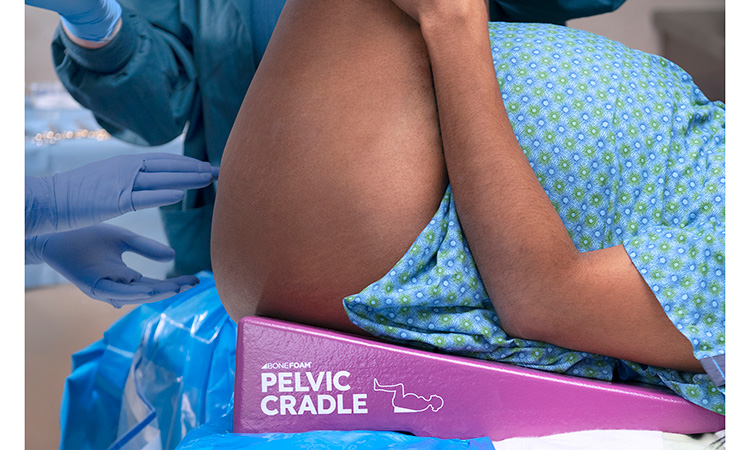
Her son helped finalize the design of what would eventually be known as the Pelvic Cradle, a medical device that puts women in a tilted positioned during pelvic examinations. It’s designed to make exams easier for doctors and more comfortable for patients.
Two years ago, Gilligan formed a business partnership with Dr. Alexandra Bader, a Bemidji-based OB-GYN, for the product. The pair then took the idea to Corcoran-based medical device company BoneFoam, which agreed to sell and manufacture it.
Gilligan says she came up with the invention because she heard patients say other methods to elevate women’s pelvises were uncomfortable. Some common methods include metal or plastic bedpans, rolled up towels, or simply having patients sitting on their fists. Doctors also might have patients come down to the end of the examination table or bed.
But Gilligan notes that plastic bedpans would sometimes crack and are not weight bearing. Having women sit on their fists limits movement, and can be scary to the patient, especially for those who have experienced sexual assault, she says.
“I decided I was going to create something because I was tired of the disrespect and the inability for these other makeshift products or tools that didn’t work well,” Gilligan says. “We all know, in this field, that posterior tilt to the pelvis will create better visualization.”
Gilligan and Bader brought their idea to Ben Watters, director of product development at BoneFoam. The two women also began working with Shea Ryan, BoneFoam’s lead engineer, and Peter Cole Jr., BoneFoam’s vice president.
“How lucky are we to have found a patient positioning manufacturing and design team here in the Twin Cities that’s already in the medical device business?” Gilligan says.
Buzz Hannahan, BoneFoam’s CEO, believes the Pelvic Cradle fills a needed gap in the marketplace, and that there really isn’t another medical device quite like this.
Hannahan declined to say if there was any outside funding for the Pelvic Cradle.
The Pelvic Cradle is geared towards clinicians and other health care professionals, like OB-GYN doctors and health care systems, Hannahan said, adding that the goal is to eventually have patients ask their doctors about this device in the future.
Hannahan said usually BoneFoam has to travel to see different medical devices but was excited to work with Bader and Gilligan, who are local.
“The industry and clinicians have always been partnering to deliver solutions to impact patient safety and drive efficiencies,” Hannahan said. “This is happening in our own backyard.”
Adds Gilligan: “It’s not only going to improve birth but any pelvic exam that women have to go through on a daily basis. The excitement doesn’t come from the sales; it comes from the fact that it’s going to create a healthier maternal health.”
The Pelvic Cradle has been soft launched with a few health care providers and is expected to be released on a wider basis in the first week of December.