Whatever Happened to Concierge Medicine?
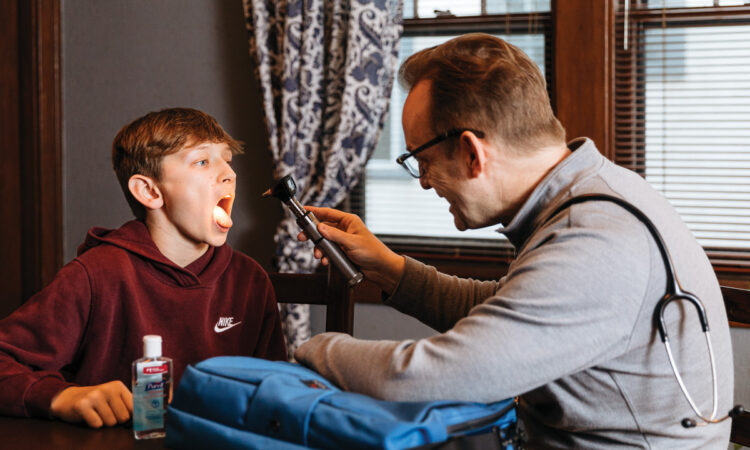
Pediatrician Michael Hobbs quit his job last April, leaving the independent practice Pediatric Services in St. Louis Park. His personal practice there included 2,000 patients. He now works out of a one-room office he subleases from an internal medicine doc in Edina. He has 225 patients. He has no receptionist. No nurses. No X-ray machine. He’s available to his patients 24/7 and returns calls himself.
“I’m happier, my patients are happier.”
Hobbs is on the not quite cutting edge of a medical movement called direct patient care (DPC), which is similar to the concierge medicine movement that began a couple decades ago. When mature, his new practice will be 15–20% the size of his old one. He expects to have a better work/life balance, offer better care, and give patients better access, all for a modest monthly fee of $75.
“The problem in medicine is, as we get bigger, the profession works toward what systems need rather than focusing on care,” Hobbs explains. “I wanted to be a small-town doc.”
That wistful vision of medicine passed into history in the Twin Cities between 1980 and 2000, by and large, as insurers and health systems sought greater control over what medicine cost and how it was practiced. Minnesotans under 40 probably can’t remember an era when doctors owned their practices and patients chose them based on reasons having nothing to do with care networks or insurance policies.
During the health maintenance organization (HMO) boom of the 1980s and 1990s, where corporate medical groups began to squeeze out independents, a new type of practice called concierge medicine emerged, designed for people who didn’t want an insurer telling them which doctors they could see. The docs who practiced it didn’t accept insurance—or the rules set by insurers. (Insurance still paid for diagnostic tests, medicines, and specialist referrals.) They charged patients an annual fee and limited the size of their practice, resulting in more time with patients.
Today concierge medicine is entrenched in places with high concentrations of the affluent and elderly, says Dr. Ben Bache-Wiig, former chief clinical officer for Allina Health, now executive medical director of St. Louis Park-based Lifespark, a home care company. “[Concierge] thrives in markets where dissatisfaction with access and time spent with providers is high,” he says.
Bache-Wiig says alternative models have not taken root in MSP, because a small number of companies (Allina, Park Nicollet, Fairview, North) control the care market, and insurers have found it difficult to streamline networks because they encompass so many area doctors. As a result, access is less of an issue here. Bache-Wiig says most Minnesotans who use concierge medicine do so as snowbirds in Florida, where many practices are closed to new Medicare patients.
One of the longest-standing concierge practitioners locally is Dr. Jason Reed. In 2003, after five years in his post-residency practice with Allina, he co-founded a concierge practice that also catered to executive medicine—comprehensive annual physicals for C-suite execs paid for by corporations. The Plymouth-based practice, Specialists in Internal Medicine, serves patients “who need a quarterback, a coordinator, someone who can get a prescription refill issued the same day,” Reed says. Unlike one New York City concierge doctor, who charges $100,000 for personal cell phone access, Reed’s practice charges in the “mid-$3,000s” for annual care. Not all his 300–500 patients are affluent.
“People make sacrifices to be part of this sort of practice,” he explains. In return they receive “time, consultations, deeply considered referrals. We get to know our patients deeply. The model is really positive for [preventing] physician burnout.” Reed’s practice is in growth mode, adding two new physicians recently, with a goal to establish reciprocity with a Florida practice. In his previous practice, Reed had over 1,000 patients.
“How many days of work will you miss because your kids have pink eye” and can’t see a doc right away? “How much value does that have to you?”
—Dr. Michael Hobbs
Hobbs and Reed affirm that neither expected to earn more money after leaving corporate medicine, and in Hobbs’ case, he expects to earn less. “Many doctors still live a philosophy of [service],” Reed says. “If I can see 15 people today with upper respiratory infections, that’s good service, but if I can reach one or two people on long-term lifestyle changes, that’s meaningful.”
Hobbs notes that DPC medicine is offered by about a dozen local practices, but there are 2,000 practitioners nationwide. “The model is about value. How many days of work will you miss because your kids have pink eye” and they can’t see a doc right away? “How much value does that have to you?” he asks.
Hobbs expects his practice to fill via word of mouth in a matter of months. His only regret at this point is the 1,600–1,800 patients he could not take along. “It was hard to come to terms with leaving them to find a new provider,” he says. “If every primary care doctor did what I’m doing, there wouldn’t be enough providers to see all the patients in an environment where there is already a shortage.”